Now Is the Time!

by Budd Titlow

http://www.buddtitlow.com

In the overall history of human life here on Earth, we have never faced more broad-based and existential environmental threats than those posed by the climate emergency and biodiversity loss. On a geologic time scale, we are accelerating toward our own oblivion at laser-focused warp speed. Right now—every day—the world is adding more layers of atmospheric pollution and species disintegration to the enveloping shroud that may eventually doom our own species (Homo sapiens) to extinction. 

These twin towers of environmental degradation are not something that might become a problem in the future—maybe by 2030 or 2050 or 2100. They are problems right now—and they’re getting worse every day that we sit by and pretend that nothing important is really happening. 
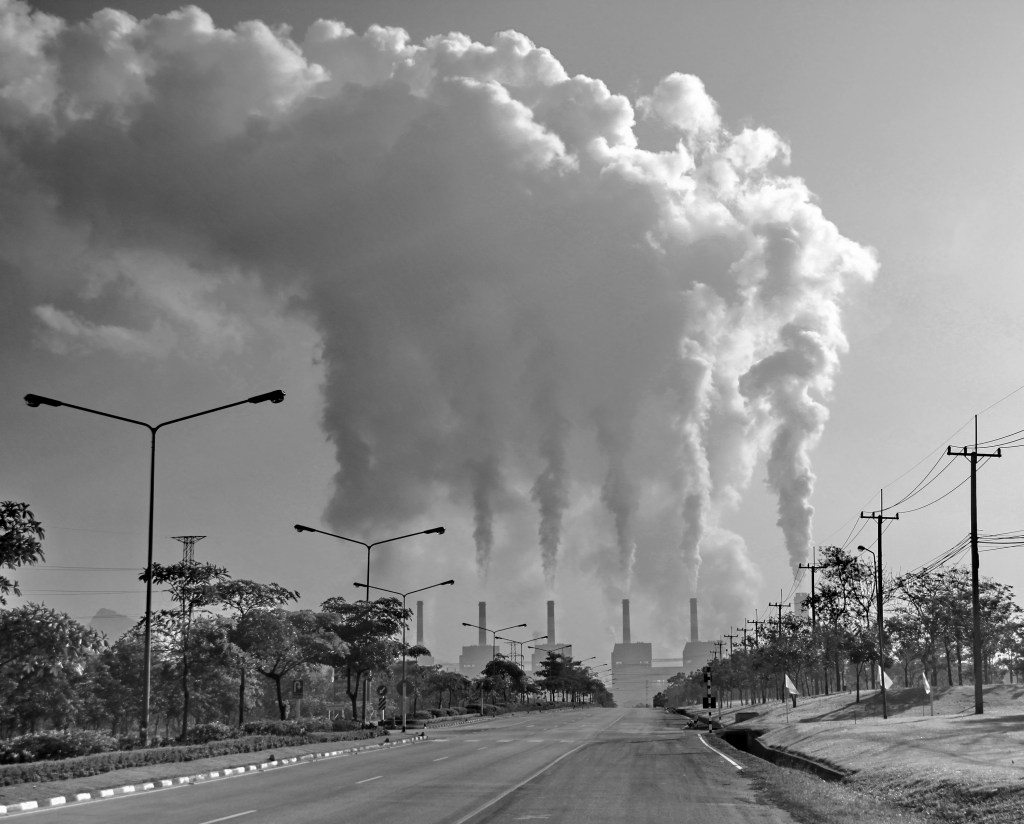
Smoke from a coal plant: industrial pollution filling our skies with greenhouse gases.

However, the climate crisis and biodiversity loss do not have to remain problems. In fact—if we focus and work together—both of these conundrums can be well on their way to full resolution in as little as ten years.

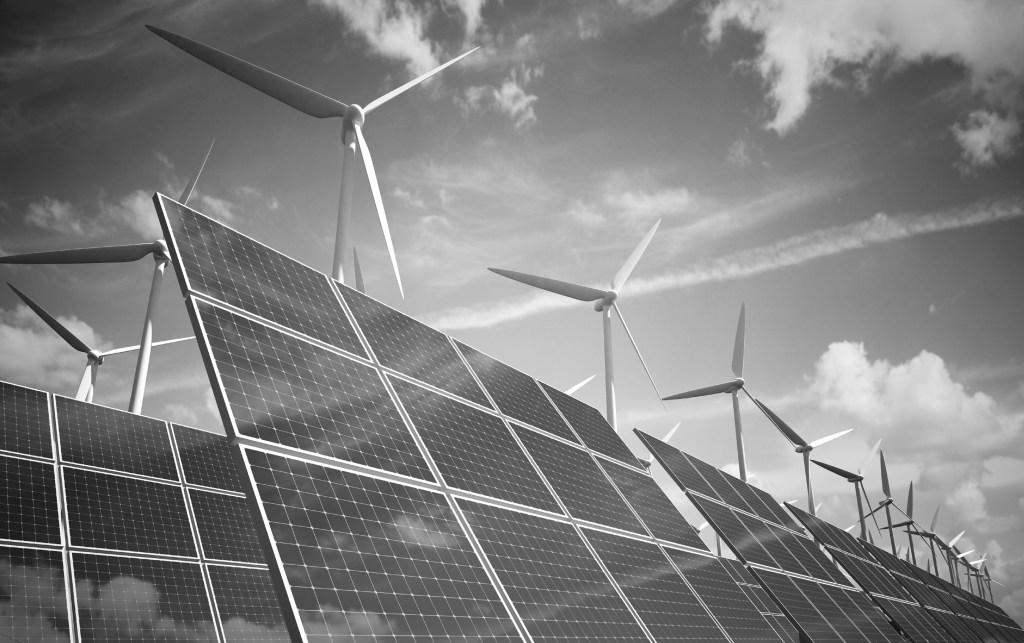
If we play our cards right, we can use the perpetual, inextinguishable energy of Earth—the sun’s glorious rays, the wind’s constant breezes, and the water’s endless waves—to work for us all. And, in the process, we’ll leave the polluting fossil fuels right where they belong—buried in the ground, never to see the light of day.

Think about it: Renewable energy here on Earth is abundant and omnipresent. Each time we go outside, we see and feel it everywhere. It’s like an endless symphony written by a master composer and played by a world-class orchestra. The golden rays of streaming sunlight are the strings—always there, maintaining the basic rhythm of the interwoven movements. The wind provides the percussion—rising from gentle whispering breezes of the snare drum to bold resounding gusts of the tympani. Then moving water blends in with the woodwinds and the brass—transitioning from gently lapping melodic notes of the flute to lazy ripples of an oboe’s dulcet tones and concluding with rolling waves of trumpet blasts.

We are right on the cusp of what will be the Renewables Revolution,—providing a mighty parallel to the Industrial Revolution. The Industrial Revolution resulted in the transformation of our nation from a rural agrarian society to an urban, manufacturing society. Now we are about to transform ourselves again—from a hard-edged, fossil-fuel driven economy to a softer-sided renewable energy world.

The transformation from fossil fuels to renewable energy is already possible. The Solutions Project (www.thesolutionsproject.org) lays out immediate plans for converting each of our states—plus many countries—from fossil fuels to renewable resources. And we can accomplish this at the same time as we create numerous new industries in wind, solar, and water power.

In fact—right now—“Big Oil” has the wherewithal to lead the transformation from fossil fuels to renewable energy. They know it’s coming—they’ve known for more than 30 years. They’re already planning for the transition. They just want to delay things as long as possible because—in the short term—they will take a financial hit. But—in the long run—they will actually make more money from renewables than they are currently making from fossil fuel production and processing. The sooner we can make the fossil fuel giants acknowledge this fact and make the switch, the better off we’ll all be. 

Overall, the mighty impetus created by nationwide conversion to renewable energy will bolster every sector of our economy. As the old adage goes: “A rising tide lifts all boats.” This renewable energy boom will create millions of new jobs—leading to increased financial security for everyone. And that’s a “win-win scenario” we can all live with. Plus, our children, grandchildren, and all future generations will look back and be forever grateful to us for being proactive in tackling and resolving our current climate and biodiversity dilemmas.”

So, now—finally—the decision is in our hands. The issue is about preserving the existing quality and character of Earth’s species and their habitats. Will we decide to make the changes that will save our ice sheets, oceans, coral reefs, rain forests, and polar bears? Or will we just watch while our world slides into oblivion—at least for Homo sapiens?

Text excerpted from book:      PROTECTING THE PLANET: Environmental Champions from Conservation to Climate Change, written by Budd Titlow and Mariah Tinger and published by Prometheus Books. Photo caption & credit: Smoke from a coal plant: industrial pollution filling our skies with greenhouse gases. Copyright—Ungnoi Lookjeab / Shutterstock

Author’s bio:              For the past 50 years, professional ecologist and conservationist Budd Titlow has used his pen and camera to capture the awe and wonders of our natural world. His goal has always been to inspire others to both appreciate and enjoy what he sees. Now he has one main question: Can we save humankind’s place — within nature’s beauty — before it’s too late? Budd’s two latest books are dedicated to answering this perplexing dilemma. PROTECTING THE PLANET: Environmental Champions from Conservation to Climate Change, a non-fiction book, examines whether we still have the environmental heroes among us — harking back to such past heroes as Audubon, Hemenway, Muir, Douglas, Leopold, Brower, Carson, and Meadows — needed to accomplish this goal. Next, using fact-filled and entertaining story-telling, his latest book — COMING FULL CIRCLE: A Sweeping Saga of Conservation Stewardship Across America — provides the answers we all seek and need. Having published five books, more than 500 photo-essays, and 5,000 photographs, Budd Titlow lives with his music educator wife, Debby, in San Diego, California.
PROTECTING THE PLANET

Environmental Champions from Conservation to Climate Change

ISBN: 978-1-63388-225-1

by Budd Titlow

http://www.buddtitlow.com

The Homestead Act—A Precursor of Environmental Disaster

Owing in large part to the Homestead Act of 1862—which provided each family with 160 acres of land to plow and farm as they saw fit—westward expansion spread steadily—like a soaking ink blot—across the American landscape. Access to virgin prairie was so easy that intrepid settlers tended to plow, plant, and harvest until they depleted the fertility of the land through a combination of soil erosion (no control devices) and poor farming practices (no crop rotation). They knew that when the land became unproductive, they could just pack their families up, move further west, claim more land, and start all over again.

In a situation with an eerie similarity to today’s climate-change crisis, the major faux pas of the pioneering farm families was believing that their resources were boundless and—because of this—doing nothing to protect the resources they were using. Seventy years later—in 1932—these same laissez-faire attitudes created the worst environmental disaster the United States had ever experienced—the Great Dust Bowl.

The Great Dust Bowl—Occurrence of Unprecedented Natural Disaster

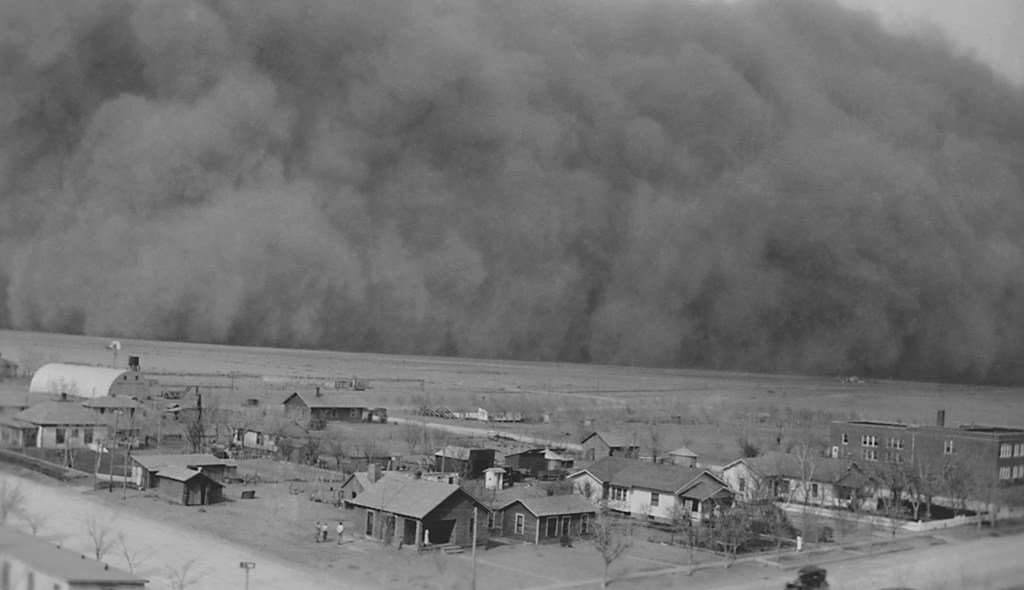
Dust Bowl storm rolling into Rolla, Kansas.

During the 1930s, nowhere was the concept of “nature strikes back” more evident than on the soil-ravaged and agriculturally pillaged plains of the United States and Canada. The Great Dust Bowl occurred because poor farming practices caused huge portions of what had been luscious and golden prairie grasslands to dry up and blow away with the wind.

Eager settlers had moved west to the prairies, lured by advertisements promising a Garden of Eden. They brought with them farming techniques that had worked in the Northeast but that were incompatible with the prairie ecology. In what was called “the Great Plow Up,” settlers dug deeply into the virgin topsoil and pulled up the thickly rooted native grasses that had held the soil in place and trapped moisture through periods of severe drought. Recent rapid advancements in farming equipment in the early twentieth century—notably gasoline-powered tractors and massive combine harvesters—allowed more and more of these arid, native grasslands to be converted to wheat fields.

When drought came and the crops dried up, the unanchored soil turned to dust and blew away—forming huge dark clouds that blackened the sky for miles around. These choking billows of dust—named “black blizzards”—also traveled cross-country, reaching as far as New York, Philadelphia, and Washington, DC.

The Dust Bowl covered 300,000 square miles of territory located in Kansas, Texas, western Oklahoma, eastern Colorado, and New Mexico. In the hardest-hit areas, agriculture virtually ceased. With successive storms, the wind and the flying dust cut off wheat stalks at ground level and tore out the roots. Blowing dirt shifted from one field to another, burying crops not yet carried away by the wind. Cattle tried to eat the dust-laden grass and filled their stomachs with fatal “mud balls.” 

The dust banked against houses and farm buildings like snow, and buried fences up to the post tops. Dirt penetrated into automobile engines and clogged the vital parts. Housewives fought vainly to keep it out of their homes, but it seeped in through cracks and crevices, through wet blankets hung over windows, through oiled cloths and tape, covering everything with grit. Hospitals reported hundreds of patients suffering from “dust pneumonia.” The black blizzards struck so suddenly that many farmers became lost in their own fields and suffocated, some literally within yards of shelter. More than 350,000 people fled the Great Plains during the 1930s. These “Okies” loaded their meager household goods and struck out along famous highway Route 66 for California.

Bankrupt and forced to abandon their homes and farms to foreclosure due to loss of crops, these desperate migrants arrived at their destinations with great hope, only to find situations that were little better than those they had left. In the minds of many, the Dust Bowl still ranks as the worst and most prolonged natural disaster the United States has ever experienced. In his 1939 novel, The Grapes of Wrath, John Steinbeck painted a poignant image of what it was like to experience the Dust Bowl:

“Carloads, caravans, homeless and hungry; twenty thousand and fifty thousand and a hundred thousand and two hundred thousand. They streamed over the mountains, hungry and restless—restless as ants, scurrying to find work to do—to lift, to push, to pull, to pick, to cut—anything, any burden to bear, for food.”

Federal Government to the Rescue—Creation of the Soil Conservation Service

In response to the social and environmental horrors of the Dust Bowl, Congress passed two significant pieces of legislation. First, the Taylor Grazing Act of 1934 defined designated areas where livestock grazing could occur on federal lands—thus minimizing the rampant overgrazing that was occurring. Next—and most importantly in April 1935—the Soil Conservation Act led to the establishment of the Soil Conservation Service (SCS)—now called the Natural Resource Conservation Service (NRCS)—a federal agency tasked with advocating good farming practices that would minimize the potential for future wind and water erosion of farming topsoil.

The SCS’s raison d’etre declared that the federal government bore permanent responsibility for reducing water and wind erosion of the Nation’s soils. The SCS included more than ten thousand permanent and part-time employees, and utilized the labor of some 450 Civilian Conservation Corps (CCC) units. The SCS also operated twenty-three research stations, where it studied the causes, extent, and prevention of soil erosion.

The SCS addressed the problem of soil erosion by creating “demonstration projects” in which the agency cooperated with landowners to implement conservation measures. The SCS assisted farmers in devising and implementing soil conservation plans for their land. In exchange for the landowner’s agreement to cooperate for a five-year period and to contribute his labor, the SCS supplied technical advice, materials, and additional labor. The Service urged farmers and ranchers voluntarily to plant ground cover vegetation to protect vulnerable soils, to rotate crops and allow fields to occasionally lie fallow, to build terraces and use contour plowing to retain soil moisture, and to refrain from planting crops on highly erodible land.

Although more than fifty thousand farmers participated in SCS demonstration projects, attacking the widespread problem of soil erosion one farm at a time was costly and inefficient. In 1936, therefore, the SCS published a model statute that would enable farmers to create a soil conservation district in their vicinity, which could stipulate land use practices within the district. Many state governments passed laws permitting farmers to form soil conservation districts, but many farmers and state legislators were reluctant to grant districts the power to require landowners to comply with district regulations, and soil conservation efforts remained largely voluntary.

Today, more than 3,000 Soil and Water Conservation Districts (SWCD’s) serve throughout the Nation, providing watershed planning, flood prevention, erosion control plan reviews on agricultural land, control of non-point source pollution, wildlife habitat preservation, conservation education, and youth work. These SWCD’s work very closely with the federal Natural Resource Conservation Service (nee SCS), originally founded—as described above—in response to the Dust Bowl disaster of the 1930’s.

Text excerpted from book:          PROTECTING THE PLANET: Environmental Champions from Conservation to Climate Change written by Budd Titlow and Mariah Tinger, published by Prometheus Books. Photo caption & credit:       Dust Bowl storm in Rolla, Kansas. Copyright Everett Historical/Shutterstock.

Author’s bio:     For the past 50 years, professional ecologist and conservationist Budd Titlow has used his pen and camera to capture the awe and wonders of our natural world. His goal has always been to inspire others to both appreciate and enjoy what he sees. Now he has one main question: Can we save humankind’s place — within nature’s beauty — before it’s too late? Budd’s two latest books are dedicated to answering this perplexing dilemma. PROTECTING THE PLANET: Environmental Champions from Conservation to Climate Change, a non-fiction book, examines whether we still have the environmental heroes among us — harking back to such past heroes as Audubon, Hemenway, Muir, Douglas, Leopold, Brower, Carson, and Meadows — needed to accomplish this goal. Next, using fact-filled and entertaining story-telling, his latest book — COMING FULL CIRCLE: A Sweeping Saga of Conservation Stewardship Across America — provides the answers we all seek and need. Having published five books, more than 500 photo-essays, and 5,000 photographs, Budd Titlow lives with his music educator wife, Debby, in San Diego, California.

GLOBAL WARMING?—THE ANSWER IS IN PLAIN SIGHT!

http://www.buddtitlow.com

by

Budd Titlow 

While I was driving from San Diego to Las Vegas recently, I had a revelation. And it didn’t have anything to do with my destination—the so-called “Entertainment Capital of the World”.

My mental awakening involved a solution to global warming. It was right there—staring me in the face—on both sides of the highway. Thousands upon thousands of acres of open land, alternately festooned with low sand ridges and greasewood flats. It is a virtual Valhalla for renewable energy facilities. Or—at least—it should be.

To my great dismay, I counted only two single wind turbines and one solar array in more than 200 miles of driving through this high desert terrain. I kept asking myself why don’t we have wind turbines bracketing all these ridges and solar arrays blanketing the intervening plateaus. Doing so would certainly give us a jump start on the fossil fuel to renewable energy conversion process that we so desperately need right now.

Now, don’t get me wrong. I’m a career professional wildlife biologist and ardent conservationist. I realize that the majority of this land has ecological value as undeveloped desert habitat. But I’m also a realist. Natural resource protectors must be willing to give up something to save something better. We aren’t going back to the Stone Age—we must create new energy sources to continue powering the world we all live in.

We have to balance the bad with the good. In my mind, construction of large renewable energy facilities is much preferable to continued fossil fuel development. Fossil fuels are a thing of the past—just like the dinosaurs from which they sprang. We need to leave them in the ground—right where they’ve been since these great beasts last roamed the Earth.

Now let’s compare the environmental impacts of fossil fuels versus renewable energy. Construction of new solar arrays and wind farms will certainly have negative impacts. We will undoubtedly lose some valuable wildlife habitats. 

But I ask you to consider where we should now explore for and develop new fossil fuel reserves—the irreplaceable Alaska National Wildlife Refuge, ANWAR for short. The proposed extension of the Prudhoe Bay oil complex will decimate one of the last great ecosystems on Earth—home to hundreds of thousands of migrating caribou and musk oxen. The wildlife and other natural resources in ANWAR are absolutely beyond belief. If you want proof, Google “Florian Schultz Productions”. Florian’s mind-boggling cinematography will knock your socks off while bringing you to tears.    

Assuming we agree that the environmental impacts associated with renewables are preferable to digging up more fossil fuels, let’s look at the finances.  How are we going to pay for hundreds of new wind farms and solar arrays? The easy answer is to let Big Oil foot the bill. They’ve got the money and—don’t kid yourself—they know the day is coming when they will be forced to convert to renewable energy sources. We just have to demand that Congress levy a carbon fee—on both producers and distributors—to kick start their time frames.

Here are some other pluses supporting this idea. The existing wind farms and solar arrays—while way too few and far between—have proven that renewable technology works very well. Next, most of the open land between Victorville and Las Vegas is federally owned, so land acquisition costs would be minimal. Finally, much of the power distribution grid is already in place. I saw hundreds of miles of high voltage transmissions lines, crisscrossing the desert landscape at 10-mile intervals. While some upgrades may be necessary, this transmission grid should require relatively minimal additional investment. No matter how power is generated, the distribution system stays essentially the same.   

In conclusion, here’s my hope for preserving the quality of life for all of our future generations. To quote Spike Lee, let’s “all do the right thing”. In 10 years, I want to drive to Las Vegas again and—this time—I want to see vast solar arrays and wind farms occupying both sides of the highway. We can and must do this!

For the past 50 years, author, professional ecologist, and conservationist Budd Titlow has used his pen and camera to capture the awe and wonders of our natural world. His goal has always been to inspire others to both appreciate and enjoy what he sees. Now he has one main question: Can we save humankind’s place — within nature’s beauty — before it’s too late? His latest book, “COMING FULL CIRCLE—A Sweeping Saga of Conservation Stewardship Across America”, is now for sale on AMAZON.

OP-ED—Now Is the Time!

by Budd Titlow

http://www.buddtitlow.com

In the overall history of human life here on Earth, we have never faced more broad-based and existential environmental threats than those posed by the climate emergency and biodiversity loss. On a geologic time scale, we are accelerating toward our own oblivion at laser-focused warp speed. Right now—every day—the world is adding more layers of atmospheric pollution and species disintegration to the enveloping shroud that may eventually doom our own species (Homo sapiens) to extinction. 

These twin towers of environmental degradation are not something that might become a problem in the future—maybe by 2030 or 2050 or 2100. They are problems right now—and they’re getting worse every day that we sit by and pretend that nothing important is really happening. 

But now—with a new administration that will make decisions based on solid science instead of insouciant lies—there is hope. The climate crisis and biodiversity loss do not have to remain problems. In fact—if we focus and work together—both of these conundrums can be well on their way to full resolution in as little as ten years.

If we play our cards right, we can use the perpetual, inextinguishable energy of Earth—the sun’s glorious rays, the wind’s constant breezes, and the water’s endless waves—to work for us all. And, in the process, we’ll leave the polluting fossil fuels right where they belong—buried in the ground, never to see the light of day.

Think about it: Renewable energy here on Earth is abundant and omnipresent. Each time you go outside, you see and feel it everywhere. It’s like an endless symphony written by a master composer and played by a world-class orchestra. The golden rays of streaming sunlight are the strings—always there, maintaining the basic rhythm of the interwoven movements. The wind provides the percussion—rising from gentle whispering breezes of the snare drum to bold resounding gusts of the tympani. Then moving water blends in with the woodwinds and the brass—transitioning from gently lapping melodic notes of the flute to lazy ripples of an oboe’s dulcet tones and concluding with rolling waves of trumpet blasts.

We are right on the cusp of what will be the Renewables Revolution,—providing a mighty parallel to the Industrial Revolution. The Industrial Revolution resulted in the transformation of our nation from a rural agrarian society to an urban, manufacturing society. Now we are about to transform ourselves again—from a hard-edged, fossil-fuel driven economy to a softer-sided renewable energy world.

The transformation from fossil fuels to renewable energy is already possible. The Solutions Project (www.thesolutionsproject.org) lays out immediate plans for converting each of our states—plus many countries—from fossil fuels to renewable resources. And we can accomplish this at the same time as we create numerous new industries in wind, solar, and water power.

In fact—right now—“Big Oil” has the wherewithal to lead the transformation from fossil fuels to renewable energy. They know it’s coming—they’ve known for more than 30 years. They’re already planning for the transition. They just want to delay things as long as possible because—in the short term—they will take a financial hit. But—in the long run—they will actually make more money from renewables than they are currently making from fossil fuel production and processing. The sooner we can make the fossil fuel giants acknowledge this fact and make the switch, the better off we’ll all be. 

Overall, the mighty impetus created by nationwide conversion to renewable energy will bolster every sector of our economy. As the old adage goes: “A rising tide lifts all boats.” This renewable energy boom will create millions of new jobs—leading to increased financial security for everyone. And that’s a “win-win scenario” we can all live with. Plus, our children, grandchildren, and all future generations will look back and be forever grateful to us for being proactive in tackling and resolving our current climate and biodiversity dilemmas.”

So, now—finally—the decision is in our hands. The issue is about preserving the existing quality and character of the human species here on Earth. Will we decide to make the changes that will save our ice sheets, oceans, coral reefs, rain forests, and polar bears? Or will we just watch while our world slides into oblivion—at least for Homo sapiens?

Author’s bio:For the past 50 years, professional ecologist and conservationist Budd Titlow has used his pen and camera to capture the awe and wonders of our natural world. His goal has always been to inspire others to both appreciate and enjoy what he sees. Now he has one main question: Can we save humankind’s place — within nature’s beauty — before it’s too late? Budd’s two latest books are dedicated to answering this perplexing dilemma. “PROTECTING THE PLANET: Environmental Champions from Conservation to Climate Change”, a non-fiction book, examines whether we still have the environmental heroes among us — harking back to such past heroes as Audubon, Hemenway, Muir, Douglas, Leopold, Brower, Carson, and Meadows — needed to accomplish this goal. Next, using fact-filled and entertaining story-telling, his latest book — “COMING FULL CIRCLE: A Sweeping Saga of Conservation Stewardship Across America”— provides the answers we all seek and need.Having published five books, more than 500 photo-essays, and 5,000 photographs, Budd Titlow lives with his music educator wife, Debby, in San Diego, California.

Now Is the Time!

by Budd Titlow

http://www.buddtitlow.com

In the overall history of human life here on Earth, we have never faced more broad-based and existential environmental threats than those posed by the climate emergency and biodiversity loss. On a geologic time scale, we are accelerating toward our own oblivion at laser-focused warp speed. Right now—every day—the world is adding more layers of atmospheric pollution and species disintegration to the enveloping shroud that may eventually doom our own species (Homo sapiens) to extinction. 

These twin towers of environmental degradation are not something that might become a problem in the future—maybe by 2030 or 2050 or 2100. They are problems right now—and they’re getting worse every day that we sit by and pretend that nothing important is really happening. 

But now—with a new administration that will make decisions based on solid science instead of insouciant lies—there is hope. The climate crisis and biodiversity loss do not have to remain problems. In fact—if we focus and work together—both of these conundrums can be well on their way to full resolution in as little as ten years.

If we play our cards right, we can use the perpetual, inextinguishable energy of Earth—the sun’s glorious rays, the wind’s constant breezes, and the water’s endless waves—to work for us all. And, in the process, we’ll leave the polluting fossil fuels right where they belong—buried in the ground, never to see the light of day.

Think about it: Renewable energy here on Earth is abundant and omnipresent. Each time you go outside, you see and feel it everywhere. It’s like an endless symphony written by a master composer and played by a world-class orchestra. The golden rays of streaming sunlight are the strings—always there, maintaining the basic rhythm of the interwoven movements. The wind provides the percussion—rising from gentle whispering breezes of the snare drum to bold resounding gusts of the tympani. Then moving water blends in with the woodwinds and the brass—transitioning from gently lapping melodic notes of the flute to lazy ripples of an oboe’s dulcet tones and concluding with rolling waves of trumpet blasts.

We are right on the cusp of what will be the Renewables Revolution,—providing a mighty parallel to the Industrial Revolution. The Industrial Revolution resulted in the transformation of our nation from a rural agrarian society to an urban, manufacturing society. Now we are about to transform ourselves again—from a hard-edged, fossil-fuel driven economy to a softer-sided renewable energy world.

The transformation from fossil fuels to renewable energy is already possible. The Solutions Project (www.thesolutionsproject.org) lays out immediate plans for converting each of our states—plus many countries—from fossil fuels to renewable resources. And we can accomplish this at the same time as we create numerous new industries in wind, solar, and water power.

In fact—right now—“Big Oil” has the wherewithal to lead the transformation from fossil fuels to renewable energy. They know it’s coming—they’ve known for more than 30 years. They’re already planning for the transition. They just want to delay things as long as possible because—in the short term—they will take a financial hit. But—in the long run—they will actually make more money from renewables than they are currently making from fossil fuel production and processing. The sooner we can make the fossil fuel giants acknowledge this fact and make the switch, the better off we’ll all be. 

Overall, the mighty impetus created by nationwide conversion to renewable energy will bolster every sector of our economy. As the old adage goes: “A rising tide lifts all boats.” This renewable energy boom will create millions of new jobs—leading to increased financial security for everyone. And that’s a “win-win scenario” we can all live with. Plus, our children, grandchildren, and all future generations will look back and be forever grateful to us for being proactive in tackling and resolving our current climate and biodiversity dilemmas.”

So, now—finally—the decision is in our hands. The issue is about preserving the existing quality and character of the human species here on Earth. Will we decide to make the changes that will save our ice sheets, oceans, coral reefs, rain forests, and polar bears? Or will we just watch while our world slides into oblivion—at least for Homo sapiens?

Author’s bio:For the past 50 years, professional ecologist and conservationist Budd Titlow has used his pen and camera to capture the awe and wonders of our natural world. His goal has always been to inspire others to both appreciate and enjoy what he sees. Now he has one main question: Can we save humankind’s place — within nature’s beauty — before it’s too late? Budd’s two latest books are dedicated to answering this perplexing dilemma. “PROTECTING THE PLANET: Environmental Champions from Conservation to Climate Change”, a non-fiction book, examines whether we still have the environmental heroes among us — harking back to such past heroes as Audubon, Hemenway, Muir, Douglas, Leopold, Brower, Carson, and Meadows — needed to accomplish this goal. Next, using fact-filled and entertaining story-telling, his latest book — “COMING FULL CIRCLE: A Sweeping Saga of Conservation Stewardship Across America”— provides the answers we all seek and need.Having published five books, more than 500 photo-essays, and 5,000 photographs, Budd Titlow lives with his music educator wife, Debby, in San Diego, California.