The Fierce Green Fire of Aldo Leopold

by

Budd Titlow

http://www.buddtitlow.com

In 1949, the majority of the US population still—somewhat inexplicably—held fast to the religious fervor that maintained the indomitable belief that the early colonists first brought with them from foreign shores.  As we discussed at the very beginning of this section, the dominant thinking was that man had a God-given right to exert dominion over all of nature’s creatures.  The general idea was that the beasts of the forests, fields, rivers, and streams were put there to serve man’s needs.  Not taking advantage of this natural bounty was still considered a sacrilege and an affront to human integrity almost 175 years after our Nation was founded!

Ironically, the man who was to raise the greatest challenge—to date—to this deeply held belief was an avid outdoorsman himself.  As a young adult, Aldo Leopold hunted and fished his native Wisconsin countryside with boundless zeal and aplomb.  Then on a hunting trip to Arizona, something happened inside his heart and mind that changed his life forever after he shot a female wolf.  But let’s hear the rest of this poignant vignette from the man himself:

“We reached the old wolf in time to watch a fierce green fire dying in her eyes. I realized then, and have known ever since, that there was something new to me in those eyes—something known only to her and to the mountain. I was young then, and full of trigger-itch; I thought that because fewer wolves meant more deer, that no wolves would mean hunters’ paradise. But after seeing the green fire die, I sensed that neither the wolf nor the mountain agreed with such a view.” 

– Aldo Leopold, A Sand County Almanac 
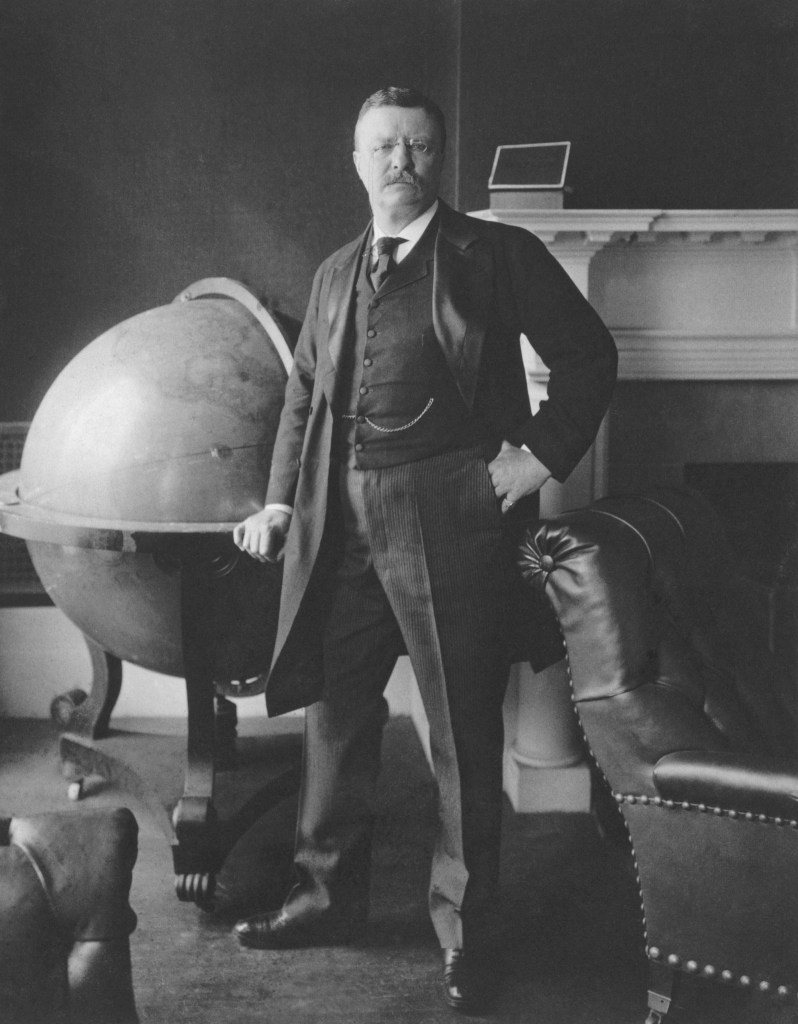
As Aldo Leopold matured from a gung-ho young hunter to a serious researcher of wildlife ecology, he was more often seen with a pair of binoculars around his neck than a rifle slung over his shoulder.

Born in January of 1889 in Burlington, Iowa, Leopold was an outdoorsman almost before he could walk.  His dad, a German immigrant and woodcrafter, regularly took the young Aldo on nature forays around the Iowa countryside and—during the summers—in Michigan’s Les Cheneaux Islands in Lake Huron.  Attending Yale University, Leopold became one of the first graduates of the Yale school of Forestry which had been created by an endowment from Gifford Pinchot, the first Chief Forester of the US Forest Service.
The experience with the old wolf changed Leopold from a man who took great pleasure in killing animals to one who often relished just watching and documenting what they did. In his younger years—before the “fierce green fire”, he was seldom seen without a hunting jacket on and a high-powered rifle slung over his shoulder.  After he shot the wolf—although he didn’t give up hunting—he was more likely to have a long-stem pipe poking thoughtfully out of the corner of his mouth and a pair of binoculars hanging around his neck. Forty years later in 1949, this dramatic change in Leopold’s personal thinking led to the publication of A Sand County Almanac—a book that also changed the thoughts of the entire US Environmental Movement and ushered in a totally new field, the science of wildlife management.       

Acknowledged by many as the “Father of Wildlife Conservation” and one of the most influential conservation thinkers of the 20th Century, Leopold was also one of the early leaders of the American wilderness movement. As we have previously discussed—prior to Leopold around the turn of the century—conservation was based almost solely on economics and benefits to humanity.  

But in his stirring essay, “The Land Ethic” that concluded A Sand County Almanac, Leopold described his groundbreaking concepts that everything on earth was interrelated and that man and nature existed in a harmonious relationshipThese beliefs—which were the precursor to the modern concept of ecology—stressed that man was just part of the overall global ecosystem.  Plus—as the most intelligent component of this global ecosystem—man had the responsibility of being the caretaker of all living things on Earth. Leopold also stressed that all living things were owed the right to a healthy existence.  These concepts were not only incredibly innovative but also were far ahead of their time. 
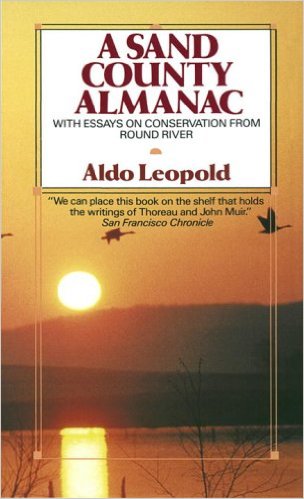
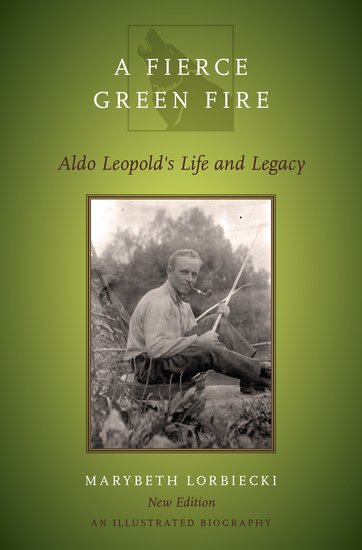
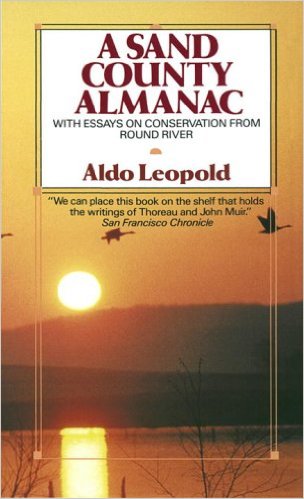
Leopold wrote A Sand County Almanac from a refurbished chicken coop—which he called simply “The Shack”—located on a farm he was restoring in the sand counties of Wisconsin near Baraboo.  With more than two million copies in print and having been translated into 12 languages, this book is one of the most beloved and respected books about the environment ever published. 

Ironically, Leopold died in 1948—just a few months before publication of his most famous work—from a heart attack while fighting a forest fire on the property of one of his neighbors.  Despite this, his legacy and writings will always live on—both spanning and blending the disciplines of forestry, wildlife management, conservation biology, sustainable agriculture, restoration ecology, private land management, environmental history, literature, education, esthetics, and ethics.

Although Aldo Leopold did not live long enough to hear much—if anything—about Global Warming, his “land ethic” views form the basis of the rationale for combating Climate Change.  If he were alive today, he would have most certainly taken a firm stance that as an integral—and supposedly harmonious—part of the natural world, humanity must not only take responsibility for the warming climate, we must also take the lead in combating it.  He would emphasize that studying our place within—not outside of—nature will allow us to most effectively see how we are influencing these changes.  Then—once we have this understanding—we can go about making the necessary corrections to counteract the looming crisis. As Mike Dombeck, Emeritus Professor of Global Environmental Management at Wisconsin–Stevens Point, recently wrote “As a society, we are just now beginning to realize the depth of Leopold’s work and thinking.”

“Like winds and sunsets, wild things were taken for granted until progress began to do away with them.  Now, we face the question whether a still higher ‘standard of living’ is worth its cost in things natural, wild, and free.”

– Aldo Leopold, A Sand County Almanac

“The last word in ignorance is the man who says of an animal or plant: ‘What good is it?’ To keep every cog and wheel is the first precaution of intelligent tinkering.” 

– Aldo Leopold, A Sand County Almanac 

Text excerpted from book: “PROTECTING THE PLANET: Environmental Champions from Conservation to Climate Change” written by Budd Titlow and Mariah Tinger and published by Prometheus Books. Photo credit: Copyright Shutterstock(2). 

Author’s bio:  For the past 50 years, professional ecologist and conservationist Budd Titlow has used his pen and camera to capture the awe and wonders of our natural world. His goal has always been to inspire others to both appreciate and enjoy what he sees. Now he has one main question: Can we save humankind’s place — within nature’s beauty — before it’s too late? Budd’s two latest books are dedicated to answering this perplexing dilemma. “PROTECTING THE PLANET: Environmental Champions from Conservation to Climate Change”, a non-fiction book, examines whether we still have the environmental heroes among us — harking back to such past heroes as Audubon, Hemenway, Muir, Douglas, Leopold, Brower, Carson, and Meadows — needed to accomplish this goal. Next, using fact-filled and entertaining story-telling, his latest book — “COMING FULL CIRCLE: A Sweeping Saga of Conservation Stewardship Across America” — provides the answers we all seek and need. Having published five books, more than 500 photo-essays, and 5,000 photographs, Budd Titlow lives with his music educator wife, Debby, in San Diego, California.

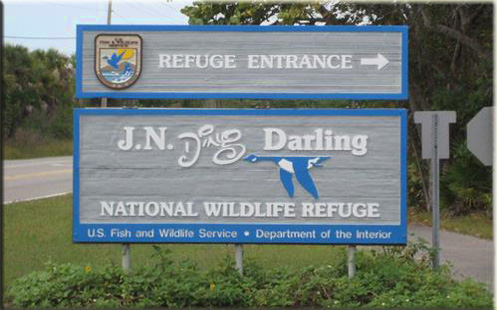
 

“Ding” Darling—The Man Who Saved Ducks

by

Budd Titlow

http://www.buddtitlow.com

Our next Past Environmental Hero had the best name in the history of the US Environmental Movement and—like Roger Tory Peterson— also used his creative artistic ability in a very special way.  But this time, the craftsmanship was combined with offbeat humor—instead of birding field marks—to get the public’s attention and build a consensus of support.  Jay Norwood “Ding” Darling combined an artist’s eye with a humorist’s ear and—or 50 years—produced prize-winning political cartoons that bemused the American public while galvanizing their support for landmark conservation initiatives. 

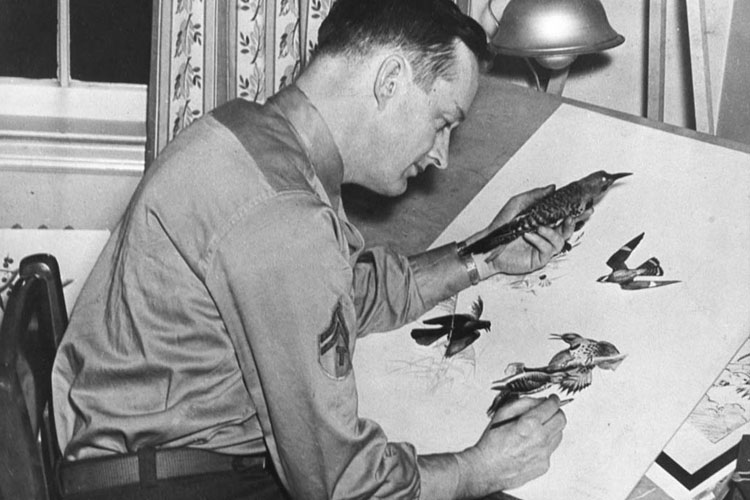
Jay Norwood “Ding” Darling enjoys his dual passions, working as a Pulitzer Prize winning political cartoonist and advocating for the protection of wild birds—as demonstrated by the photo posted behind his newspaper desk.

Born in Norwood, Michigan in 1876, Darling always considered himself an Iowan—even though his middle name derived from his place of birth.  When he moved with his parents to Sioux City, Iowa in 1886, he reveled in getting out and exploring the “edge of the American frontier”.  Gallivanting about through unspoiled prairie teeming with seemingly limitless wildlife gave Darling a life-long passion for protecting nature’s bounty.

An affable and energetic man with a penchant for a bow tie and a strong resemblance to long-time news anchor Walter Cronkite—“the most trusted man in America”, Darling began his political cartooning career in 1900 with the Sioux City Journal. After joining the Des Moines Register in 1906, he began signing his cartoons with his nickname “Ding”, a pseudonym he came up with in college by combining the first initial of his last name with the last three letters.  By 1917, his work was syndicated across the country through the New York Herald Tribune

Appearing in 130 daily newspapers, Darling’s witty and insightful drawings entertained an audience of millions. Awarded Pulitzer Prizes in 1923 and 1942, Darling specialized in using his satirical pen to promote issues of conservation and bring national attention to environmental concerns. 

While he always claimed that he was a conservationist as “only a hobby”Darling’s monumental accomplishments in the conservation arena belie that statement. In 1934, as Chief of the Bureau of Biological Survey—predecessor of the U.S. Fish and Wildlife Service—he dramatically cut waterfowl bag limits and seasons to bolster dwindling waterfowl populations.  This action earned him his life-long reputation as “the man who saved ducks”. 

Always an articulate speaker and tireless activist, Darling convinced President Franklin Delano Roosevelt to call the first North American Wildlife Conference in 1936—a landmark meeting that emphasized the need to have a permanent organization espousing protection of wildlife and wild places throughout the US.  Out of this conservation confab, the General Wildlife Federation (GWF)—forerunner of today’s esteemed National Wildlife Federation—was born.  The GWF—with Darling as its first president—provided a long-term public platform for taking care of one of Darling’s life concerns, the uncontrolled exploitation of wildlife. 

Darling solved his other primary concern—wanton destruction of key waterfowl habitat—by initiating the Federal Duck Stamp Program.  Proceeds from the sale of duck hunting stamps—the first of which Darling drew himself—went into a fund set aside specifically for purchasing wetlands to preserve waterfowl nesting and migratory habitat. 

Darling was also—in large part—responsible for establishing the network of National Wildlife Refuges that now lace across our country in all directions. The Federal Aid in Wildlife Restoration Act of 1937 (also known as the “Pittman-Robertson Act”)—which provides money to states for the purchase of game habitat and helps fund wildlife research through a tax on sporting firearms and ammunition—also owes its existence to Darling’s work. 

For many years of his life, Darling owned a winter home on Captiva Island in South Florida. Thanks to the efforts of many of his island neighbors and the J.N. “Ding” Darling Foundation, the adjacent Sanibel National Wildlife Refuge—which had dutifully protected wildlife habitat since 1948—was renamed the J.N. Ding Darling National Wildlife Refuge and officially dedicated to him in 1978.  Today, “The Ding” is a mecca for both birdwatchers and photographers living throughout South Florida and around the world. 

For many years starting in the winter of 1995, I often enjoyed the distinct avian pleasure of visiting “The Ding”. Every morning just before sunrise, serious photographers armed with telephoto lenses the size of bazookas and life birders toting their Swarovski binoculars line up to be the first to see what new birds have arrived on the refuge overnight.  What many of them may not realize is that the refuge’s namesake is the primary reason the birds are there in the first place!

“Land, water and vegetation … Without these three primary elements in natural balance, we can have neither fish nor game, wildflowers nor trees, labor nor capital, nor sustaining habitat for humans.” 

– Jay Norwood “Ding” Darling 

Jay Norwood “Ding” Darling used his cartoonist fame as a springboard to create two American wildlife management institutions—the US Fish and Wildlife Service and the National Wildlife Federation.  But, more importantly, he also found creative ways to finance his two favorite conservation causes—wildlife research and waterfowl management. Fees collected from the very people that participated in—and therefore benefited from—sport hunting were used to purchase habitat and protect nesting areas. The same fund-raising approach could be used in combating Climate Change.  Fossil fuel consumers could be charged a user fee and then the collected money—no doubt in the billions of dollars—could be applied to research facilities for renewable energy power generation and distribution.

Author’s footnote: As I’m sure you know, both Sanibel Island and Ding Darling National Wildlife Refuge took a direct hit from Category 4 Hurricane Ian on September 28, 2022. While the full extent of the damage to the “Ding’s” wildlife habitats may not be known for years, I’m sure hoping the refuge recovers to again become one of the best places in the world to watch and photograph wild birds.

Text excerpted from book: “PROTECTING THE PLANET: Environmental Champions from Conservation to Climate Change” written by Budd Titlow and Mariah Tinger and published by Prometheus Books. Photo credit: Copyright Shutterstock(2). 

Author’s bio:  For the past 50 years, professional ecologist and conservationist Budd Titlow has used his pen and camera to capture the awe and wonders of our natural world. His goal has always been to inspire others to both appreciate and enjoy what he sees. Now he has one main question: Can we save humankind’s place — within nature’s beauty — before it’s too late? Budd’s two latest books are dedicated to answering this perplexing dilemma. “PROTECTING THE PLANET: Environmental Champions from Conservation to Climate Change”, a non-fiction book, examines whether we still have the environmental heroes among us — harking back to such past heroes as Audubon, Hemenway, Muir, Douglas, Leopold, Brower, Carson, and Meadows — needed to accomplish this goal. Next, using fact-filled and entertaining story-telling, his latest book — “COMING FULL CIRCLE: A Sweeping Saga of Conservation Stewardship Across America” — provides the answers we all seek and need. Having published five books, more than 500 photo-essays, and 5,000 photographs, Budd Titlow lives with his music educator wife, Debby, in San Diego, California.
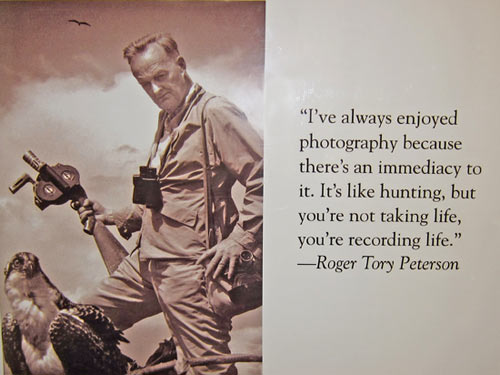
Roger Tory Peterson—Father of the Field Guide

by

Budd Titlow

http://www.buddtitlow.com

Who would you say the local townspeople in the small city of Jamestown, New York voted for in 1975 as their most famous native daughter or son?  If you guessed the world-famous television star and comedienne Lucille Ball, you’d be wrong.  Although Lucille Ball was indeed born in Jamestown, the townsfolk chose Roger Tory Peterson as their best-known local resident.

Yes, this man with a handsomely-craggy face and—by many accounts—a somewhat obstinate personality—was then known to some 20 million birdwatchers around the nation as simply “Peterson”—as in “quick, look it up in your Peterson”.  You see—in 1934—ardent naturalist and profound wildlife artist Roger Tory Peterson published his first of many field guides that kicked off a long-lasting trend in the dissemination of natural resource information that sold millions of copies throughout the US. 

Born on August 28, 1908 in Jamestown, Peterson seemed destined to be anything but a famous artist and writer.  He was known to his teachers and other townsfolk as a constant troublemaker—always pulling pranks and raising hijinks.  But Peterson’s epiphany occurred at age 11 when he joined the local Junior Audubon Bird Club. Once he latched onto his first birding field guide and pair of binoculars, his wayward days ended and a life-long passion began.  

Peterson’s interest in art also kicked in when—as a young adult—he enrolled in the Art Students League in New York City and also studied at the National Academy of Art Design.  Along the way during this educational process, Peterson was heavily influenced by a bevy of serious young birders—including Joe Hickey, Allan Cruickshank, and John Aldrich.

In his early twenties—while he was struggling to make a living as an artist—Peterson’s two life passions first merged into his psyche.  He began to notice that each bird species had distinctive field marks that obviously set them apart from other—even closely related—species.  He realized from these initial observations that he had discovered a way for birds to be quickly identified—even at a distance.   

Barely able to contain his excitement, Peterson set to work drawing and writing his first book, A Field Guide to the Birds, which was first published in 1934.  Since then—through more than forty-seven total re-printings—over seven million copies of his two primary birding field guides—Guide to the Eastern Birds and Guide to the Western Birds—have been sold.  Even after his birding guides became huge successes, Peterson continued to boost public interest in wild birds by writing articles for popular publications that bridged the gap between professional ornithologists and amateur backyard birdwatchers.

Roger Tory Peterson at work on his magnum opus, “A Field Guide to the Birds”.

Peterson’s 1948 book, Birds Over America, also demonstrated his depth and breadth as a dedicated conservationist.  While primarily describing birds and birdwatching across North America, this book also packs wallops in the arenas of both ecological principles and environmental ethics.  In particular, Birds Over America features the interconnected web of all living things, how hunters and farmers affect conservation, the ominous threats posed by invasive species, and the importance of protecting endangered species and the critical habitats they depend on. 

For the 50 million folks that regularly watch birds in the US, Peterson is now known as the “Father of the Field Guide”.  Birders everywhere now always carry these trusty pocket-sized books that provide vital field mark clues for accurate bird identification.  Plus the bird paintings included in his first field guides also earned Peterson the most appropriate acclaim as “The Audubon of the Twentieth Century.”

In fact, during the entire 20th Century‚ no one did more to promote interest in nature and the environment than Peterson. His entire series of Peterson’s Field Guides—including everything from amphibians to butterflies, fish, reptiles, wildflowers, and even seashells—fostered an appreciation for the natural world and helped set the stage for ramping up the US Environmental Movement during the Sixties and Seventies.  It became impossible to find someone who was interested in the environment that didn’t have at least ten or more Peterson Field Guides on their home or office bookshelves.

Although never a professed activist, Peterson always maintained his dedication to environmental protection and dogged opposition to environmental hazards—like the use of DDT—throughout his career.  In fact, when Rachel Carson’s 1962 Silent Spring[i]  boomed its warning about pesticides’ threat to bird habitats, the Peterson Field Guide Series had already called on the American public and the scientific community to heed the battle cry and fight to save habitat and protect endangered species.

Following his move to Old Lyme, Connecticut, Peterson continued to write and publish an array of field guides and other books and was rewarded by many public accolades; including the American Ornithologists’ Union Brewster Medal, the Gold Medal of the New York Zoological Society, the Presidential Medal of Freedom, the Linnaean Society of New York’s Eisenmann Medal, and the Order of the Golden Ark of the Netherlands.

Also catering to the serious nature photographers of the world in 1994, Peterson invited a cadre of world famous outdoor photographers, editors, vendors, and authors to his institute in Jamestown, New York for the founding of the North American Nature Photography Association (NANPA).  NANPA is now the world’s only organization devoted solely to practitioners of outdoor photography.  I am very proud to say that I am a Charter Member of NANPA—having joined in 1995 at the first “Nature Photography Summit” in Ft. Myers, Florida—while also serving on NANPA’s Board of Directors from 2009 to 2015.

Peterson also received nominations for the Nobel Peace Prize as well as honorary doctorates from several universities. Since he passed away in 1996 at his Old Lyme home, the Roger Tory Peterson Institute has continued to publish and promote his field guides, display his fine art paintings, and carry on his work in conservation and education.  

In the final analysis, it can be said that Roger Tory Peterson—a troubled youth with seemingly no discernible drive or sense of direction—started a revolution in the field of environmental education that has continued to this day. He brought the study and understanding of the natural world out of the halls of academia and into the farms, fields, meadows, and mountains of North America. This is exactly the type of educational effort that will be required to create the groundswell of public support that will truly make a difference in the Climate Change movement.

“The philosophy that I have worked under most of my life is that the serious study of natural history is an activity which has far-reaching effects in every aspect of a person’s life.  It ultimately makes people protective of the environment in a very committed way.  It is my opinion that the study of natural history should be the primary avenue for creating environmentalists.”

– Roger Tory Peterson

Text excerpted from book:         PROTECTING THE PLANET: Environmental Champions from Conservation to Climate Change” written by Budd Titlow and Mariah Tinger and published by Prometheus Books. Photo credit:   Copyright Shutterstock (2). 

Author’s bio:  For the past 50 years, professional ecologist and conservationist Budd Titlow has used his pen and camera to capture the awe and wonders of our natural world. His goal has always been to inspire others to both appreciate and enjoy what he sees. Now he has one main question: Can we save humankind’s place — within nature’s beauty — before it’s too late? Budd’s two latest books are dedicated to answering this perplexing dilemma. “PROTECTING THE PLANET: Environmental Champions from Conservation to Climate Change”, a non-fiction book, examines whether we still have the environmental heroes among us — harking back to such past heroes as Audubon, Hemenway, Muir, Douglas, Leopold, Brower, Carson, and Meadows — needed to accomplish this goal. Next, using fact-filled and entertaining story-telling, his latest book — “COMING FULL CIRCLE: A Sweeping Saga of Conservation Stewardship Across America” — provides the answers we all seek and need. Having published five books, more than 500 photo-essays, and 5,000 photographs, Budd Titlow lives with his music educator wife, Debby, in San Diego, California.

.


John Steinbeck—Prolific Author and Staunch Conservationist

by

Budd Titlow

http://www.buddtitlow.com

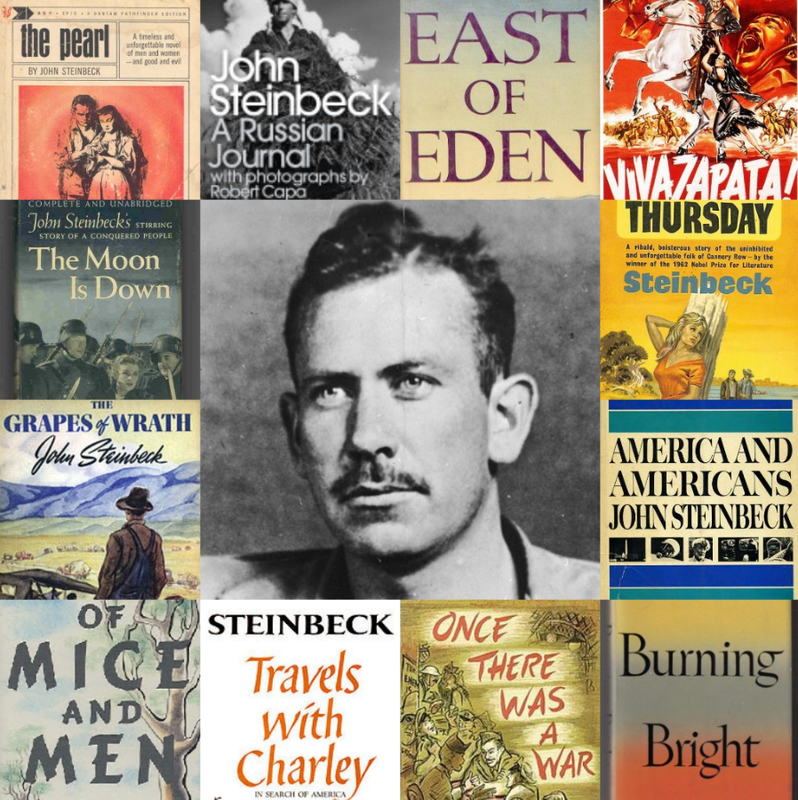
Many people would call John Steinbeck—another one of our Past Environmental Heroes— America’s greatest writer. We are among those, not just because of Steinbeck’s empathy with the human spirit but also because of the ardent environmentalism he displayed in his works. Steinbeck’s perpetually exasperated look, thin—almost evil looking mustache overtopping his ever-present cigarillo—somewhat belied his strong feelings about and support for the everyday working man and his living conditions. 

From The Grapes of Wrath to Cannery Row, Steinbeck wrote searingly about America’s degradation of our environment. He lashed out at overharvesting fisheries stocks, about harmful farming practices, and – most emphatically—about the global evils of human overpopulation. In his novel, Sweet Thursday, Steinbeck warns that, “Man, in saving himself, has destroyed himself”. 

Throughout his writings, Steinbeck staunchly preached conservation and, in his last work, America and Americans, he put forth the hope that we could learn to not “destroy wantonly”.  If he were still alive today, we strongly suspect his next book would be entitled something along the lines of: Dark and Angry Skies – Fighting the World’s War Against Climate Contaminants

Born in Salinas, California in 1902, John Steinbeck lived in a modest family home in the midst of a prosperous farming community that formed the background for his novels and the basis for his characters who strongly identified with the land.  Beginning in early adolescence, he demonstrated his strong propensity for the pen.  In high school, he would hide away in his secret attic cubby and write short stories that he would send out to magazines under pseudonyms without a return address.  In later years, he sheepishly admitted that “he was scared to death to get a rejection slip, but more afraid of getting an acceptance.”

In 1919, Steinbeck enrolled at Stanford University but never graduated after five years of taking courses on and off.  It was during this time, however, that he became enamored with science and biology.  While working for a fish hatchery in Tahoe City, California, he met and married Carol Henning.  The couple moved to a cottage owned by his Dad on the Monterey Peninsula of which Steinbeck wrote,  “Financially we are in a mess, but spiritually we ride the clouds.  Nothing else matters.” 

Finally with the acceptance and publication of Pastures of Heaven, a loosely connected collection of short stories about the Salinas Valley, Steinbeck’s writing career took off in earnest. What many consider his best work that we’ve just discussed, The Grapes of Wrath, won both a Pulitzer Prize and a National Book Award in 1939. 

Steinbeck’s ties to environmentalism and ecology—before each became a watchword in the US—have been acknowledged and described by many scientists.  In the book entitled Steinbeck and the Environment, Clifford and Mimi Gladstein describe his beliefs this way: “Literary works often precede and foretell the articulation of philosophical concepts.  And lovers of the natural world have been among the most devoted readers of John Steinbeck.  Maybe it is because they see in his works strong identification with and respect for tillers of the soil and harvesters of the sea as well as an abiding reverence for the earth in its pristine state.”

Writing in the same book, Lorelei Cederstrom takes things a step further, “In his depiction of the fertile earth and the lives of those who have depended on her for abundance, John Steinbeck in The Grapes of Wrath presents a visionary foreshadowing of the universal ecological disaster that looms so prominently on the horizon today.”

Steinbeck continued to write in his later years, including many highly acclaimed and widely read other books—Burning Bright (1950), East of Eden (1952), The Winter of Our Discontent (1961), and Travels with Charley: In Search of America(1962). In 1962, he received the vaunted Nobel Prize for Literature which was awarded for his “… realistic and imaginative writings, combining as they do sympathetic humor and keen social perception.”  Steinbeck died of heart disease on December 20, 1968, at his home in New York City at the age of 66—far too young for an environmental savant of his stature.

The best two pieces of advice any writer can ever receive are “be observant of the world around you” and “write about what you know”.  Based on his prolific and heartfelt works, Steinbeck was a master at both of these directives.  Those of us with writing predilections who are working today to counter Climate Change would do well to study Steinbeck’s books.  We need to learn how to emulate his marvelous skills at perfectly portraying the absolute essence of the social, business, and environmental inequities he saw happening in his day and time.  If we can figure out how to transfer our feelings about the perils that Climate Change pose with the same burning passion that John Steinbeck displayed, we will surely be successful at rallying the world to our cause.     

Text excerpted from book:     PROTECTING THE PLANET: Environmental Champions from Conservation to Climate Change” written by Budd Titlow and Mariah Tinger and published by Prometheus Books. Photo credit: Copyright Shutterstock. 

Author’s bio:  For the past 50 years, professional ecologist and conservationist Budd Titlow has used his pen and camera to capture the awe and wonders of our natural world. His goal has always been to inspire others to both appreciate and enjoy what he sees. Now he has one main question: Can we save humankind’s place — within nature’s beauty — before it’s too late? Budd’s two latest books are dedicated to answering this perplexing dilemma. “PROTECTING THE PLANET: Environmental Champions from Conservation to Climate Change”, a non-fiction book, examines whether we still have the environmental heroes among us — harking back to such past heroes as Audubon, Hemenway, Muir, Douglas, Leopold, Brower, Carson, and Meadows — needed to accomplish this goal. Next, using fact-filled and entertaining story-telling, his latest book — “COMING FULL CIRCLE: A Sweeping Saga of Conservation Stewardship Across America” — provides the answers we all seek and need. Having published five books, more than 500 photo-essays, and 5,000 photographs, Budd Titlow lives with his music educator wife, Debby, in San Diego, California.


.

Franklin Delano Roosevelt (“FDR”) Comes to the Rescue

by

Budd Titlow

http://www.buddtitlow.com

Our next Past Environmental Hero is Franklin Delano Roosevelt (“FDR”) who was a true American hero on three other major fronts—health care, economic issues, and military prowess—in addition to land conservation. Born in 1882 on his family’s estate in Hyde Park, New York, FDR was availed the best schooling at the prestigious Groton School in Massachusetts, Harvard University, and Columbia University. As an adult standing more than six feet tall, Roosevelt was a strikingly handsome, lean, and athletic young man with deep blue eyes, dark wavy hair, and a strong thrusting jaw. He was also ebullient, charming, persuasive, gregarious, and genuinely interested in people and their problems.

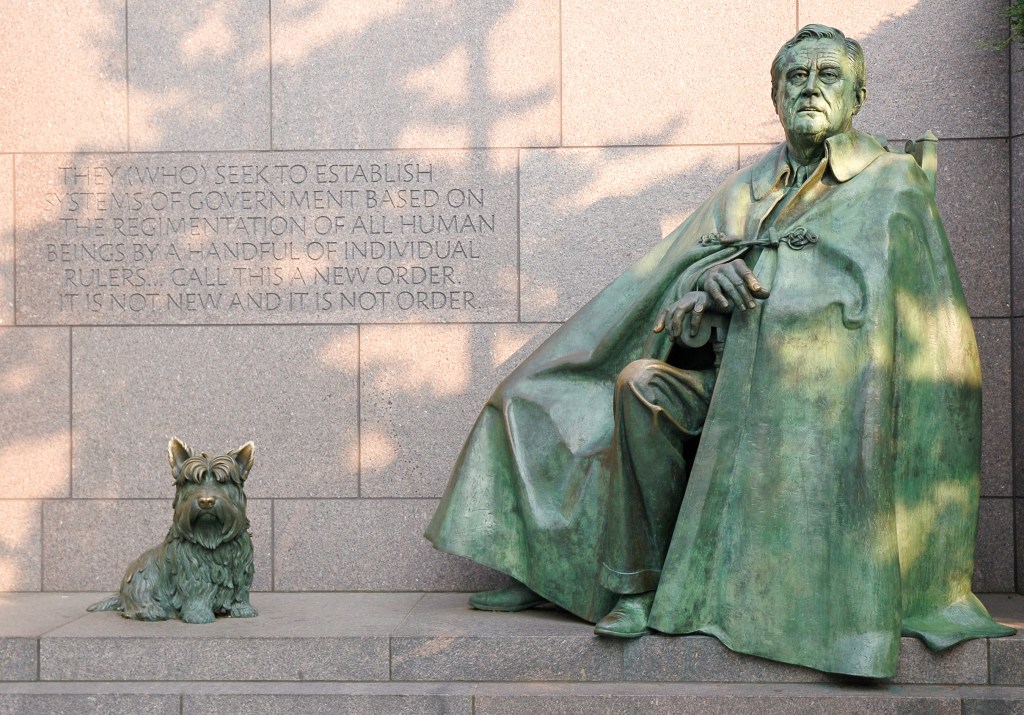
Bronze statue of a multi-faceted hero: President Franklin Delano Roosevelt (“FDR”) and his beloved dog, “Fala”.

In 1921 while visiting his beloved Campobello Island on the border of New Brunswick, Canada and the State of Maine, Roosevelt contracted poliomyelitis otherwise known as infantile paralysis or simply the dreaded—at the time—disease called “polio”.  Perhaps his most heroic feat was how he dealt with this debilitating affliction with dignity for the rest of his life.  He not only worked out ways to make it appear that he wasn’t really disabled—which was, unfortunately, considered a dehumanizing disgrace in those days—but he also initiated the “March of Dimes”, a fundraising organization which led to the development of the Salk Vaccine that eventually wiped out polio in the US.

From an economic perspective, Roosevelt’s election in 1932 proved to be the saving grace of the United States and the US Environmental Movement.  Known as the “New Deal”, his program for relief, recovery, and reform included a great expansion of the role the federal government played in the economy. New Deal policies introduced an array of social programs—including Social Security, the Wagner Act, and Fair Labor Standards Act—that still form the backbone of the federal government’s provision of economic prosperity and wellbeing for all of its citizens.  According to Benjamin Kline: “If it were not for the ravages of the Great Depression, Roosevelt may have ranked among the most successful of environmental leaders in American history.”

Roosevelt’s “alphabet soup” of other federal programs included the Agricultural Adjustment Act (AAA), the Civilian Conservation Corps (CCC), and the Tennessee Valley Authority (TVA).  The AAA paid subsidies to farmers for not planting crops—intentionally leaving fields fallow—and not slaughtering livestock.  This avoided having surplus agricultural products—like wheat, corn, livestock, and dairy products—which would have driven the price of these commodities down and put many farmers out of business.  Although always controversial, the federal price subsidy program still exists today—using federal subsidies to maintain the price of agricultural products.

The CCC put young men to work on federal lands all across the nation.  Many of the hundreds of infrastructure improvements—including bridges, dikes, impoundments, roads, trails, and shelters—still form the backbone of recreational uses in our national parks and monuments, national forests, and national wildlife refuges.  FDR’s concepts for multi-purposing conservation and development were perhaps best epitomized by his TVA projects that were established to bring water supplies, flood control, and inexpensive and renewable hydropower—as well as recreational amenities—to underserved areas of the nation.

Several new national parks—Olympic, Shenandoah, Kings Canyon, plus the groundwork for Grand Teton—came to fruition during FDR’s administration.  He also oversaw two momentous turns in wildlife management—the outlawing of killing predators in national parks and the establishment of the US Fish and Wildlife Service in 1940.

Today, there are more than 560 national wildlife refuges across the country, with at least one in every US state and territory. Today, wildlife refuges attract nearly 50 million visitors every year in pursuit of a mix of active and passive recreational activities— including wildlife-watching, hunting, fishing, photography, hiking, canoeing, kayaking, and environmental education.

Roosevelt’s final heroic act occurred during his unprecedented third term in office when he assumed the role of Commander-in-Chief throughout WWII’s conflict with Nazi Germany and Imperial Japan.  We’ll discuss this war that saved the world from dictatorial enslavement in more detail later in this section.  But it’s important to note that Roosevelt served as the American counterpart to Great Britain’s Winston Churchill throughout the war, staying actively involved in all military activities and even overriding the decisions of field commanders when he believed the situations were called for.

Roosevelt also moved to create a “Grand Alliance” against the Axis powers—Germany, Italy, and Japan—through a peacekeeping organization that is today known as the United Nations.  Many historians believe that the additional stress of WWII—on top of managing his severe handicap and the nation’s economic problems—proved too much for Roosevelt.  He died a few hours after experiencing a massive stoke at his Little White House in Warm Springs, Georgia, ironically on the eve of the US’s complete military victory in Europe and just months before the victory over Japan in the Pacific Theatre. 

“We seek to use our natural resources not as a thing apart but as something that is interwoven with industry, labor, finance, taxation, agriculture, homes, recreation, and good citizenship.  The results of this interweaving will have a greater influence on the future American standard of living than the rest of our economics put together.”  

– Franklin Delano Roosevelt

Despite FDR’s diligent remediation efforts, most of the concerns about environmental protection went out the window—along with just about everyone’s dutifully scrimped-and-saved-for life savings—during “The Depression Decade” of the Thirties. In the minds of many preservationists, this was payback for generations of disregard for and rampant misuse and degradation of the Nation’s natural resources.

On a positive note, however, many of the ideas FDR put into practice—in an effort to bring the US out of the Great Depression—have relevancy to solving the Climate Change crisis.  As with the AAA’s price subsidies for agriculture, providing payments to fossil fuel companies not to extract new reserves could maintain their financial statuses while forcing them to develop renewable energy sources to meet the customer demands on their systems.  Also a new federal agency along the lines of FDR’s TVA could be established.  This new agency would be specifically tasked with solving the Climate Change crisis by promoting and managing the concurrent reduction in fossil fuels with the expansion of renewable energy supplies.  Finally a CCC-like organization could put hundreds of scientists and laborers to work immediately on designing and constructing the sources and infrastructure required to deliver renewable energy supplies to every corner of the US. 

Text excerpted from book:     PROTECTING THE PLANET: Environmental Champions from Conservation to Climate Change” written by Budd Titlow and Mariah Tinger and published by Prometheus Books. Photo credit: Copyright Zack Frank/Shutterstock. 

Author’s bio:  For the past 50 years, professional ecologist and conservationist Budd Titlow has used his pen and camera to capture the awe and wonders of our natural world. His goal has always been to inspire others to both appreciate and enjoy what he sees. Now he has one main question: Can we save humankind’s place — within nature’s beauty — before it’s too late? Budd’s two latest books are dedicated to answering this perplexing dilemma. “PROTECTING THE PLANET: Environmental Champions from Conservation to Climate Change”, a non-fiction book, examines whether we still have the environmental heroes among us — harking back to such past heroes as Audubon, Hemenway, Muir, Douglas, Leopold, Brower, Carson, and Meadows — needed to accomplish this goal. Next, using fact-filled and entertaining story-telling, his latest book — “COMING FULL CIRCLE: A Sweeping Saga of Conservation Stewardship Across America” — provides the answers we all seek and need. Having published five books, more than 500 photo-essays, and 5,000 photographs, Budd Titlow lives with his music educator wife, Debby, in San Diego, California.


Robert Bob Marshall—Wilderness Was in His Blood

By

Budd Titlow

http://www.buddtitlow.com

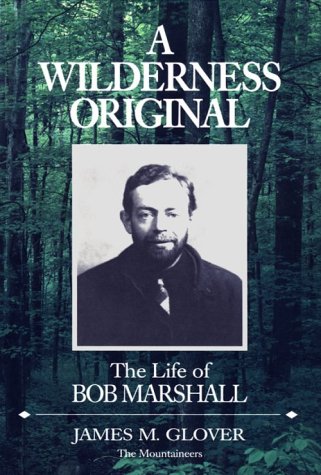
There’s a revered—many would say mythical—landscape in northwestern Montana that features 1.5 million acres of pristine lakes, crystal rivers, snow-capped mountains, and evergreen valleys.  The name of this magnificent wilderness jewel is simply “The Bob”.

Wilderness has always been in Dr. Robert “Bob” Marshall’s blood. While he didn’t live to see the completion of his namesake wilderness area—a fitness fanatic, he ironically died far too early at age 38—his legacy as a conservationist and humanitarian will forever stand strong in Montana as well as throughout all the other wilderness areas now found scattered throughout the US.  

Born on January 2, 1901 as the son of Louis Marshall—a wealthy civil rights lawyer and philanthropist—in New York City, Marshall spent his summers at the family home, named “Knollwood”, on Lower Saranac Lake in the heart of the Adirondack Mountains.  As a teenager and young adult, he roamed all over his beloved mountain group, eventually becoming a member of “46ers Club” by virtue of climbing all 46 of the range’s peaks that are above 4,000 feet. 

After graduating from the Ethical Culture School in New York, Marshall attended Columbia College, the New York State College of Forestry at Syracuse, and then Harvard University. From there, his national wanderings took him to the Northern Rocky Mountain Forest Experiment Station in Missoula, Montana where he worked from 1925–28.  Then his peripatetic habit kicked in again and he went back to school in 1928 at Johns Hopkins University to get a Ph.D. degree in plant physiology—one of three doctorate degrees he earned in his lifetime.

In February 1930, Marshall’s most poignant essay, The Problem of the Wilderness, was published by The Scientific American and became one of the most important works in conservation history.  In this piece, Marshall opined that there are many reasons for preserving wilderness beyond just its esoteric value as landscape untrammeled by human activities: “There is just one hope of repulsing the tyrannical ambition of civilization to conquer every niche on the whole earth. That hope is the organization of spirited people who will fight for the freedom of the wilderness.”  Today, many wilderness historians credit The Problem of the Wilderness as being a seminal “call-to-action” while setting the stage—more than 30 years later—for the passage of the 1964 Wilderness Protection Act. 

While much has been made—and rightfully so—about Marshall’s work for wilderness preservation, his life’s interests extended far beyond such backcountry pursuits as hiking, mountain climbing, fishing, and horseback riding.  Although he came from a very wealthy family, he had a deep and abiding—bordering on the spiritual—concern for those who were less fortunate than himself.  In particular, Marshall cared about the indigenous groups of people he met during his extensive travels in pursuit of wilderness preservation.   

For example in 1930 and 1931, while living among the native Koyukuk people in the remote Alaskan village of Wiseman, Marshall got the inspiration for writing his first book, Arctic Village.  The book became a best-seller in 1933 and earned him $3,600—a princely sum of money back then.  After the book came out—instead of pocketing all the money for himself—Marshall gave away half of the profits in the form of checks made out to each of the Koyukuk he had known during his stay in Wiseman.  

Then throughout his multi-faceted career as a federal public lands administrator, he made equal rights for all people—no matter what race, sex, creed, or religion—a personal priority. He worked diligently to fully involve all Native Americans in the management of their tribal forests and mountain ranges.  After realizing that their customs and freedoms of religious worship had been stripped away, he fought to provide them with the level of equality he felt all Americans should enjoy.  In fact, Marshall diligently worked to provide every American with equal access and visitation rights to all recreational areas on all federal lands.  He even proposed subsidized travel so families with less expendable incomes could experience the beauty of the American landscapes on a first-hand, “up-close-and-personal” manner.  [i]

Back now on the wilderness track, Marshall believed that truly wild lands had intrinsic values for the human spirit—providing places where people could go to find themselves and rekindle their souls.  While serving as Chief Forester for the Bureau of Indian Affairs in 1935, Marshall—along with Aldo Leopold, whom we’ll meet later in this section, and others—established the Wilderness Society, an organization dedicated to preserving the wilderness in its unspoiled state. Then as Assistant to the Chief of the US Forest Service—a position he held until he died—Marshall devoted much of his energy and intelligence to the development of the National Forest’s wilderness system. 

Marshall’s name and strong promotion of America’s wilderness preservation system will forever remain a driving force for land conservation today.  When he passed away in 1939, he bequeathed one-fourth of his $1.5 million estate to the Wilderness Society— thus assuring the organization’s future in the name of wilderness preservation.  Today, the “Bob Marshall Award” is the highest honor bestowed by the Wilderness Society.

“(Wilderness) is the song of the hermit thrush at twilight and the lapping of waves against the shoreline and the melody of the wind in the trees. It is the unique odor of balsams and of freshly turned humus and of mist rising from mountain meadows. It is the feel of spruce needles under foot and sunshine on your face and wind blowing through your hair. It is all of these at the same time, blended into a unity that can only be appreciated with leisure and which is ruined by artificiality.”

– Robert “Bob” Marshall

“How many wilderness areas do we need?  How many Brahms symphonies do we need?”

– Robert “Bob” Marshall

Throughout Bob Marshall’s remarkable—albeit far too short—life he demonstrated an uncanny blend of caring deeply about both natural preservation and equal human rights for all people.  This is exactly the type of dual thinking that will allow us to bring Climate Change solutions home to all people on Earth.  The people in developing countries must understand and believe that they are fully involved in every decision that is being made and every action that is being taken.  They can no longer feel like the “Environmental Justice Movement” has bypassed them in favor of catering to the wealth and power of the countries.

Text excerpted from book: “PROTECTING THE PLANET: Environmental Champions from Conservation to Climate Change” written by Budd Titlow and Mariah Tinger, published by Prometheus Books.

Author’s bio:  For the past 50 years, professional ecologist and conservationist Budd Titlow has used his pen and camera to capture the awe and wonders of our natural world. His goal has always been to inspire others to both appreciate and enjoy what he sees. Now he has one main question: Can we save humankind’s place — within nature’s beauty — before it’s too late? Budd’s two latest books are dedicated to answering this perplexing dilemma. “PROTECTING THE PLANET: Environmental Champions from Conservation to Climate Change”, a non-fiction book, examines whether we still have the environmental heroes among us — harking back to such past heroes as Audubon, Hemenway, Muir, Douglas, Leopold, Brower, Carson, and Meadows — needed to accomplish this goal. Next, using fact-filled and entertaining story-telling, his latest book — “COMING FULL CIRCLE: A Sweeping Saga of Conservation Stewardship Across America”— provides the answers we all seek and need. Having published five books, more than 500 photo-essays, and 5,000 photographs, Budd Titlow lives with his music educator wife, Debby, in San Diego, California.


.

.


Ansel Adams—Landscape Photographer and Conservationist Supreme

by Budd Titlow

http://www.buddtitlow.com

Choosing a professional career is typically a difficult decision for anyone to make.  For years, I aspired to be a full-time nature photographer, making a living by sharing my love for the bounteous breadth of beauty that breathed life into every one of my footsteps in the great outdoors.   After a few years of trying, I realized that there was simply too much competition and I should just be happy with the occasional opportunities I had to see—and capture—nature in its rawest and most inspiring forms.  

That’s why I will forever remain in awe of a man who had the requisite skills and desire to be both a concert pianist and a master photographer.  Fortunately for legions of nature lovers and conservationists throughout the US, he eschewed the performance halls and proceeded to become the greatest landscape photographer the world has ever known.

Ansel Adams was born in the Western Addition of San Francisco in 1902—just four years before the city’s “Great Quake”—an event that etched a permanent disfigurement into his remarkably memorable face.  While he was uninjured by the quake’s primary rocking and rolling, an aftershock sent him tumbling into a garden wall.  The face-first smash broke his nose and he never bothered to have it surgically repaired.  That’s why any portrait you see of Adams makes him look like a cherubic gremlin—his round face festooned by outsized ears and a nose that looks like it has been knocked askance in a street fight. 

First visiting Yosemite National Park in 1916—only two years after John Muir’s death and three months before the founding of the National Park Service—Adams stood mesmerized by the landmark’s iconic splendor.  While music was still his primary passion and planned profession, this first Yosemite experience at age 14 planted the sparks that burned brightly in his brain for what the future might hold.   From that day forward, he joyfully explored the natural world—especially his beloved Yosemite—while attempting to capture black-and-white replicas of the grandeur he saw at every turn.

Ansel Adams understood the masterful use of nuanced gradations in black-and-white scenery to produce iconically memorable images better than any other photographer who has ever lived.

In 1927, Adams got the break that changed his life forever when he was named the Sierra Club’s official trip photographer.  Afterwards, his role in the Sierra Club grew rapidly and the group’s organized hikes and talks became vital to his early success as a photographer with his first photographs and writings published in the Sierra Club Bulletin. He also became politically involved in the club’s environmental activities—suggesting proposals for improving parks and wilderness areas—and soon became widely known as both an artist and ardent representative of Yosemite National Park.

Between 1929 and 1942, Adams expanded his repertoire, focusing on detailed close-ups as well as large formats images of everything from mountains to factories. He spent a great deal of time in New Mexico hobnobbing with such other well-known artists as Alfred Stieglitz, Georgia O’Keeffe, and Paul Strand.  During this period, Adams also joined photographers Dorothea Lange and Walker Evans in their commitment to affecting social and political change through art. After the internment of Japanese people during World War II, Adams photographed life in the camps for a photo-essay on wartime injustices.

The first use of Adams’ images for environmental purposes occurred when the Sierra Club was seeking the creation of a national park in the Kings River region of the Sierra Nevada. Adams lobbied Congress for a Kings Canyon National Park and created an impressive, limited-edition book entitled Sierra Nevada: The John Muir Trail which influenced both Interior Secretary Harold Ickes and President Franklin Roosevelt to embrace the Kings Canyon Park idea. The park was created in 1940. [v]

Adam’s iconic black-and-white landscape images—especially those of the American West—have since inspired millions of people.  His master photographs and skilled writings—including more than 40 books—helped expand the National Park System and the nascent Sierra Club.  His collective works have been hailed as providing the foremost record of what many of our national parks were like before the advent of tourism. While he diligently pursued his crafts, Adams also tirelessly advocated for balancing progress with maintenance of the peace and solitude that can only be found in unfettered natural areas.

As a Past Environmental Hero and a symbol of the American West, Adams was also a visionary figure in nature photography and wilderness preservation. Expressing a sentiment that we should all hope to emulate in our careers, Adams wrote, “I hope that my work will encourage self-expression in others and stimulate the search for beauty and creative excitement in the great world around us.”

In 1968 Adams was awarded the Conservation Service Award, the Interior Department’s highest civilian honor: “In recognition of your many years of distinguished work as a photographer, artist, interpreter and conservationist, a role in which your efforts have been of profound importance in the conservation of our great natural resources.” Then in 1980 he also received the Presidential Medal of Freedom, for: “His efforts to preserve this country’s wild and scenic areas, both on film and on earth. Drawn to the beauty of nature’s monuments, he is regarded by environmentalists as a national institution.”Ansel Adams died from cardiovascular disease at the Community Hospital in Monterey, California on April 22, 1984—a day when every other serious nature photographer in US also experienced a little heartache.

Why was Ansel Adams revered by Americans as no other artist or conservationist had ever been? Author William A. Turnage offers this explanation: “More than any other influential American of his epoch, Adams believed in both the possibility and the probability of humankind living in harmony and balance with its environment.” 

Ansel Adams was a master of more than just landscape photography.  He plied his magnificent works of art to draw people into his thoughts. Then, once he had the public’s attention, he put forth—in his writings and speaking engagements—the subtle message that if we are not careful we could easily lose all of our Nation’s unparalleled natural splendor.  

Adam’s same skills of blending positive reinforcement into support for a cause is critical to converting Climate Change deniers and fence-sitters to the plus side of the ledger.  If he were alive today—with his beliefs in humankind—Ansel Adams would certainly be in the forefront of our heroic charge to design and implement Climate Change solutions that would allow the harmony and balance of humans and the environment to continue unabated forever!


Text excerpted from book: PROTECTING THE PLANET: Environmental Champions from Conservation to Climate Change” written by Budd Titlow and Mariah Tinger and published by Prometheus Books. Author’s bio:  For the past 50 years, professional ecologist and conservationist Budd Titlow has used his pen and camera to capture the awe and wonders of our natural world. His goal has always been to inspire others to both appreciate and enjoy what he sees. Now he has one main question: Can we save humankind’s place — within nature’s beauty — before it’s too late? Budd’s two latest books are dedicated to answering this perplexing dilemma. “PROTECTING THE PLANET: Environmental Champions from Conservation to Climate Change”, a non-fiction book, examines whether we still have the environmental heroes among us — harking back to such past heroes as Audubon, Hemenway, Muir, Douglas, Leopold, Brower, Carson, and Meadows — needed to accomplish this goal. Next, using fact-filled and entertaining story-telling, his latest book — “COMING FULL CIRCLE: A Sweeping Saga of Conservation Stewardship Across America”— provides the answers we all seek and need. Having published five books, more than 500 photo-essays, and 5,000 photographs, Budd Titlow lives with his music educator wife, Debby, in San Diego, California.

Martha—The World’s Last Passenger Pigeon

by

Budd Titlow

http://www.buddtitlow.com

In a landmark tragedy of the US Environmental Movement, Martha—the last passenger pigeon, named in honor of our original First Lady Martha Washington—died at the Cincinnati Zoo on September 1, 1914.  Perhaps no other event in US history so clearly defined the fact that humans were dramatically impacting the natural environment.  When European colonists first arrived, the passenger pigeon was the most abundant wild bird in the US—and possibly in the world.  Flying in tight-knit flocks numbering in the billions, passenger pigeons once darkened the skies throughout the US for days on end.  Now remaining as the US’s most iconic representative of the horrors of species extinction, Martha’s stuffed remains were kept on display until September 2015 at the Smithsonian Institution from in the exhibit entitled “Once There Were Billions”. 

Text excerpted from book: “PROTECTING THE PLANET: Environmental Champions from Conservation to Climate Change” written by Budd Titlow and Mariah Tinger and published by Prometheus Books.

Photo credit: Copyright Tim Hough 2013

Author’s bio:  For the past 50 years, professional ecologist and conservationist Budd Titlow has used his pen and camera to capture the awe and wonders of our natural world. His goal has always been to inspire others to both appreciate and enjoy what he sees. Now he has one main question: Can we save humankind’s place — within nature’s beauty — before it’s too late? Budd’s two latest books are dedicated to answering this perplexing dilemma. “PROTECTING THE PLANET: Environmental Champions from Conservation to Climate Change”, a non-fiction book, examines whether we still have the environmental heroes among us — harking back to such past heroes as Audubon, Hemenway, Muir, Douglas, Leopold, Brower, Carson, and Meadows — needed to accomplish this goal. Next, using fact-filled and entertaining story-telling, his latest book — “COMING FULL CIRCLE: A Sweeping Saga of Conservation Stewardship Across America” — provides the answers we all seek and need. Having published five books, more than 500 photo-essays, and 5,000 photographs, Budd Titlow lives with his music educator wife, Debby, in San Diego, California.
Anna Botsford Comstock and Her Handbook of Nature Study

by

Budd Titlow

http://www.buddtitlow.com

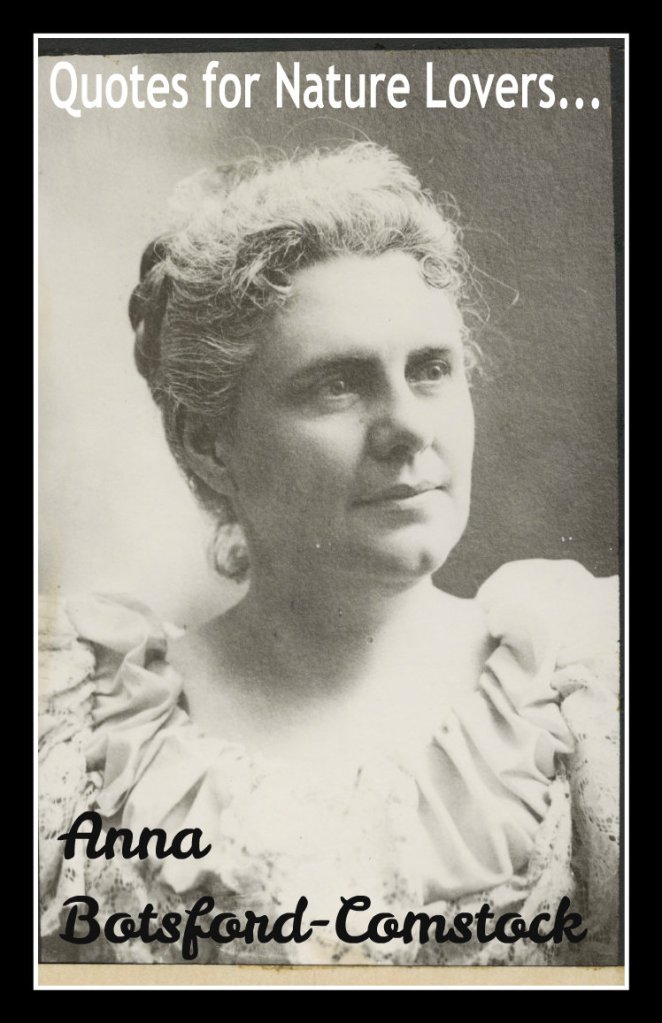
Anna Botsford Comstock provides us with another strong example of a Past Environmental Hero who used her exquisite writing skills to spawn sincere interest in and caring for the natural world. Comstock was a conservationist before most people knew what the word meant.  In her 1912 book, The Handbook of Nature Study, she was way ahead of her time in stressing the importance of the interactive relationships—both biological and abiotic—that work together to form what we now call ecosystems.

Born in 1854, Comstock grew up on a farm in Otto, New York where she traipsed around outdoors with her Quaker mother who taught her about all the elements of the natural world—including insects, birds, wildflowers, and trees.  In 1874, she enrolled at Cornell University where she met and fell in love with her husband-to-be, John Henry Comstock, an entomology professor.  She then withdrew from school and spent several unheralded years drawing exquisite insect illustrations for her husband’s books.

In the mid-1890s, Comstock finally had the chance to break out and shine like the star she was destined to be.  The New York Society for the Promotion of Agriculture asked her to help introduce a nature study program—the first of its kind in the United States— into local schools in Westchester County, New York. At first, many parents and teachers resisted the idea of teaching about the outdoors as being both frivolous, unproductive, and a waste of time.  Despite these objections, Comstock’s outdoor education initiative soon grew into a nationwide teacher-education program administered by Cornell University and her career was off and running.

Comstock stayed busy promoting her nature study program by producing study guides and instructional booklets for teachers to use across the country.  By encouraging instructors to take their students outside to learn, and then helping them see the relationship between people and the natural world, she left her mark on countless generations.[i] Now that’s what we call fantastic stick-to-it-tive-ness—going from an unappreciated drop-out to the founder of a national education initiative—all at the same university!

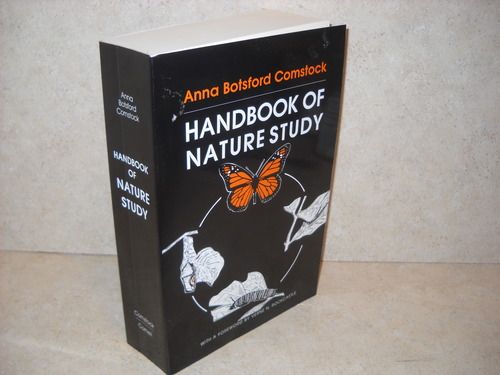
During the early 1900’s, Comstock and husband John opened the Comstock Publishing Company with its motto: Nature through Books”.  It was here that she wrote and illustrated a series of her own books, including Ways of the Six-Footed(1903), How to Keep Bees (1905)[ii]The Pet Book (1914)[iii], and Trees at Leisure (1916). But her tour de forceremained her nearly 900-page tome, The Handbook of Nature Study, which is now a famous sourcebook for teachers that has gone through twenty-four editions and has been translated into eight languages. 

Throughout her landmark work, Comstock continually emphasizes the rewards of direct observation of the natural world. Here’s how she described her approach to nature study as used in the book: “I want to cultivate the child’s imagination, love of the beautiful, and sense of companionship with life out-of-doors.” Expressing such a radical shift from today’s reliance on electronic tethers, it’s no wonder that the Handbook of Nature Study  still remains so popular with grade schools teachers—even today!

Comstock retired from full-time teaching in 1922, but continued to lecture and—in a 1923 poll by the League of Women Voters—was named one of “America’s 12 Greatest Living Women”.  Comstock died of cancer in Ithaca, New York on August 24, 1930.  

Outside of the classrooms, Comstock’s work as a conservationist remained largely unknown and unappreciated until the US Environmental Movement started to gather steam in the 1960s and 1970s. Then—fittingly in 1988—she was named to the National Wildlife Federation’s esteemed Conservation Hall of Fame where she is now forever lauded as the “Mother of Nature Education.”

While she was not an audacious conservation leader on the order of such contemporaries as Theodore Roosevelt or John Muir, Anna Botsford Comstock—in her own quiet and inimitable way—bolstered the national environmental consciousness by reaching out to America’s youth.  Since Climate Change holds the greatest peril for future generations of Americans, it is incumbent on us all to involve our children and grandchildren in finding solutions.  A guidebook written along the same lines as Comstock’s Handbook of Nature Study would certainly go a long way toward accomplishing this.

Text excerpted from book: PROTECTING THE PLANET: Environmental Champions from Conservation to Climate Change” written by Budd Titlow and Mariah Tinger and published by Prometheus Books.

Photo credits: Shutterstock(2)

Author’s bio:  For the past 50 years, professional ecologist and conservationist Budd Titlow has used his pen and camera to capture the awe and wonders of our natural world. His goal has always been to inspire others to both appreciate and enjoy what he sees. Now he has one main question: Can we save humankind’s place — within nature’s beauty — before it’s too late? Budd’s two latest books are dedicated to answering this perplexing dilemma. “PROTECTING THE PLANET: Environmental Champions from Conservation to Climate Change”, a non-fiction book, examines whether we still have the environmental heroes among us — harking back to such past heroes as Audubon, Hemenway, Muir, Douglas, Leopold, Brower, Carson, and Meadows — needed to accomplish this goal. Next, using fact-filled and entertaining story-telling, his latest book — “COMING FULL CIRCLE: A Sweeping Saga of Conservation Stewardship Across America”— provides the answers we all seek and need. Having published five books, more than 500 photo-essays, and 5,000 photographs, Budd Titlow lives with his music educator wife, Debby, in San Diego, California.

.

.


Theodore Teddy Roosevelt—The Conservation President

by

Budd Titlow

http://www.buddtitlow.com

The federal government became the agency of choice to manage our natural resources during the turn of the 20th Century because the bulk of the citizenry believed that private corporations and organizations were too corrupt, self-serving, and greedy to be trusted. When Theodore Teddy Roosevelt assumed the Presidency by accident after the assassination of William McKinley in 1901, resource conservationists finally had the friend they needed in The White House.

Usually depicted immaculately dressed in a three-piece suit with his intensely honest stare framed by a bushy moustache and chained glasses, Roosevelt epitomized a true man’s man.  While his unfailingly politeness and courtesy earned him consistent favor with women, his reputation as a “rough-riding” adventurer and big-game marksman always garnered heroic accolades from men.

Teddy Roosevelt, protector of wildlife and natural resources, became known as the “conservation president” soon after taking office. 

In ironic twists for such a lifelong outdoorsman, Roosevelt was born in 1858 in the middle of America’s most populous city—a Manhattan brownstone—and home-schooled as a sickly child.  But he didn’t let these inconveniences sway him away from what he loved to do. At the age of seven, he formed a local nature club with some of his cousins and they quickly started riding herd on every critter they could find creeping and crawling in their urban “stomping grounds”. Within a few years, the boys had collected, analyzed, and mounted enough specimens for display to start what they called the “Roosevelt Museum of Natural History”.

In another ironic twist of fate, Roosevelt’s love of the rugged outdoors was significantly enhanced because of a dual tragedy in his life.  On the same day—February 14, 1884— both his mother and his wife tragically died.  To deal with the unbearable grief he was feeling over this twin loss, Roosevelt packed up, left New York City, and moved to the Dakota Territory for two years. While there, he left his infant daughter in the care of his elder sister while he worked as a cowboy and cattle rancher in the peaceful solitude of the American West’s wide-open spaces.

Soon after he took office, Roosevelt quickly began earning his reputation as “The Conservation President”He dedicated himself to protecting both wildlife and natural resources as an avid adventurer and lover of nature.  He realized that dramatic action would be required to prevent the rich natural resources and incomparable landscapes of our country from disappearing as quickly as the American bison—leaving future generations without a legacy of natural splendors. 

As President, Roosevelt was faced with a quandary that was a carry-over from the banner years of the “Industrial Age”.  He knew that the deep pocket entrepreneurs —who controlled the bulk of the nation’s wealth—were so busy trying to make more money that they didn’t have time to worry about protecting the nation’s fast-disappearing natural resources.   He also knew that these same power players did not have any desire to give up the man’s dominion over naturephilosophy that had governed their lifestyles for decades.  But he also sincerely believed that the long-term happiness of most Americans was directly associated with how intelligently and properly natural resources were managed.  

On the surface, these conflicting ideologies presented a beguiling crisis.  But good old “Uncle Teddy” had a plan.  He believed that—with enough foresight—natural resources could be used, economically and recreationally, while simultaneously being conserved for the long-term.  In other words, Roosevelt was onto something that would become the world’s first plan for sustainable resource management and he set about proving that his plan could work. 

Management of the nation’s vast tracts of national forests perfectly epitomized Roosevelt’s beliefs on sustainable management.  In his opinion, the national forests had to serve multiple purposes.  While they had to provide a wide array of recreational opportunities—including everything from hunting and fishing to hiking, mountaineering, and birdwatching—the national forests also needed to pay their own way.  This meant portions of the forests had to be selectively logged and sold for building construction and pulp.  The trick was to accomplish this sustainably in a manner that provided some income while not detracting from the broad visitor enjoyment of these magnificent resources.  Then the areas where timber harvests occurred had to be immediately replanted with trees for use by future generations.  

As president, Roosevelt provided federal protection for 150 national forests, the first 51 federal bird reservations, five national parks, the first 18 national monuments, the first four national game preserves, and the first 24 reclamation—or federal irrigation—projects.  Many of these federal designations were bitterly opposed by commercial interests.  For example, the Nation’s first National Wildlife Refuge on Florida’s Pelican Island in 1903 raised the hackles of the millinery trade—as we’ve previously discussed—since it was specifically established to thwart the acquisition of wild bird feathers. 

All told during his presidency, Theodore Roosevelt protected more than 230,000,000 acres of public land—an area equivalent to the entire Eastern Seaboard from Maine to Florida. Outside of his political career, Roosevelt also published more than 25 books about a range of subjects—including history, biology, geography, and philosophy as well as an autobiography comprised of four volumes.

Roosevelt’s pragmatic side also shone through in his creation of the Bureau of Reclamation in 1902 to manage water resources in the 17 western states. Reclamation’s goals were to provide a mix of economic benefits—hydropower, irrigation, and flood control—while also maintaining a litany of recreational activities.  The boating, fishing, and water skiing provided by federal water projects were received as a huge benefit by western residents—many of whom were just settling into new villages, towns, and cities.

Theodore Roosevelt died in his sleep at age 60 on January 6, 1919, at his Long Island estate, Sagamore Hill, after suffering a coronary embolism. On January 16, 2001, President Bill Clinton posthumously conferred Roosevelt with the Congressional Medal of Honor—the highest award for military service in the United States —for the Battle of San Juan Heights that occurred more than 100 years earlier. 

“Conservation means development as much as it does protection. I recognize the right and duty of this generation to develop and use the natural resources of our land but I do not recognize the right to waste them, or to rob, by wasteful use, the generations that come after us.” 

 – Theodore Roosevelt

President Teddy Roosevelt had an idea about how to get the nation’s wealthy elite and middle and lower classes working together for a common cause.  Then he applied his unwavering dedication—some might even call it his “Bull Moose” stubbornness—to make his plan work.  Thanks to Roosevelt’s gritty combination of foresight and fortitude, our nation put into place the world’s first plan for sustainable resource management and long-term conservation. Roosevelt’s accomplishments more than a century ago are even more apropos today, as we work toward bringing a divided nation together and deciding how to live sustainably with the goal of combating Climate Change.

Text excerpted from book:     “PROTECTING THE PLANET: Environmental Champions from Conservation to Climate Change” written by Budd Titlow and Mariah Tinger and published by Prometheus Books.

Photo caption and credit: Teddy Roosevelt, protector of wildlife and natural resources, became known as the “conservation president” soon after taking office. Copyright Everett Historical/Shutterstock.

Author’s bio:  For the past 50 years, professional ecologist and conservationist Budd Titlow has used his pen and camera to capture the awe and wonders of our natural world. His goal has always been to inspire others to both appreciate and enjoy what he sees. Now he has one main question: Can we save humankind’s place — within nature’s beauty — before it’s too late? Budd’s two latest books are dedicated to answering this perplexing dilemma. “PROTECTING THE PLANET: Environmental Champions from Conservation to Climate Change”, a non-fiction book, examines whether we still have the environmental heroes among us — harking back to such past heroes as Audubon, Hemenway, Muir, Douglas, Leopold, Brower, Carson, and Meadows — needed to accomplish this goal. Next, using fact-filled and entertaining story-telling, his latest book — “COMING FULL CIRCLE: A Sweeping Saga of Conservation Stewardship Across America” — provides the answers we all seek and need. Having published five books, more than 500 photo-essays, and 5,000 photographs, Budd Titlow lives with his music educator wife, Debby, in San Diego, California.