ANOTHER CLIMATE CHANGE CONUNDRUM

CAN VENICE, ITALY—THE CROWN JEWEL OF THE ADRIATIC—BE SAVED?

By Budd Titlow

http://www.buddtitlow.com

I’ve had the good fortune to visit Venice, Italy several times.  Not only is Venice one of the world’s most entrancingly beautiful cities, but it also is unrivaled for its setting and urban design.  Strolling along the narrow, winding city streets is like suddenly being transported to the middle of a Giorgione landscape painting. The unparalleled sights—the gondoliers poling their ornate craft along the shimmering canals, the rippling reflections of multi-hued flags and flower baskets, the armadas of boats of every size and color—are at once both iconic and unforgettable.  

Sadly, even though Venice has been around for a very long time—founded in 421 C.E. —it would never be built in today’s world.  That’s because there is no contiguous landmass under the city.  Yes that’s right, Venice is essentially a collage of grand and sacred structures that are floating on top of an archipelago of 117 islands scattered throughout a shallow lagoon of the Adriatic Sea.

As you can imagine, sea level rise has always been a particular concern for this flood-prone city. Now on top of the rising sea level problem, comes the realization that Venice is still sinking—a problem that was thought to have been resolved in the 1970’s by ceasing groundwater withdrawals for factory use.
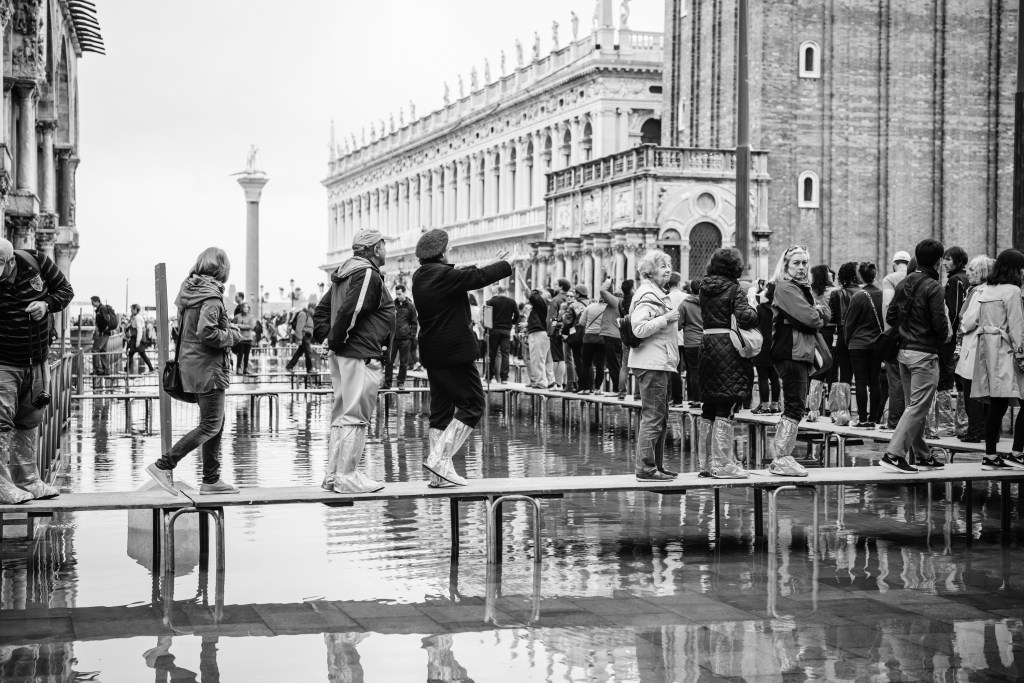
Tourists avoiding sea-level rise in San Marco Square, Venice, Italy.

Enter the city’s expensive and oft-delayed system of underwater so-called MOSE barriers —named as a nod to Moses and his parting of the Red Sea.  Blasting the city’s engineering budget at a total cost of more than $6.7 billion, MOSE consists of a series of steel gates installed at the three inlets separating the Adriatic Sea from the lagoon surrounding Venice.  

Many Venetians remain skeptical of the MOSE project due to the high costs and concerns over environmental risks.  When the flood barriers are raised, they trap the considerable pollution and untreated sewage—Venice has no modern sewage treatment system—within the confines of the city’s lagoon and famous canals.  While the gates are up, the contamination is not able to dissipate and dilute itself as it normally does when it drains out into the Adriatic.

NASA climatologist Vivien Gormitz, a contributor to the IPCC’s Fourth Assessment Report, thinks estimates of high water events are conservative scenarios and the reality could be much worse. “Sea levels are already rising faster than forecast in the IPCC’s estimates”, said Gornitz.  If sea levels rise more than 1.7 feet by 2100, MOSE—which can only cope with 2.0 feet of increase—may be insufficient to save the city. Because of this, Venice needs to quickly look into alternatives. For example, pumping seawater into a 2,297-foot deep aquifer below the lagoon could buoy the city by as much as one foot over a decade.

Whether or not any of these rather dramatic engineering concepts work out, I have my concerns that they may not be able to save this Italian jewel of the sea for the long term.  Something tells me that if we don’t simply put a halt to the global rising sea levels as soon as possible, this entire colossus of artistic and cultural glories may slip beneath the waters of the Adriatic never to be seen again.  And that would be a shame, indeed, especially for those who have never had the opportunity to experience her visual delights.

Text excerpted from book: PROTECTING THE PLANET: Environmental Champions from Conservation to Climate Change written by Budd Titlow and Mariah Tinger and published by Prometheus Books. 

Photo caption & credit: Tourists avoiding sea-level rise in San Marco Square, Venice, Italy. Copyright Yulia Grigoryeva/Shutterstock.

Author’s bio:  For the past 50 years, professional ecologist and conservationist Budd Titlow has used his pen and camera to capture the awe and wonders of our natural world. His goal has always been to inspire others to both appreciate and enjoy what he sees. Now he has one main question: Can we save humankind’s place — within nature’s beauty — before it’s too late? Budd’s two latest books are dedicated to answering this perplexing dilemma. PROTECTING THE PLANET: Environmental Champions from Conservation to Climate Change, a non-fiction book, examines whether we still have the environmental heroes among us — harking back to such past heroes as Audubon, Hemenway, Muir, Douglas, Leopold, Brower, Carson, and Meadows — needed to accomplish this goal. Next, using fact-filled and entertaining story-telling, his latest book — COMING FULL CIRCLE: A Sweeping Saga of Conservation Stewardship Across America — provides the answers we all seek and need. Having published five books, more than 500 photo-essays, and 5,000 photographs, Budd Titlow lives with his music educator wife, Debby, in San Diego, California.

CLIMATE CHANGE POSES PERILS FOR OUTDOOR PHOTOGRAPHERS

By Budd Titlow

http://www.buddtitlow.com

Sun setting behind a giant salsify seed head.

As documenters of the world’s outdoor quality of life, all nature photographers need to be especially concerned about the rapidly advancing perils of climate change. In the overall history of human life here on Earth, we have never faced more broad-based and imminent environmental threats than those posed by climate change and global warming. On a geologic time scale, we are accelerating toward our own oblivion at laser-focused warp speed. Right now—every day—the world is adding another spike of atmospheric pollution to the shroud that may eventually doom our own species to extinction.

Climate change is not something that might become a problem in the future—maybe by 2030 or 2050 or 2100. It is a problem right now, getting worse every day that we sit by and pretend that it is not really happening.

But here is the good news. Climate change does not have to remain a problem. In fact, if we focus and work together, climate change can be well on its way toward full resolution within as little as fifteen years—maybe even sooner.

If we play our cards right, we can use the perpetual, inextinguishable energy of Earth—the sun’s glorious rays, the wind’s constant breezes, and the water’s endless waves—to work for us all. And, in the process, we’ll leave the polluting fossil fuels right where they belong—buried in the ground, never to see the light of day.

Think about it: Renewable energy here on Earth is abundant and omnipresent. Each time you go outside, you see and feel it everywhere. It’s like an endless symphony written by a master composer and played by a world-class orchestra. The golden rays of streaming sunlight are the strings—always there, maintaining the basic rhythm of the interwoven movements. The wind provides the percussion—rising from gentle whispering breezes of the snare drum to bold resounding gusts of the tympani. Then moving water blends in with the woodwinds and the brass—transitioning from gently lapping melodic notes of the flute to lazy ripples of an oboe’s dulcet tones and concluding with rolling waves of trumpet blasts.

We are right on the cusp of what we can call the “Renewable Revolution,” providing a mighty parallel to the Industrial Revolution. The Industrial Revolution resulted in the transformation of our nation from a rural agrarian society to an urban, manufacturing society. Now we are about to totally transform ourselves again, from a hard-edged, fossil-fuel driven economy to a softer-sided renewable energy world community.

The transformation from fossil fuels to renewable energy is already possible. The Solutions Project (www.thesolutionsproject.org) lays out plans for converting each of our states—plus many countries—from fossil fuels to renewable resources. And we can accomplish this at the same time as we create numerous new industries in the wind, water, and solar power sector.

Along with this industrial boom will come millions of new jobs, leading to increased financial security for everyone. Now that’s a win-win scenario we can all live with. Our children, grandchildren, and all future generations will look back and be forever grateful to us for being proactive and resolving the climate-change dilemma.

Text is excerpted from a book by Budd Titlow and Mariah Tinger entitled PROTECTING THE PLANET: Environmental Champions from Conservation to Climate Change— ISBN 978-1633882256—published by Prometheus Books.

Photo caption & credit:  Sun setting behind a giant salsify seed head. Copyright Budd Titlow, NATUREGRAPHS. 

Author’s bio: For the past 50 years, professional ecologist and conservationist Budd Titlow has used his pen and camera to capture the awe and wonders of our natural world. His goal has always been to inspire others to both appreciate and enjoy what he sees. Now he has one main question: Can we save humankind’s place — within nature’s beauty — before it’s too late? Budd’s two latest books are dedicated to answering this perplexing dilemma. PROTECTING THE PLANET: Environmental Champions from Conservation to Climate Change, a non-fiction book, examines whether we still have the environmental heroes among us — harking back to such past heroes as Audubon, Hemenway, Muir, Douglas, Leopold, Brower, Carson, and Meadows — needed to accomplish this goal. Next, using fact-filled and entertaining story-telling, his latest book — COMING FULL CIRCLE: A Sweeping Saga of Conservation Stewardship Across America — provides the answers we all seek and need.Having published five books, more than 500 photo-essays, and 5,000 photographs, Budd Titlow lives with his music educator wife, Debby, in San Diego, California.

OUR LOOMING FOOD CRISIS

by Budd Titlow

http://www.buddtitlow.com

The climate crisis is threatening to take food off your family’s dinner table. Unprecedented global warming is causing a catastrophic combination of crop-sapping droughts and farm-swallowing floods.

For the past 10 years, I’ve been working as a food safety consultant in the agricultural industry. In 2015, I teamed with my daughter to publish a 600-page book on the climate crisis. Despite my dual experience in these two arenas, I failed to recognize the strong connectivity between agriculture and the climate crisis. That is—until recently!

The climate crisis is enmeshed in all aspects of our lives on this planet. It’s analogous to heralded California naturalist John Muir’s quote about the web of life: “When we try to pick out anything by itself, we find it hitched to everything else in the Universe.” And so it is with the climate crisis. When we pull on one strand of the climate web, all the other strands resonate in response. The climate crisis is now affecting everything we do, think, and feel. And this is especially true for world-wide agriculture and food production.

As Lisa Archer and Kari Hamerschlag emphasize in their February 8, 2019 GreenBiz webcast: “The food sector is the single biggest generator of climate-harming greenhouse gases. In fact, agriculture accounts for nearly one-third of our global emissions. This means that—with scientists worldwide confirming we have just 12 years to avoid irreversible climate chaos—transforming food and agriculture is central to addressing our climate crisis.”

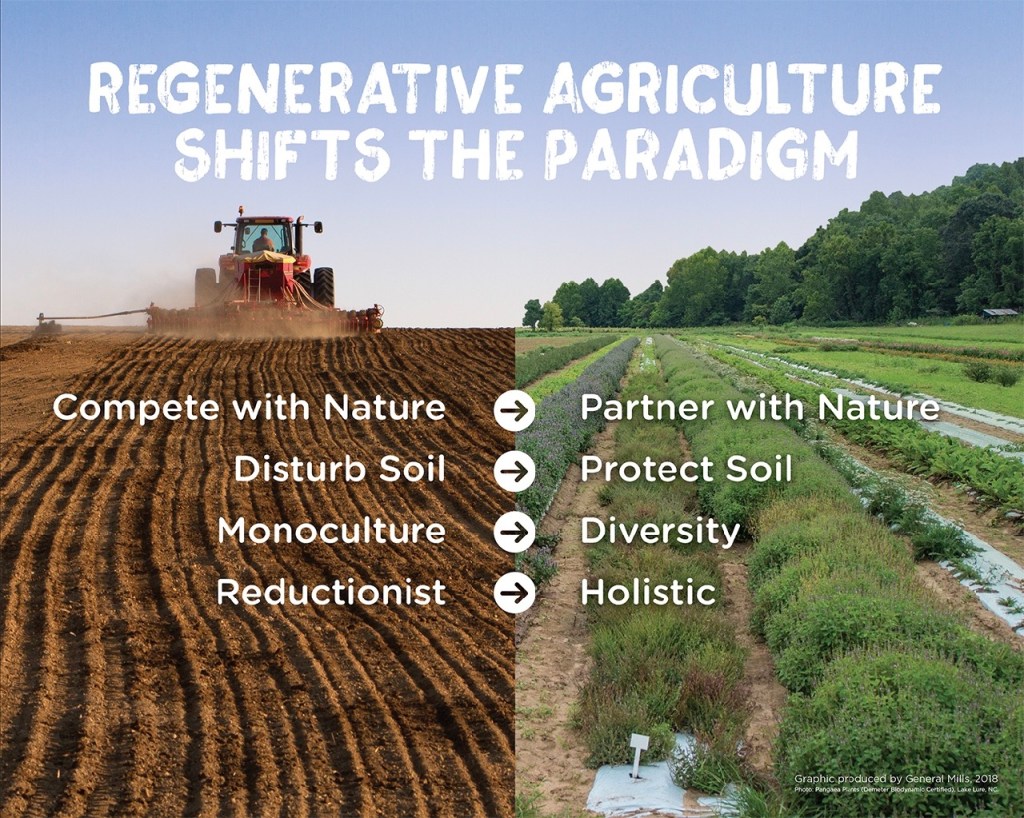
So we know for certain that the climate crisis is currently threatening the essential food supplies of our families. But what can we do about it? An array of farming practices—known collectively as Regenerative Agriculture (RA)—is the answer. Actually, much of RA is not really new. In fact, some of the practices harken back to the way things used to be done down on the good ol’ family farm.

In a nutshell, RA involves farming smaller and smarter. Instead of routinely tilling the soil in all fields before each crop season, eliminate tilling completely. Tilling is a major factor in releasing carbon dioxide (CO2) from agricultural fields to the atmosphere. Instead, emphasize using crop rotation and cover crops. 

Also increase the use of organic fertilizers—such as manure and compost—in lieu of synthetic chemical fertilizers. These “old school” practices simultaneously preserve topsoil fertility, biological diversity, and carbon sequestration while minimizing the potential for soil erosion caused by both wind and water.

Regenerative Agriculture emphasizes a speedy transition from our current mega-scale, chemical-dependent food producing methods to healthier, organic, and ecologically-minded farming practices. Archer and Hamerschlag state that making the RA transition will mandate resilient, fair, local, and regional food systems while ensuring good jobs and healthy food for all.

So how do we make the transition to RA a reality? As Archer and Hamerschlag summarize it: Our government must stop giving billions of dollars in subsidies, loans, and research to support large-

scale industrial agriculture (in other words, “Big Ag”). Instead we need to expand our support for resilient—local and regional—farmers and ranchers.

To be successful, RA must also emphasize growing crops that are both organically and ecologically sound. Accomplishing this requires healthy, low-carbon, plant-based crop production. Future federal subsidies must then be focused on farms that feature conservation practices that lead to carbon sequestration and better soil health/biological structure. 

If wisely and broadly applied, Regenerative Agriculture will help ensure your dinner table remains set with the healthy food your family needs and deserves. Plus, the resultant wide-spread increase in carbon sequestration will help us harness the climate crisis. Now that’s a win-win situation we can all live with!

Author’s bio:For the past 50 years, professional ecologist and conservationist Budd Titlow has used his pen and camera to capture the awe and wonders of our natural world. His goal has always been to inspire others to both appreciate and enjoy what he sees. Now he has one main question: Can we save humankind’s place — within nature’s beauty — before it’s too late? Budd’s two latest books are dedicated to answering this perplexing dilemma. PROTECTING THE PLANET: Environmental Champions from Conservation to Climate Change, a non-fiction book, examines whether we still have the environmental heroes among us — harking back to such past heroes as Audubon, Hemenway, Muir, Douglas, Leopold, Brower, Carson, and Meadows — needed to accomplish this goal. Next, using fact-filled and entertaining story-telling, his latest book — COMING FULL CIRCLE: A Sweeping Saga of Conservation Stewardship Across America — provides the answers we all seek and need.Having published five books, more than 500 photo-essays, and 5,000 photographs, Budd Titlow lives with his music educator wife, Debby, in San Diego, California.

MOBILIZING TO COMBAT THE CLIMATE CRISIS

It’s Old Hat for the US!

By

Budd Titlow

http://www.buddtitlow.com

Paraphrasing President John F. Kennedy: We choose to conquer the climate crisis not because it’s easy—but because it’s hard. Because the challenge is one we are unable to postpone and one we intend to win for the preservation of all future generations of human life on this planet.

The United States is perfectly primed to lead the world’s mobilization toward resolution of our climate crisis. Throughout our history, we’ve successfully mobilized to overcome many existential threats—not just once, but many times. In fact, there are already several US precedents in place for using legislative action to stand up to huge corporations, getting them to completely change how they do business.

After Pearl Harbor—in a matter of weeks—we mobilized our assembly lines and factories to produce bombers and tanks instead of cars and trucks. In the process, we helped save the world from the scourge of Nazi domination. 

Next—holding true to President Kennedy’s words—we figured out how to send men to the moon in less than a decade.

Then—starting in the late sixties—we had the battles with the US automobile industry over toxic exhaust pollution (“brown clouds”). In the end, we forced the US auto industry to retool their assembly lines to produce vehicles that ran on unleaded gasoline and used catalytic converters.

On April 22, 1970, the first Earth Day was held, a sign of the serious interest in environmental protection was beginning to take hold. The brainchild of Wisconsin senator Gaylord Nelson, Earth Day spotlighted such problems as thermal pollution of the atmosphere, dying lakes, the profusion of solid waste, ruinous strip mining, catastrophic oil spills, and dwindling natural resources. As a pivotal event in the environmental movement, the first Earth Day emphasized that the obsession with industrial growth and consumerism was straining the environment to the breaking point and introduced the idea of living lightly on the Earth.[i]

After the first Earth Day was over, Nelson mulled over what had just occurred—the greatest demonstration of public support for a cause in US history: “No one could organize 20 million people, 10,000 grade schools and high schools, 2,500 colleges and 1,000 communities in three and a half months even if he had $20 million. [Nelson had just $190,000.] The key to the whole thing was the grass roots response.”[ii]

All concerned climate change activists would do well to study the unequivocal success of the first Earth Day. The unexpected magnitude of the response to this landmark event clearly shows what can be done when the political and social moods of the country collide, coming together with a message that says, “Let’s get something done.” Furthermore, the resulting outpouring of federal environmental legislation proves that Congress was listening to what the people were asking for. Such a groundswell of public opinion—all speaking with the same voice—will certainly go a long way toward passing similar laws and regulations to initiate real climate change solutions both in the United States and around the world.

In 1976 came the fight with the chemical powerhouse DuPont over the hole in the ozone layer. The final verdict here was that Freon—the product primarily responsible for producing ozone-destroying CFCs—was banned for good. Finally, we had the conflict with power plants and manufacturing facilities over the generation of acid rain, which started in the late 1980s. The US EPA took care of this problem with the Acid Rain Program (ARP) that eventually set caps on emissions of both of the responsible pollutants—NOx and SO2.

So, what is the best answer to our climate crisis conundrum? In addition to pressuring fossil-fuel industries to stop burning fossil fuels, there are many other reasons why a carbon fee is the most important component of any plan for solving climate change. First and foremost: it will generate money —mean lots of money, especially in the short-term. According to the Center for Climate and Energy Solutions, a carbon fee has the potential to raise significant revenues for the government. Depending on the carbon fee imposed, the money raised could be tens or even hundreds of billions of dollars each year. The Center for Climate and Energy Solutions states that, for example, “A carbon fee starting at about $16 per ton of CO2 in 2014 and rising four percent over inflation would raise more than $1.1 trillion in the first ten years, and more than $2.7 trillion over a 20-year period.”

So let’s all get started in earnest. Let’s prove that we can successfully once again mobilize to protect the long-term quality of life of our children, grandchildren, and all future generations of humans on Planet Earth!

Our hands are needed to ensure the future of Earth’s inhabitants.

Text excerpted from the book, PROTECTING THE PLANET: Environmental Champions from Conservation to Climate Change, written by Budd Titlow and Mariah Tinger and published by Prometheus Books. Photo caption & credit: Our hands are needed to ensure the future of Earth’s inhabitants. Copyright CHOATphotographer/Shutterstock. 

Author’s bio:For the past 50 years, professional ecologist and conservationist Budd Titlow has used his pen and camera to capture the awe and wonders of our natural world. His goal has always been to inspire others to both appreciate and enjoy what he sees. Now he has one main question: Can we save humankind’s place — within nature’s beauty — before it’s too late? Budd’s two latest books are dedicated to answering this perplexing dilemma. “PROTECTING THE PLANET: Environmental Champions from Conservation to Climate Change”, a non-fiction book, examines whether we still have the environmental heroes among us — harking back to such past heroes as Audubon, Hemenway, Muir, Douglas, Leopold, Brower, Carson, and Meadows — needed to accomplish this goal. Next, using fact-filled and entertaining story-telling, his latest book — “COMING FULL CIRCLE: A Sweeping Saga of Conservation Stewardship Across America”— provides the answers we all seek and need.Having published five books, more than 500 photo-essays, and 5,000 photographs, Budd Titlow lives with his music educator wife, Debby, in San Diego, California.





GETTING PUBLISHED!

by Budd Titlow

http://www.buddtitlow.com

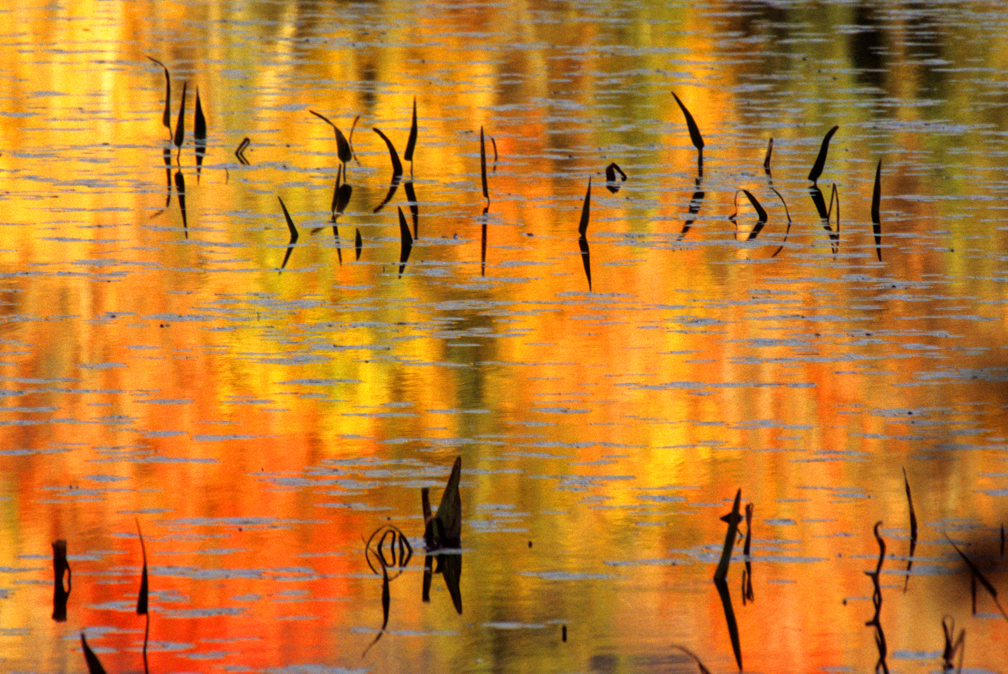
Close-up of autumn reflections on a pond in New Hampshire’s White Mountains.

So … you’ve been an avid outdoor/nature photographer for several years.  Your shots always win compliments from family and friends and ribbons at local camera club competitions.  Now you want to move up to the next level and start selling your work.  How do you do this?

Getting Started

Be realistic.  Don’t even think about quitting your day job—at least for a while.  The romantic allure of traveling the globe—camera in hand—is very enticing.  But unless you’re living off a trust fund, just hit the lottery, or have one‑in‑a‑million shots of mutant pygmy crocodiles in Borneo, it’s not going to happen.  You simply aren’t going to suddenly start making a living from nature photography.

Consider the facts:  The competition in the world of nature photography is incredibly fierce.  How can you compete with the likes of George Lepp, Art Wolfe, Frans Lanting, and other pros who can travel the world with $100,000 worth of camera gear and paid entourages? The answer: You’re not going to—at least not immediately!

So what do you do?  While the following suggestions may not make you rich, they will help you gear up for the world of photo marketing. If all goes well each year, you’ll be able to pay for equipment upgrades, travel to some exotic locations, earn a little extra sending money, and move your career along to future self-sufficiency.

Work your way up.  In many ways, the publishing world is a Catch22.  Editors like to see previous publication credits as verification of the quality of your work.  But if you haven’t been published, how do you break in?

Start small.  Chances are your first sales won’t be to National Geographic, National Wildlife, Audubon, or Outdoor Photographer.  But think about all the publications right there in your hometown or local area.  Town/city newspapers, conservation/corporate newsletters, city/regional/state magazines—most of these publications depend on freelance submissions.  They are always interested in well‑crafted photo-essays targeted for their audiences.  After you’ve got a few of these under your belt, then move up to the larger regional and national markets. 

Originality works.  Photo editors typically review thousands of digital files each month.  How do you make your work stand out from the rest?  First you have to build what I call a “foot‑in‑the‑door portfolio” of eye‑catching shots.  Then lead every submission with some of your showcase images.  In addition to getting an editor’s attention, they might wind up in places like Outdoor Photographer’s “Showcase”, Outside Magazine’s “Exposure”, or—who knows—even on a National Wildlife Magazine cover!

Remember, the one thing Lepp, Wolfe, and Lanting don’t have is your individual creative eye.  And the development of your creative vision doesn’t require trips to exotic locations or telephoto lenses that cost as much as compact cars.  It just requires a willingness to break the mold and try a few things that will set your work apart.  If you’re true to your own heart and personal vision, you will eventually be successful.  How can someone else market what only you can see?

Finding Ideas

Determine your marketing targets.  Whether you’re trying to publish a 1,000-word photo-essay or a 400-page book, you first need to decide who is most likely to be interested in your ideas. This means undertaking a comprehensive review of the magazine or book publishers who specialize in your preferred subject matter. I’ve found this is best accomplished by buying the most recent annual editions of both Photographer’s Market and Writer’s Market. If you’re an aspiring author/photographer, these two publications are literally worth their weight in gold. They provide you with the latest and most up-to-date information on each publisher’s contacts, preferred subject matter, what they are currently seeking, and how to format your submission. Both of these books are published by Writer’s Digest Books in Blue Ash, Ohio and can be ordered on-line directly from Amazon.

Photo-essays sell.  A picture may be worth a thousand words but words certainly help if you’re trying to sell the picture.  Editors love photographers who provide the complete package.  It makes their jobs a whole lot easier.  Learn to write crisply and engagingly.  Draw the reader in with fact‑filled text presented in a rapidly‑flowing, readable style.

Travel for Tips.  Nothing spurs the creative process like travel.  Anytime you go anywhere, think about unusual angles and perspectives that would make a good photo-essay.  Spectacular scenery, colorful characters, rare wildlife, local lore—anything is potential photo-essay material, if it’s presented with the right twist.  If you capture the essence of your trip in well‑crafted photos and words, you’ll definitely have some sales when you return home.  

This approach worked well for me during my early photographic years—living in Colorado.  Every time I returned from a weekend trip, I fired off several ideas to local magazines.  In less than a year, I was a contributing editor to both the Sunday Denver Post and Colorado Homes and Lifestyles Magazines

Making Submissions

To query or not to query.  The professional approach is to pitch your ideas to editors in brief—one page is best—“query letters”.  A query letter outlines your idea, tells why it would be of special interest to the publication’s readers, and describes your credentials for preparing the piece.  But when you’re first starting out, it’s difficult to get editors to bite on query letters.  Since they are “buying into” a piece when they give you the go‑ahead, they like to know what they’re getting.  If you haven’t published anything, it’s difficult to give them this comfort level—the old Catch22 strikes again!

So here’s a twist I recommend to bypass the Catch 22 when you first start out. If you think you have a truly marketable photo-essay, go ahead and bite the bullet. Prepare the complete text and accompanying photos—and then try to sell the whole package (instead of just writing query letters).  In fact, pull together several solid photo‑text packages and start sending them to your list of target publications (as developed from Photographer’s Market and Writer’s Market).  This way editors get to see exactly what they’re buying—with no guesswork on either side.  

Once you’ve sold a few pieces, especially to the same publication, then you have your “foot in the door”. Now you can start working on a query letter basis—pitching ideas first and getting editors to bite before you invest the time in pulling the pieces together.

Follow the publisher’s guidelines for submissions. Before you submit anything to one of the publications you have targeted, ask for their submission guidelines. You must make sure that you follow their specifications to the letter. Such things as digital styles and file sizes for your sample photos are critical to know. Approximate numbers of words and document formats are also critical to follow. Finally you need to know exactly how to submit your packages—e-mail addresses, name of receiving editors (if provided), etc. If your packages don’t follow specified submission protocols, chances are they may never even reach an editor’s desk.    

Don’t take it personally.  When a submission gets rejected—and believe me, many will—just immediately turn around and e-mail it to the next publication/editor on your list.  One thing the world of publishing will do is help you develop a very thick skin.  If you don’t handle rejection well, you might want to think twice about even trying to get published.  

But if you’re braced for rejection, the thrill of that first acceptance—which will inevitably come, if you’re persistent—is well worth all the disappointment that preceded it.  Few things in life can compete with the satisfaction of seeing your own photos and words in print!

These marketing techniques have worked well for author Budd Titlow during his 40-year career as a freelance nature photographer and writer. To date, he has written and published five books and more than 500 magazine/newspaper photo-essays, including an estimated 5,000 photographs. 

For the past 50 years, professional ecologist and conservationist Budd Titlow has used his pen and camera to capture the awe and wonders of our natural world. His goal has always been to inspire others to both appreciate and enjoy what he sees. Now he has one main question: Can we save humankind’s place within nature’s beauty, before it’s too late?

Photo caption & credit: Close-up of autumn reflections on a pond in New Hampshire’s White Mountains. Merit Award Winner in the 2003 Wildlife Photographer of the Year Competition. Copyright Budd Titlow, NATUREGRAPHS. 

Budd’s two latest books are dedicated to solving our perplexing environmental dilemmas of climate change and biodiversity loss. PROTECTING THE PLANET: Environmental Champions from Conservation to Climate Change, a non-fiction book, examines whether we still have the environmental champions among us — harking back to such past heroes as Audubon, Hemenway, Muir, Douglas, Leopold, Brower, Carson, and Meadows — needed to accomplish this goal. Next, using fact-filled and entertaining story-telling, his historical fiction book — COMING FULL CIRCLE: A Sweeping Assessment of Conservation Stewardship Across America — provides the answers we all seek and need.

Eastern Elk – They’re Still here!

By Budd Titlow

http://www.buddtitlow.com

The thrilling bugle of a bull elk crackles through the clear, crisp autumn air.  Ah, life is sure grand here in — southeastern Virginia?  Yes, it’s true — thanks to one of the most unusual stipulations ever placed on a federal government land purchase.

Centuries ago, American elk (Cervus canadensis) – also called wapiti by Native American tribes – were a common sight across most of Virginia.  For proof, just look at any Virginia highway map and you’ll see place names like Elk Creek, Elkhorn Lake, Elk Run, Elkton, Elk Mountain, and Elk Garden dotted all over the landscape.

After the end of the American Revolution, hale and hearty colonists ventured rapidly westward, clearing the elk’s forested habitats to build homes and plant crops while killing thousands of these out-sized (500-to-1,000 pound) ungulates (hoofed mammals) to feed their families and ward off winter famine.  By 1880, as much as 85% of the region’s forestland and all of its wild elk populations were gone, extirpated (wiped out) by the human “pioneering spirit”.

But thanks to the efforts of a dedicated Canadian farmer, this regal icon of eastern deciduous (oak-hickory) forests never actually completely vanished from the Virginia landscape.  In 1877, James Bellwood bought a 2,000-acre farm in Chesterfield County – about 10 miles south of the City of Richmond.  While he loved the temperate winters here, Bellwood soon longed for the wildlife of his native Canada.  To make himself feel more at home, he imported a mated pair of wapiti from Northwest Canada and turned them loose to graze on his homestead and start a new “Americanized” herd.

Soon after the horror of Pearl Harbor pulled the United States into World War II, the U.S. Army realized the critical strategic value of the Bellwood Farm as a supply depot and approached James’ two sons about a sale.  In their sixties at the time and ready to retire from farming, the Bellwood Brothers were quite anxious to sell their land for Uncle Sam’s war effort.  Surprised to learn that their main concern was protecting their father’s elk herd, Army Colonel J. W. G. Stephens told the brothers, Boys, I suggest you take this money, retire, and spend the rest of your summers in Canada and your winters down in sunny Florida, and we’ll look after your elk!”

Signed with this gentlemen’s agreement in place, the Bellwood land sale created the U.S. Government’s first official “Wild Elk Herd”.  The Bellwood Elk immediately attracted a great deal of attention from the local citizenry.  On warm Sunday afternoons, families would pack picnic lunches and hop the Richmond-Petersburg Trolley for the quick trip to the “Bellwood Animal Park”.  In fact, as the subject of feature stories in a variety of national newspapers – including the immensely popular “Saturday Evening Post” – these majestic, cud-chewing creatures soon became national celebrities!

Over the years, the Bellwood Elk grazed and flourished on a diet of lush pasture grasses and vitamin supplements.  Throughout World War II (1941 – 1945), elk roaming freely on the 640-acre Defense Supply Center Richmond (DSCR) campus became a common sight to the 5,000 civilian and military employees and 2,500 German prisoners-of-war working and living there.  With no mortality from hunting or natural predation, the herd expanded rapidly, reaching a peak size of 23 animals in the late 1940’s.

While the overall story of the Bellwood Elk has been quite positive, there have been a few bumps along the road.  For starters, it costs approximately $300/month to feed and provide veterinary care for the herd.  Since – by law – government funds cannot be spent on the elk, DSCR employees and neighbors took it upon themselves to keep Colonel Stephens’ long-held promise to the Bellwood Family.  Several times a year, they pitch in to organize special “Support Our Elk” fund-raising events and recycling campaigns.  

Next, in 2002, the Virginia Department of Game and Inland Fisheries (VGDIF) passed a ban on transporting cervids (deer and elk) into and within the Commonwealth’s boundaries.  While VGDIF did this as a proactive measure to prevent the spread of Chronic Wasting Disease which is always fatal to deer and elk, it severely threatened the Bellwood herd’s long-term genetic diversity and ultimate survival.  Suddenly stripped of their ability to keep the herd’s DNA fresh by “swapping out” adult elk with zoos and other captive breeding facilities, the herd’s managers were facing catastrophic inbreeding.  Fortunately, the DSCR staff started using artificial insemination to eliminate the inbreeding threat and keep the herd healthy.

Today, the Bellwood Elk Herd is managed by the Defense Logistics Agency Installation Support at Richmond. With vegetation consisting of low grasses and a dense stand of oak trees, the massive ungulates now live in a 25-acre fenced preserve. The elk’s managers continually emphasize that their herd consists of still wild animals and — despite living in proximity to humans — they are not handled unless they are being treated by a veterinarian.

Now — if everything continues as planned — the bull elk’s plaintive, bugle-like wail will continue to herald the onset of crisp autumn mornings in southeastern Virginia.

Photo credit: Copyright Shutterstock

Author’s bio:              For the past 50 years, professional ecologist and conservationist Budd Titlow has used his pen and camera to capture the awe and wonders of our natural world. His goal has always been to inspire others to both appreciate and enjoy what he sees. Now he has one main question: Can we save humankind’s place — within nature’s beauty — before it’s too late? Budd’s two latest books are dedicated to answering this perplexing dilemma. PROTECTING THE PLANET: Environmental Champions from Conservation to Climate Change, a non-fiction book, examines whether we still have the environmental heroes among us — harking back to such past heroes as Audubon, Hemenway, Muir, Douglas, Leopold, Brower, Carson, and Meadows — needed to accomplish this goal. Next, using fact-filled and entertaining story-telling, his latest book — COMING FULL CIRCLE: A Sweeping Saga of Conservation Stewardship Across America — provides the answers we all seek and need. Having published five books, more than 500 photo-essays, and 5,000 photographs, Budd Titlow lives with his music educator wife, Debby, in San Diego, California.
Now Is the Time!

by Budd Titlow

http://www.buddtitlow.com

In the overall history of human life here on Earth, we have never faced more broad-based and existential environmental threats than those posed by the climate emergency and biodiversity loss. On a geologic time scale, we are accelerating toward our own oblivion at laser-focused warp speed. Right now—every day—the world is adding more layers of atmospheric pollution and species disintegration to the enveloping shroud that may eventually doom our own species (Homo sapiens) to extinction. 

These twin towers of environmental degradation are not something that might become a problem in the future—maybe by 2030 or 2050 or 2100. They are problems right now—and they’re getting worse every day that we sit by and pretend that nothing important is really happening. 

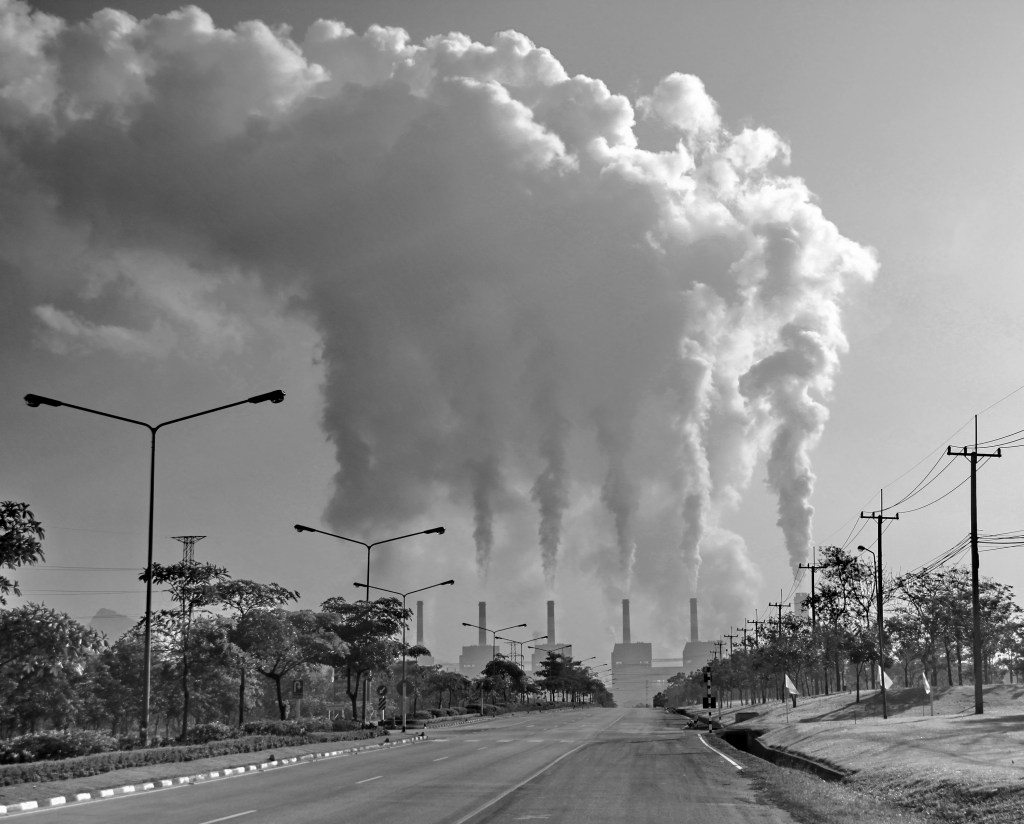
Smoke from a coal plant: industrial pollution filling our skies with greenhouse gases.

However, the climate crisis and biodiversity loss do not have to remain problems. In fact—if we focus and work together—both of these conundrums can be well on their way to full resolution in as little as ten years.

If we play our cards right, we can use the perpetual, inextinguishable energy of Earth—the sun’s glorious rays, the wind’s constant breezes, and the water’s endless waves—to work for us all. And, in the process, we’ll leave the polluting fossil fuels right where they belong—buried in the ground, never to see the light of day.

Think about it: Renewable energy here on Earth is abundant and omnipresent. Each time we go outside, we see and feel it everywhere. It’s like an endless symphony written by a master composer and played by a world-class orchestra. The golden rays of streaming sunlight are the strings—always there, maintaining the basic rhythm of the interwoven movements. The wind provides the percussion—rising from gentle whispering breezes of the snare drum to bold resounding gusts of the tympani. Then moving water blends in with the woodwinds and the brass—transitioning from gently lapping melodic notes of the flute to lazy ripples of an oboe’s dulcet tones and concluding with rolling waves of trumpet blasts.

We are right on the cusp of what will be the Renewables Revolution,—providing a mighty parallel to the Industrial Revolution. The Industrial Revolution resulted in the transformation of our nation from a rural agrarian society to an urban, manufacturing society. Now we are about to transform ourselves again—from a hard-edged, fossil-fuel driven economy to a softer-sided renewable energy world.

The transformation from fossil fuels to renewable energy is already possible. The Solutions Project (www.thesolutionsproject.org) lays out immediate plans for converting each of our states—plus many countries—from fossil fuels to renewable resources. And we can accomplish this at the same time as we create numerous new industries in wind, solar, and water power.

In fact—right now—“Big Oil” has the wherewithal to lead the transformation from fossil fuels to renewable energy. They know it’s coming—they’ve known for more than 30 years. They’re already planning for the transition. They just want to delay things as long as possible because—in the short term—they will take a financial hit. But—in the long run—they will actually make more money from renewables than they are currently making from fossil fuel production and processing. The sooner we can make the fossil fuel giants acknowledge this fact and make the switch, the better off we’ll all be. 

Overall, the mighty impetus created by nationwide conversion to renewable energy will bolster every sector of our economy. As the old adage goes: “A rising tide lifts all boats.” This renewable energy boom will create millions of new jobs—leading to increased financial security for everyone. And that’s a “win-win scenario” we can all live with. Plus, our children, grandchildren, and all future generations will look back and be forever grateful to us for being proactive in tackling and resolving our current climate and biodiversity dilemmas.”

So, now—finally—the decision is in our hands. The issue is about preserving the existing quality and character of Earth’s species and their habitats. Will we decide to make the changes that will save our ice sheets, oceans, coral reefs, rain forests, and polar bears? Or will we just watch while our world slides into oblivion—at least for Homo sapiens?

Text excerpted from book:      PROTECTING THE PLANET: Environmental Champions from Conservation to Climate Change, written by Budd Titlow and Mariah Tinger and published by Prometheus Books. Photo caption & credit: Smoke from a coal plant: industrial pollution filling our skies with greenhouse gases. Copyright—Ungnoi Lookjeab / Shutterstock

Author’s bio:              For the past 50 years, professional ecologist and conservationist Budd Titlow has used his pen and camera to capture the awe and wonders of our natural world. His goal has always been to inspire others to both appreciate and enjoy what he sees. Now he has one main question: Can we save humankind’s place — within nature’s beauty — before it’s too late? Budd’s two latest books are dedicated to answering this perplexing dilemma. PROTECTING THE PLANET: Environmental Champions from Conservation to Climate Change, a non-fiction book, examines whether we still have the environmental heroes among us — harking back to such past heroes as Audubon, Hemenway, Muir, Douglas, Leopold, Brower, Carson, and Meadows — needed to accomplish this goal. Next, using fact-filled and entertaining story-telling, his latest book — COMING FULL CIRCLE: A Sweeping Saga of Conservation Stewardship Across America — provides the answers we all seek and need. Having published five books, more than 500 photo-essays, and 5,000 photographs, Budd Titlow lives with his music educator wife, Debby, in San Diego, California.

PROTECTING THE PLANET

Environmental Champions from Conservation to Climate Change

ISBN: 978-1-63388-225-1

by Budd Titlow

http://www.buddtitlow.com

The Homestead Act—A Precursor of Environmental Disaster

Owing in large part to the Homestead Act of 1862—which provided each family with 160 acres of land to plow and farm as they saw fit—westward expansion spread steadily—like a soaking ink blot—across the American landscape. Access to virgin prairie was so easy that intrepid settlers tended to plow, plant, and harvest until they depleted the fertility of the land through a combination of soil erosion (no control devices) and poor farming practices (no crop rotation). They knew that when the land became unproductive, they could just pack their families up, move further west, claim more land, and start all over again.

In a situation with an eerie similarity to today’s climate-change crisis, the major faux pas of the pioneering farm families was believing that their resources were boundless and—because of this—doing nothing to protect the resources they were using. Seventy years later—in 1932—these same laissez-faire attitudes created the worst environmental disaster the United States had ever experienced—the Great Dust Bowl.

The Great Dust Bowl—Occurrence of Unprecedented Natural Disaster

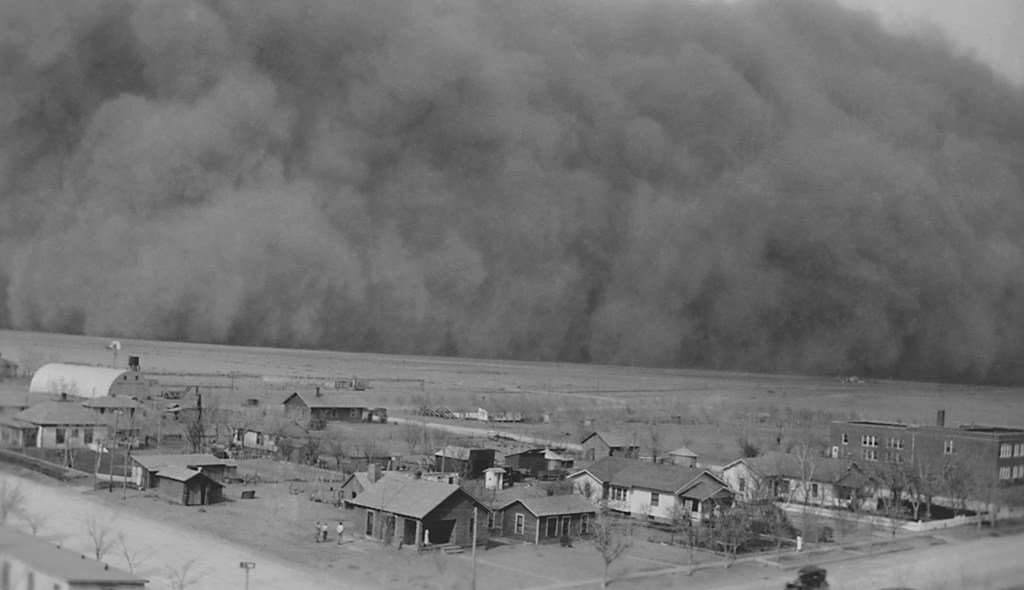
Dust Bowl storm rolling into Rolla, Kansas.

During the 1930s, nowhere was the concept of “nature strikes back” more evident than on the soil-ravaged and agriculturally pillaged plains of the United States and Canada. The Great Dust Bowl occurred because poor farming practices caused huge portions of what had been luscious and golden prairie grasslands to dry up and blow away with the wind.

Eager settlers had moved west to the prairies, lured by advertisements promising a Garden of Eden. They brought with them farming techniques that had worked in the Northeast but that were incompatible with the prairie ecology. In what was called “the Great Plow Up,” settlers dug deeply into the virgin topsoil and pulled up the thickly rooted native grasses that had held the soil in place and trapped moisture through periods of severe drought. Recent rapid advancements in farming equipment in the early twentieth century—notably gasoline-powered tractors and massive combine harvesters—allowed more and more of these arid, native grasslands to be converted to wheat fields.

When drought came and the crops dried up, the unanchored soil turned to dust and blew away—forming huge dark clouds that blackened the sky for miles around. These choking billows of dust—named “black blizzards”—also traveled cross-country, reaching as far as New York, Philadelphia, and Washington, DC.

The Dust Bowl covered 300,000 square miles of territory located in Kansas, Texas, western Oklahoma, eastern Colorado, and New Mexico. In the hardest-hit areas, agriculture virtually ceased. With successive storms, the wind and the flying dust cut off wheat stalks at ground level and tore out the roots. Blowing dirt shifted from one field to another, burying crops not yet carried away by the wind. Cattle tried to eat the dust-laden grass and filled their stomachs with fatal “mud balls.” 

The dust banked against houses and farm buildings like snow, and buried fences up to the post tops. Dirt penetrated into automobile engines and clogged the vital parts. Housewives fought vainly to keep it out of their homes, but it seeped in through cracks and crevices, through wet blankets hung over windows, through oiled cloths and tape, covering everything with grit. Hospitals reported hundreds of patients suffering from “dust pneumonia.” The black blizzards struck so suddenly that many farmers became lost in their own fields and suffocated, some literally within yards of shelter. More than 350,000 people fled the Great Plains during the 1930s. These “Okies” loaded their meager household goods and struck out along famous highway Route 66 for California.

Bankrupt and forced to abandon their homes and farms to foreclosure due to loss of crops, these desperate migrants arrived at their destinations with great hope, only to find situations that were little better than those they had left. In the minds of many, the Dust Bowl still ranks as the worst and most prolonged natural disaster the United States has ever experienced. In his 1939 novel, The Grapes of Wrath, John Steinbeck painted a poignant image of what it was like to experience the Dust Bowl:

“Carloads, caravans, homeless and hungry; twenty thousand and fifty thousand and a hundred thousand and two hundred thousand. They streamed over the mountains, hungry and restless—restless as ants, scurrying to find work to do—to lift, to push, to pull, to pick, to cut—anything, any burden to bear, for food.”

Federal Government to the Rescue—Creation of the Soil Conservation Service

In response to the social and environmental horrors of the Dust Bowl, Congress passed two significant pieces of legislation. First, the Taylor Grazing Act of 1934 defined designated areas where livestock grazing could occur on federal lands—thus minimizing the rampant overgrazing that was occurring. Next—and most importantly in April 1935—the Soil Conservation Act led to the establishment of the Soil Conservation Service (SCS)—now called the Natural Resource Conservation Service (NRCS)—a federal agency tasked with advocating good farming practices that would minimize the potential for future wind and water erosion of farming topsoil.

The SCS’s raison d’etre declared that the federal government bore permanent responsibility for reducing water and wind erosion of the Nation’s soils. The SCS included more than ten thousand permanent and part-time employees, and utilized the labor of some 450 Civilian Conservation Corps (CCC) units. The SCS also operated twenty-three research stations, where it studied the causes, extent, and prevention of soil erosion.

The SCS addressed the problem of soil erosion by creating “demonstration projects” in which the agency cooperated with landowners to implement conservation measures. The SCS assisted farmers in devising and implementing soil conservation plans for their land. In exchange for the landowner’s agreement to cooperate for a five-year period and to contribute his labor, the SCS supplied technical advice, materials, and additional labor. The Service urged farmers and ranchers voluntarily to plant ground cover vegetation to protect vulnerable soils, to rotate crops and allow fields to occasionally lie fallow, to build terraces and use contour plowing to retain soil moisture, and to refrain from planting crops on highly erodible land.

Although more than fifty thousand farmers participated in SCS demonstration projects, attacking the widespread problem of soil erosion one farm at a time was costly and inefficient. In 1936, therefore, the SCS published a model statute that would enable farmers to create a soil conservation district in their vicinity, which could stipulate land use practices within the district. Many state governments passed laws permitting farmers to form soil conservation districts, but many farmers and state legislators were reluctant to grant districts the power to require landowners to comply with district regulations, and soil conservation efforts remained largely voluntary.

Today, more than 3,000 Soil and Water Conservation Districts (SWCD’s) serve throughout the Nation, providing watershed planning, flood prevention, erosion control plan reviews on agricultural land, control of non-point source pollution, wildlife habitat preservation, conservation education, and youth work. These SWCD’s work very closely with the federal Natural Resource Conservation Service (nee SCS), originally founded—as described above—in response to the Dust Bowl disaster of the 1930’s.

Text excerpted from book:          PROTECTING THE PLANET: Environmental Champions from Conservation to Climate Change written by Budd Titlow and Mariah Tinger, published by Prometheus Books. Photo caption & credit:       Dust Bowl storm in Rolla, Kansas. Copyright Everett Historical/Shutterstock.

Author’s bio:     For the past 50 years, professional ecologist and conservationist Budd Titlow has used his pen and camera to capture the awe and wonders of our natural world. His goal has always been to inspire others to both appreciate and enjoy what he sees. Now he has one main question: Can we save humankind’s place — within nature’s beauty — before it’s too late? Budd’s two latest books are dedicated to answering this perplexing dilemma. PROTECTING THE PLANET: Environmental Champions from Conservation to Climate Change, a non-fiction book, examines whether we still have the environmental heroes among us — harking back to such past heroes as Audubon, Hemenway, Muir, Douglas, Leopold, Brower, Carson, and Meadows — needed to accomplish this goal. Next, using fact-filled and entertaining story-telling, his latest book — COMING FULL CIRCLE: A Sweeping Saga of Conservation Stewardship Across America — provides the answers we all seek and need. Having published five books, more than 500 photo-essays, and 5,000 photographs, Budd Titlow lives with his music educator wife, Debby, in San Diego, California.
GLOBAL WARMING?—THE ANSWER IS IN PLAIN SIGHT!

http://www.buddtitlow.com

by

Budd Titlow 

While I was driving from San Diego to Las Vegas recently, I had a revelation. And it didn’t have anything to do with my destination—the so-called “Entertainment Capital of the World”.

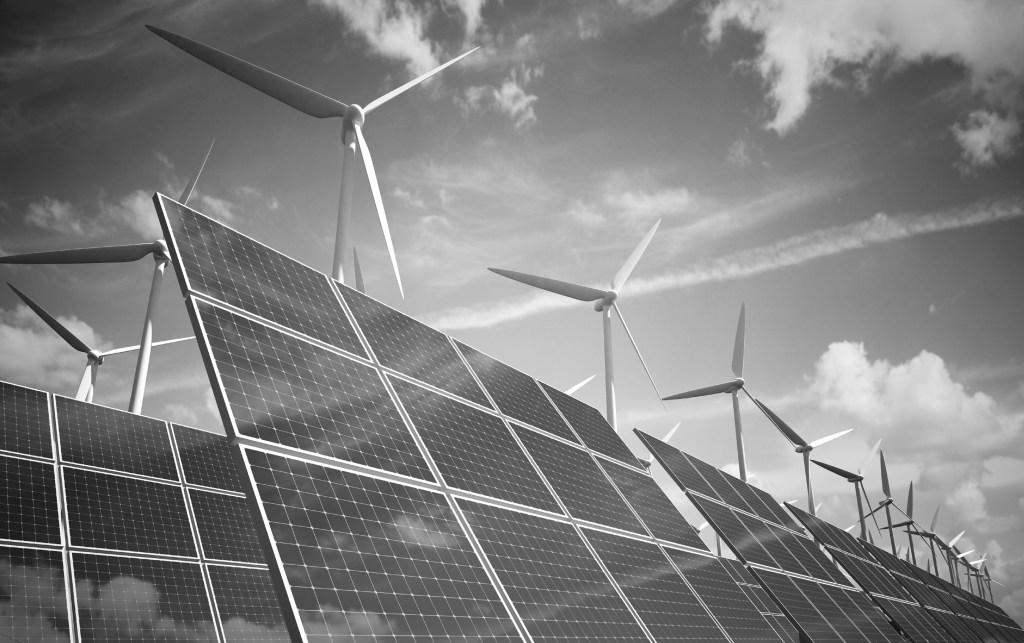
My mental awakening involved a solution to global warming. It was right there—staring me in the face—on both sides of the highway. Thousands upon thousands of acres of open land, alternately festooned with low sand ridges and greasewood flats. It is a virtual Valhalla for renewable energy facilities. Or—at least—it should be.

To my great dismay, I counted only two single wind turbines and one solar array in more than 200 miles of driving through this high desert terrain. I kept asking myself why don’t we have wind turbines bracketing all these ridges and solar arrays blanketing the intervening plateaus. Doing so would certainly give us a jump start on the fossil fuel to renewable energy conversion process that we so desperately need right now.

Now, don’t get me wrong. I’m a career professional wildlife biologist and ardent conservationist. I realize that the majority of this land has ecological value as undeveloped desert habitat. But I’m also a realist. Natural resource protectors must be willing to give up something to save something better. We aren’t going back to the Stone Age—we must create new energy sources to continue powering the world we all live in.

We have to balance the bad with the good. In my mind, construction of large renewable energy facilities is much preferable to continued fossil fuel development. Fossil fuels are a thing of the past—just like the dinosaurs from which they sprang. We need to leave them in the ground—right where they’ve been since these great beasts last roamed the Earth.

Now let’s compare the environmental impacts of fossil fuels versus renewable energy. Construction of new solar arrays and wind farms will certainly have negative impacts. We will undoubtedly lose some valuable wildlife habitats. 

But I ask you to consider where we should now explore for and develop new fossil fuel reserves—the irreplaceable Alaska National Wildlife Refuge, ANWAR for short. The proposed extension of the Prudhoe Bay oil complex will decimate one of the last great ecosystems on Earth—home to hundreds of thousands of migrating caribou and musk oxen. The wildlife and other natural resources in ANWAR are absolutely beyond belief. If you want proof, Google “Florian Schultz Productions”. Florian’s mind-boggling cinematography will knock your socks off while bringing you to tears.    

Assuming we agree that the environmental impacts associated with renewables are preferable to digging up more fossil fuels, let’s look at the finances.  How are we going to pay for hundreds of new wind farms and solar arrays? The easy answer is to let Big Oil foot the bill. They’ve got the money and—don’t kid yourself—they know the day is coming when they will be forced to convert to renewable energy sources. We just have to demand that Congress levy a carbon fee—on both producers and distributors—to kick start their time frames.

Here are some other pluses supporting this idea. The existing wind farms and solar arrays—while way too few and far between—have proven that renewable technology works very well. Next, most of the open land between Victorville and Las Vegas is federally owned, so land acquisition costs would be minimal. Finally, much of the power distribution grid is already in place. I saw hundreds of miles of high voltage transmissions lines, crisscrossing the desert landscape at 10-mile intervals. While some upgrades may be necessary, this transmission grid should require relatively minimal additional investment. No matter how power is generated, the distribution system stays essentially the same.   

In conclusion, here’s my hope for preserving the quality of life for all of our future generations. To quote Spike Lee, let’s “all do the right thing”. In 10 years, I want to drive to Las Vegas again and—this time—I want to see vast solar arrays and wind farms occupying both sides of the highway. We can and must do this!

For the past 50 years, author, professional ecologist, and conservationist Budd Titlow has used his pen and camera to capture the awe and wonders of our natural world. His goal has always been to inspire others to both appreciate and enjoy what he sees. Now he has one main question: Can we save humankind’s place — within nature’s beauty — before it’s too late? His latest book, “COMING FULL CIRCLE—A Sweeping Saga of Conservation Stewardship Across America”, is now for sale on AMAZON.

OP-ED—Now Is the Time!

by Budd Titlow

http://www.buddtitlow.com

In the overall history of human life here on Earth, we have never faced more broad-based and existential environmental threats than those posed by the climate emergency and biodiversity loss. On a geologic time scale, we are accelerating toward our own oblivion at laser-focused warp speed. Right now—every day—the world is adding more layers of atmospheric pollution and species disintegration to the enveloping shroud that may eventually doom our own species (Homo sapiens) to extinction. 

These twin towers of environmental degradation are not something that might become a problem in the future—maybe by 2030 or 2050 or 2100. They are problems right now—and they’re getting worse every day that we sit by and pretend that nothing important is really happening. 

But now—with a new administration that will make decisions based on solid science instead of insouciant lies—there is hope. The climate crisis and biodiversity loss do not have to remain problems. In fact—if we focus and work together—both of these conundrums can be well on their way to full resolution in as little as ten years.

If we play our cards right, we can use the perpetual, inextinguishable energy of Earth—the sun’s glorious rays, the wind’s constant breezes, and the water’s endless waves—to work for us all. And, in the process, we’ll leave the polluting fossil fuels right where they belong—buried in the ground, never to see the light of day.

Think about it: Renewable energy here on Earth is abundant and omnipresent. Each time you go outside, you see and feel it everywhere. It’s like an endless symphony written by a master composer and played by a world-class orchestra. The golden rays of streaming sunlight are the strings—always there, maintaining the basic rhythm of the interwoven movements. The wind provides the percussion—rising from gentle whispering breezes of the snare drum to bold resounding gusts of the tympani. Then moving water blends in with the woodwinds and the brass—transitioning from gently lapping melodic notes of the flute to lazy ripples of an oboe’s dulcet tones and concluding with rolling waves of trumpet blasts.

We are right on the cusp of what will be the Renewables Revolution,—providing a mighty parallel to the Industrial Revolution. The Industrial Revolution resulted in the transformation of our nation from a rural agrarian society to an urban, manufacturing society. Now we are about to transform ourselves again—from a hard-edged, fossil-fuel driven economy to a softer-sided renewable energy world.

The transformation from fossil fuels to renewable energy is already possible. The Solutions Project (www.thesolutionsproject.org) lays out immediate plans for converting each of our states—plus many countries—from fossil fuels to renewable resources. And we can accomplish this at the same time as we create numerous new industries in wind, solar, and water power.

In fact—right now—“Big Oil” has the wherewithal to lead the transformation from fossil fuels to renewable energy. They know it’s coming—they’ve known for more than 30 years. They’re already planning for the transition. They just want to delay things as long as possible because—in the short term—they will take a financial hit. But—in the long run—they will actually make more money from renewables than they are currently making from fossil fuel production and processing. The sooner we can make the fossil fuel giants acknowledge this fact and make the switch, the better off we’ll all be. 

Overall, the mighty impetus created by nationwide conversion to renewable energy will bolster every sector of our economy. As the old adage goes: “A rising tide lifts all boats.” This renewable energy boom will create millions of new jobs—leading to increased financial security for everyone. And that’s a “win-win scenario” we can all live with. Plus, our children, grandchildren, and all future generations will look back and be forever grateful to us for being proactive in tackling and resolving our current climate and biodiversity dilemmas.”

So, now—finally—the decision is in our hands. The issue is about preserving the existing quality and character of the human species here on Earth. Will we decide to make the changes that will save our ice sheets, oceans, coral reefs, rain forests, and polar bears? Or will we just watch while our world slides into oblivion—at least for Homo sapiens?

Author’s bio:For the past 50 years, professional ecologist and conservationist Budd Titlow has used his pen and camera to capture the awe and wonders of our natural world. His goal has always been to inspire others to both appreciate and enjoy what he sees. Now he has one main question: Can we save humankind’s place — within nature’s beauty — before it’s too late? Budd’s two latest books are dedicated to answering this perplexing dilemma. “PROTECTING THE PLANET: Environmental Champions from Conservation to Climate Change”, a non-fiction book, examines whether we still have the environmental heroes among us — harking back to such past heroes as Audubon, Hemenway, Muir, Douglas, Leopold, Brower, Carson, and Meadows — needed to accomplish this goal. Next, using fact-filled and entertaining story-telling, his latest book — “COMING FULL CIRCLE: A Sweeping Saga of Conservation Stewardship Across America”— provides the answers we all seek and need.Having published five books, more than 500 photo-essays, and 5,000 photographs, Budd Titlow lives with his music educator wife, Debby, in San Diego, California.