Ansel Adams—Landscape Photographer and Conservationist Supreme

by Budd Titlow

http://www.buddtitlow.com

Choosing a professional career is typically a difficult decision for anyone to make.  For years, I aspired to be a full-time nature photographer, making a living by sharing my love for the bounteous breadth of beauty that breathed life into every one of my footsteps in the great outdoors.   After a few years of trying, I realized that there was simply too much competition and I should just be happy with the occasional opportunities I had to see—and capture—nature in its rawest and most inspiring forms.  

That’s why I will forever remain in awe of a man who had the requisite skills and desire to be both a concert pianist and a master photographer.  Fortunately for legions of nature lovers and conservationists throughout the US, he eschewed the performance halls and proceeded to become the greatest landscape photographer the world has ever known.

Ansel Adams was born in the Western Addition of San Francisco in 1902—just four years before the city’s “Great Quake”—an event that etched a permanent disfigurement into his remarkably memorable face.  While he was uninjured by the quake’s primary rocking and rolling, an aftershock sent him tumbling into a garden wall.  The face-first smash broke his nose and he never bothered to have it surgically repaired.  That’s why any portrait you see of Adams makes him look like a cherubic gremlin—his round face festooned by outsized ears and a nose that looks like it has been knocked askance in a street fight. 

First visiting Yosemite National Park in 1916—only two years after John Muir’s death and three months before the founding of the National Park Service—Adams stood mesmerized by the landmark’s iconic splendor.  While music was still his primary passion and planned profession, this first Yosemite experience at age 14 planted the sparks that burned brightly in his brain for what the future might hold.   From that day forward, he joyfully explored the natural world—especially his beloved Yosemite—while attempting to capture black-and-white replicas of the grandeur he saw at every turn.

Ansel Adams understood the masterful use of nuanced gradations in black-and-white scenery to produce iconically memorable images better than any other photographer who has ever lived.

In 1927, Adams got the break that changed his life forever when he was named the Sierra Club’s official trip photographer.  Afterwards, his role in the Sierra Club grew rapidly and the group’s organized hikes and talks became vital to his early success as a photographer with his first photographs and writings published in the Sierra Club Bulletin. He also became politically involved in the club’s environmental activities—suggesting proposals for improving parks and wilderness areas—and soon became widely known as both an artist and ardent representative of Yosemite National Park.

Between 1929 and 1942, Adams expanded his repertoire, focusing on detailed close-ups as well as large formats images of everything from mountains to factories. He spent a great deal of time in New Mexico hobnobbing with such other well-known artists as Alfred Stieglitz, Georgia O’Keeffe, and Paul Strand.  During this period, Adams also joined photographers Dorothea Lange and Walker Evans in their commitment to affecting social and political change through art. After the internment of Japanese people during World War II, Adams photographed life in the camps for a photo-essay on wartime injustices.

The first use of Adams’ images for environmental purposes occurred when the Sierra Club was seeking the creation of a national park in the Kings River region of the Sierra Nevada. Adams lobbied Congress for a Kings Canyon National Park and created an impressive, limited-edition book entitled Sierra Nevada: The John Muir Trail which influenced both Interior Secretary Harold Ickes and President Franklin Roosevelt to embrace the Kings Canyon Park idea. The park was created in 1940. [v]

Adam’s iconic black-and-white landscape images—especially those of the American West—have since inspired millions of people.  His master photographs and skilled writings—including more than 40 books—helped expand the National Park System and the nascent Sierra Club.  His collective works have been hailed as providing the foremost record of what many of our national parks were like before the advent of tourism. While he diligently pursued his crafts, Adams also tirelessly advocated for balancing progress with maintenance of the peace and solitude that can only be found in unfettered natural areas.

As a Past Environmental Hero and a symbol of the American West, Adams was also a visionary figure in nature photography and wilderness preservation. Expressing a sentiment that we should all hope to emulate in our careers, Adams wrote, “I hope that my work will encourage self-expression in others and stimulate the search for beauty and creative excitement in the great world around us.”

In 1968 Adams was awarded the Conservation Service Award, the Interior Department’s highest civilian honor: “In recognition of your many years of distinguished work as a photographer, artist, interpreter and conservationist, a role in which your efforts have been of profound importance in the conservation of our great natural resources.” Then in 1980 he also received the Presidential Medal of Freedom, for: “His efforts to preserve this country’s wild and scenic areas, both on film and on earth. Drawn to the beauty of nature’s monuments, he is regarded by environmentalists as a national institution.”Ansel Adams died from cardiovascular disease at the Community Hospital in Monterey, California on April 22, 1984—a day when every other serious nature photographer in US also experienced a little heartache.

Why was Ansel Adams revered by Americans as no other artist or conservationist had ever been? Author William A. Turnage offers this explanation: “More than any other influential American of his epoch, Adams believed in both the possibility and the probability of humankind living in harmony and balance with its environment.” 

Ansel Adams was a master of more than just landscape photography.  He plied his magnificent works of art to draw people into his thoughts. Then, once he had the public’s attention, he put forth—in his writings and speaking engagements—the subtle message that if we are not careful we could easily lose all of our Nation’s unparalleled natural splendor.  

Adam’s same skills of blending positive reinforcement into support for a cause is critical to converting Climate Change deniers and fence-sitters to the plus side of the ledger.  If he were alive today—with his beliefs in humankind—Ansel Adams would certainly be in the forefront of our heroic charge to design and implement Climate Change solutions that would allow the harmony and balance of humans and the environment to continue unabated forever!


Text excerpted from book: PROTECTING THE PLANET: Environmental Champions from Conservation to Climate Change” written by Budd Titlow and Mariah Tinger and published by Prometheus Books. Author’s bio:  For the past 50 years, professional ecologist and conservationist Budd Titlow has used his pen and camera to capture the awe and wonders of our natural world. His goal has always been to inspire others to both appreciate and enjoy what he sees. Now he has one main question: Can we save humankind’s place — within nature’s beauty — before it’s too late? Budd’s two latest books are dedicated to answering this perplexing dilemma. “PROTECTING THE PLANET: Environmental Champions from Conservation to Climate Change”, a non-fiction book, examines whether we still have the environmental heroes among us — harking back to such past heroes as Audubon, Hemenway, Muir, Douglas, Leopold, Brower, Carson, and Meadows — needed to accomplish this goal. Next, using fact-filled and entertaining story-telling, his latest book — “COMING FULL CIRCLE: A Sweeping Saga of Conservation Stewardship Across America”— provides the answers we all seek and need. Having published five books, more than 500 photo-essays, and 5,000 photographs, Budd Titlow lives with his music educator wife, Debby, in San Diego, California.

Martha—The World’s Last Passenger Pigeon

by

Budd Titlow

http://www.buddtitlow.com

In a landmark tragedy of the US Environmental Movement, Martha—the last passenger pigeon, named in honor of our original First Lady Martha Washington—died at the Cincinnati Zoo on September 1, 1914.  Perhaps no other event in US history so clearly defined the fact that humans were dramatically impacting the natural environment.  When European colonists first arrived, the passenger pigeon was the most abundant wild bird in the US—and possibly in the world.  Flying in tight-knit flocks numbering in the billions, passenger pigeons once darkened the skies throughout the US for days on end.  Now remaining as the US’s most iconic representative of the horrors of species extinction, Martha’s stuffed remains were kept on display until September 2015 at the Smithsonian Institution from in the exhibit entitled “Once There Were Billions”. 

Text excerpted from book: “PROTECTING THE PLANET: Environmental Champions from Conservation to Climate Change” written by Budd Titlow and Mariah Tinger and published by Prometheus Books.

Photo credit: Copyright Tim Hough 2013

Author’s bio:  For the past 50 years, professional ecologist and conservationist Budd Titlow has used his pen and camera to capture the awe and wonders of our natural world. His goal has always been to inspire others to both appreciate and enjoy what he sees. Now he has one main question: Can we save humankind’s place — within nature’s beauty — before it’s too late? Budd’s two latest books are dedicated to answering this perplexing dilemma. “PROTECTING THE PLANET: Environmental Champions from Conservation to Climate Change”, a non-fiction book, examines whether we still have the environmental heroes among us — harking back to such past heroes as Audubon, Hemenway, Muir, Douglas, Leopold, Brower, Carson, and Meadows — needed to accomplish this goal. Next, using fact-filled and entertaining story-telling, his latest book — “COMING FULL CIRCLE: A Sweeping Saga of Conservation Stewardship Across America” — provides the answers we all seek and need. Having published five books, more than 500 photo-essays, and 5,000 photographs, Budd Titlow lives with his music educator wife, Debby, in San Diego, California.

Anna Botsford Comstock and Her Handbook of Nature Study

by

Budd Titlow

http://www.buddtitlow.com

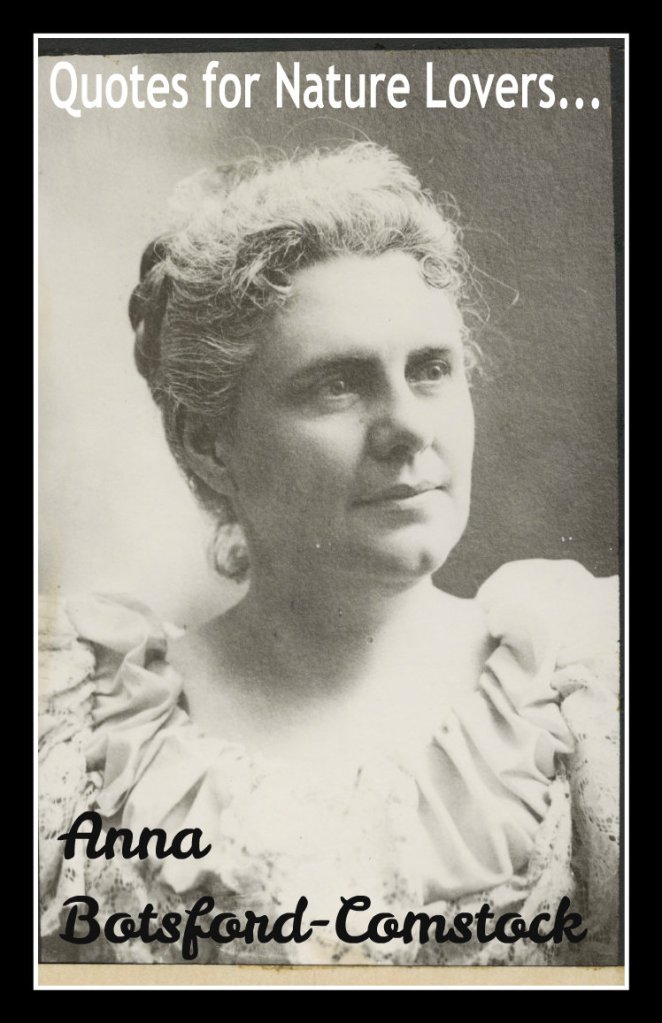
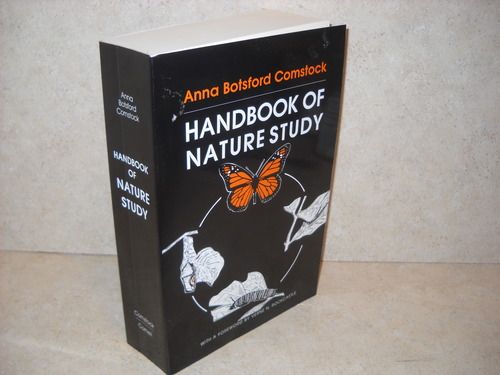
Anna Botsford Comstock provides us with another strong example of a Past Environmental Hero who used her exquisite writing skills to spawn sincere interest in and caring for the natural world. Comstock was a conservationist before most people knew what the word meant.  In her 1912 book, The Handbook of Nature Study, she was way ahead of her time in stressing the importance of the interactive relationships—both biological and abiotic—that work together to form what we now call ecosystems.

Born in 1854, Comstock grew up on a farm in Otto, New York where she traipsed around outdoors with her Quaker mother who taught her about all the elements of the natural world—including insects, birds, wildflowers, and trees.  In 1874, she enrolled at Cornell University where she met and fell in love with her husband-to-be, John Henry Comstock, an entomology professor.  She then withdrew from school and spent several unheralded years drawing exquisite insect illustrations for her husband’s books.

In the mid-1890s, Comstock finally had the chance to break out and shine like the star she was destined to be.  The New York Society for the Promotion of Agriculture asked her to help introduce a nature study program—the first of its kind in the United States— into local schools in Westchester County, New York. At first, many parents and teachers resisted the idea of teaching about the outdoors as being both frivolous, unproductive, and a waste of time.  Despite these objections, Comstock’s outdoor education initiative soon grew into a nationwide teacher-education program administered by Cornell University and her career was off and running.

Comstock stayed busy promoting her nature study program by producing study guides and instructional booklets for teachers to use across the country.  By encouraging instructors to take their students outside to learn, and then helping them see the relationship between people and the natural world, she left her mark on countless generations.[i] Now that’s what we call fantastic stick-to-it-tive-ness—going from an unappreciated drop-out to the founder of a national education initiative—all at the same university!

During the early 1900’s, Comstock and husband John opened the Comstock Publishing Company with its motto: Nature through Books”.  It was here that she wrote and illustrated a series of her own books, including Ways of the Six-Footed(1903), How to Keep Bees (1905)[ii]The Pet Book (1914)[iii], and Trees at Leisure (1916). But her tour de forceremained her nearly 900-page tome, The Handbook of Nature Study, which is now a famous sourcebook for teachers that has gone through twenty-four editions and has been translated into eight languages. 

Throughout her landmark work, Comstock continually emphasizes the rewards of direct observation of the natural world. Here’s how she described her approach to nature study as used in the book: “I want to cultivate the child’s imagination, love of the beautiful, and sense of companionship with life out-of-doors.” Expressing such a radical shift from today’s reliance on electronic tethers, it’s no wonder that the Handbook of Nature Study  still remains so popular with grade schools teachers—even today!

Comstock retired from full-time teaching in 1922, but continued to lecture and—in a 1923 poll by the League of Women Voters—was named one of “America’s 12 Greatest Living Women”.  Comstock died of cancer in Ithaca, New York on August 24, 1930.  

Outside of the classrooms, Comstock’s work as a conservationist remained largely unknown and unappreciated until the US Environmental Movement started to gather steam in the 1960s and 1970s. Then—fittingly in 1988—she was named to the National Wildlife Federation’s esteemed Conservation Hall of Fame where she is now forever lauded as the “Mother of Nature Education.”

While she was not an audacious conservation leader on the order of such contemporaries as Theodore Roosevelt or John Muir, Anna Botsford Comstock—in her own quiet and inimitable way—bolstered the national environmental consciousness by reaching out to America’s youth.  Since Climate Change holds the greatest peril for future generations of Americans, it is incumbent on us all to involve our children and grandchildren in finding solutions.  A guidebook written along the same lines as Comstock’s Handbook of Nature Study would certainly go a long way toward accomplishing this.

Text excerpted from book: PROTECTING THE PLANET: Environmental Champions from Conservation to Climate Change” written by Budd Titlow and Mariah Tinger and published by Prometheus Books.

Photo credits: Shutterstock(2)

Author’s bio:  For the past 50 years, professional ecologist and conservationist Budd Titlow has used his pen and camera to capture the awe and wonders of our natural world. His goal has always been to inspire others to both appreciate and enjoy what he sees. Now he has one main question: Can we save humankind’s place — within nature’s beauty — before it’s too late? Budd’s two latest books are dedicated to answering this perplexing dilemma. “PROTECTING THE PLANET: Environmental Champions from Conservation to Climate Change”, a non-fiction book, examines whether we still have the environmental heroes among us — harking back to such past heroes as Audubon, Hemenway, Muir, Douglas, Leopold, Brower, Carson, and Meadows — needed to accomplish this goal. Next, using fact-filled and entertaining story-telling, his latest book — “COMING FULL CIRCLE: A Sweeping Saga of Conservation Stewardship Across America”— provides the answers we all seek and need. Having published five books, more than 500 photo-essays, and 5,000 photographs, Budd Titlow lives with his music educator wife, Debby, in San Diego, California.


.

.


Theodore Teddy Roosevelt—The Conservation President

by

Budd Titlow

http://www.buddtitlow.com

The federal government became the agency of choice to manage our natural resources during the turn of the 20th Century because the bulk of the citizenry believed that private corporations and organizations were too corrupt, self-serving, and greedy to be trusted. When Theodore Teddy Roosevelt assumed the Presidency by accident after the assassination of William McKinley in 1901, resource conservationists finally had the friend they needed in The White House.

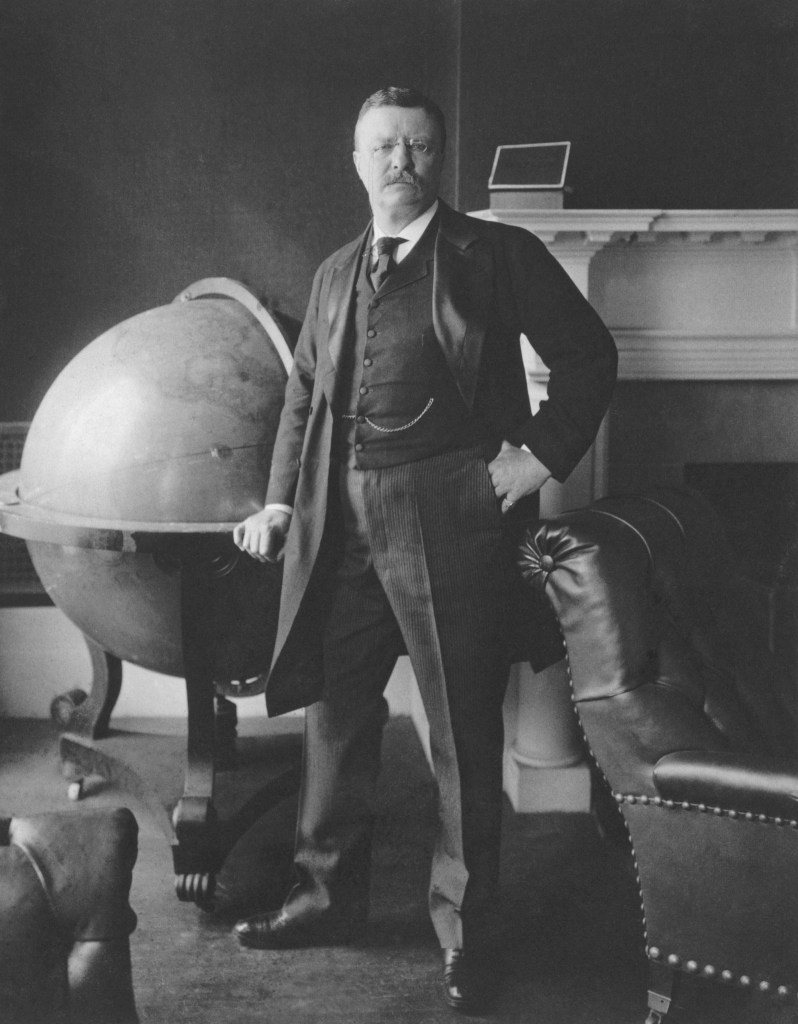
Usually depicted immaculately dressed in a three-piece suit with his intensely honest stare framed by a bushy moustache and chained glasses, Roosevelt epitomized a true man’s man.  While his unfailingly politeness and courtesy earned him consistent favor with women, his reputation as a “rough-riding” adventurer and big-game marksman always garnered heroic accolades from men.

Teddy Roosevelt, protector of wildlife and natural resources, became known as the “conservation president” soon after taking office. 

In ironic twists for such a lifelong outdoorsman, Roosevelt was born in 1858 in the middle of America’s most populous city—a Manhattan brownstone—and home-schooled as a sickly child.  But he didn’t let these inconveniences sway him away from what he loved to do. At the age of seven, he formed a local nature club with some of his cousins and they quickly started riding herd on every critter they could find creeping and crawling in their urban “stomping grounds”. Within a few years, the boys had collected, analyzed, and mounted enough specimens for display to start what they called the “Roosevelt Museum of Natural History”.

In another ironic twist of fate, Roosevelt’s love of the rugged outdoors was significantly enhanced because of a dual tragedy in his life.  On the same day—February 14, 1884— both his mother and his wife tragically died.  To deal with the unbearable grief he was feeling over this twin loss, Roosevelt packed up, left New York City, and moved to the Dakota Territory for two years. While there, he left his infant daughter in the care of his elder sister while he worked as a cowboy and cattle rancher in the peaceful solitude of the American West’s wide-open spaces.

Soon after he took office, Roosevelt quickly began earning his reputation as “The Conservation President”He dedicated himself to protecting both wildlife and natural resources as an avid adventurer and lover of nature.  He realized that dramatic action would be required to prevent the rich natural resources and incomparable landscapes of our country from disappearing as quickly as the American bison—leaving future generations without a legacy of natural splendors. 

As President, Roosevelt was faced with a quandary that was a carry-over from the banner years of the “Industrial Age”.  He knew that the deep pocket entrepreneurs —who controlled the bulk of the nation’s wealth—were so busy trying to make more money that they didn’t have time to worry about protecting the nation’s fast-disappearing natural resources.   He also knew that these same power players did not have any desire to give up the man’s dominion over naturephilosophy that had governed their lifestyles for decades.  But he also sincerely believed that the long-term happiness of most Americans was directly associated with how intelligently and properly natural resources were managed.  

On the surface, these conflicting ideologies presented a beguiling crisis.  But good old “Uncle Teddy” had a plan.  He believed that—with enough foresight—natural resources could be used, economically and recreationally, while simultaneously being conserved for the long-term.  In other words, Roosevelt was onto something that would become the world’s first plan for sustainable resource management and he set about proving that his plan could work. 

Management of the nation’s vast tracts of national forests perfectly epitomized Roosevelt’s beliefs on sustainable management.  In his opinion, the national forests had to serve multiple purposes.  While they had to provide a wide array of recreational opportunities—including everything from hunting and fishing to hiking, mountaineering, and birdwatching—the national forests also needed to pay their own way.  This meant portions of the forests had to be selectively logged and sold for building construction and pulp.  The trick was to accomplish this sustainably in a manner that provided some income while not detracting from the broad visitor enjoyment of these magnificent resources.  Then the areas where timber harvests occurred had to be immediately replanted with trees for use by future generations.  

As president, Roosevelt provided federal protection for 150 national forests, the first 51 federal bird reservations, five national parks, the first 18 national monuments, the first four national game preserves, and the first 24 reclamation—or federal irrigation—projects.  Many of these federal designations were bitterly opposed by commercial interests.  For example, the Nation’s first National Wildlife Refuge on Florida’s Pelican Island in 1903 raised the hackles of the millinery trade—as we’ve previously discussed—since it was specifically established to thwart the acquisition of wild bird feathers. 

All told during his presidency, Theodore Roosevelt protected more than 230,000,000 acres of public land—an area equivalent to the entire Eastern Seaboard from Maine to Florida. Outside of his political career, Roosevelt also published more than 25 books about a range of subjects—including history, biology, geography, and philosophy as well as an autobiography comprised of four volumes.

Roosevelt’s pragmatic side also shone through in his creation of the Bureau of Reclamation in 1902 to manage water resources in the 17 western states. Reclamation’s goals were to provide a mix of economic benefits—hydropower, irrigation, and flood control—while also maintaining a litany of recreational activities.  The boating, fishing, and water skiing provided by federal water projects were received as a huge benefit by western residents—many of whom were just settling into new villages, towns, and cities.

Theodore Roosevelt died in his sleep at age 60 on January 6, 1919, at his Long Island estate, Sagamore Hill, after suffering a coronary embolism. On January 16, 2001, President Bill Clinton posthumously conferred Roosevelt with the Congressional Medal of Honor—the highest award for military service in the United States —for the Battle of San Juan Heights that occurred more than 100 years earlier. 

“Conservation means development as much as it does protection. I recognize the right and duty of this generation to develop and use the natural resources of our land but I do not recognize the right to waste them, or to rob, by wasteful use, the generations that come after us.” 

 – Theodore Roosevelt

President Teddy Roosevelt had an idea about how to get the nation’s wealthy elite and middle and lower classes working together for a common cause.  Then he applied his unwavering dedication—some might even call it his “Bull Moose” stubbornness—to make his plan work.  Thanks to Roosevelt’s gritty combination of foresight and fortitude, our nation put into place the world’s first plan for sustainable resource management and long-term conservation. Roosevelt’s accomplishments more than a century ago are even more apropos today, as we work toward bringing a divided nation together and deciding how to live sustainably with the goal of combating Climate Change.

Text excerpted from book:     “PROTECTING THE PLANET: Environmental Champions from Conservation to Climate Change” written by Budd Titlow and Mariah Tinger and published by Prometheus Books.

Photo caption and credit: Teddy Roosevelt, protector of wildlife and natural resources, became known as the “conservation president” soon after taking office. Copyright Everett Historical/Shutterstock.

Author’s bio:  For the past 50 years, professional ecologist and conservationist Budd Titlow has used his pen and camera to capture the awe and wonders of our natural world. His goal has always been to inspire others to both appreciate and enjoy what he sees. Now he has one main question: Can we save humankind’s place — within nature’s beauty — before it’s too late? Budd’s two latest books are dedicated to answering this perplexing dilemma. “PROTECTING THE PLANET: Environmental Champions from Conservation to Climate Change”, a non-fiction book, examines whether we still have the environmental heroes among us — harking back to such past heroes as Audubon, Hemenway, Muir, Douglas, Leopold, Brower, Carson, and Meadows — needed to accomplish this goal. Next, using fact-filled and entertaining story-telling, his latest book — “COMING FULL CIRCLE: A Sweeping Saga of Conservation Stewardship Across America” — provides the answers we all seek and need. Having published five books, more than 500 photo-essays, and 5,000 photographs, Budd Titlow lives with his music educator wife, Debby, in San Diego, California.
John Muir and His Battle for Hetch Hetchy

by

Budd Titlow

http://www.buddtitlow.com

The semantic battle between conservationists and preservationists continued after President Teddy Roosevelt and U.S. Forest Service Supervisor Gifford Pinchot left office.  The preservationists believed the conservationists were exposing the nation’s natural resources to widespread overuse and eventual destruction while the conservationists categorized the preservationists as idealistic amateurs—precursors to today’s tree-huggers—who had their heads in the sand when it came to economic reality.  The whole situation was really brought to a fever pitch during a rancorous battle over the proposal to dam the Tuolomne River and flood Hetch Hetchy Valley in Yosemite National Park.

Let’s start by looking at the need for putting a water supply reservoir in Yosemite National Park in the first place.  You likely know about the historic earthquake that struck the City of San Francisco in 1906.  Blamed for more than 3,000 deaths and 80% urban devastation, the “Great Quake” still ranks as one of the worst natural disasters to ever hit the US. But you might not realize that the massive conflagration of fires sparked by the quake showed the woefully poor quality of the city’s water infrastructure.  There simply wasn’t enough water anywhere to successfully douse the fires, so they basically roared unabated throughout the entire city.

Ironically, the city fathers had just been dealing with this classically difficult human needs versus natural resource protection issue for two years before the earthquake struck.  From the human perspective, Hetch Hetchy Canyon—located 167 miles west of San Francisco—offered the perfect topographic configuration for constructing a dam and reservoir that would provide a long-term solution to San Francisco’s water needs.  On the natural side of the ledger, the Hetch Hetchy Valley was rivaled only by the Yosemite Valley in terms of spectacular scenery, abundant wildlife, and marvelously varied recreational opportunities.

As so often happens following a calamity, the severity of the earthquake and fires flipped the ongoing debate in favor of damming the Tuolomne River as it flowed through Hetch Hetchy.  So in 1908, the US Department of the Interior—which had previously denied a permit—granted the City of San Francisco’s application for development rights of the Tuolumne River in Hetch Hetchy Canyon. With this decision firmly in hand, the process of planning for construction of the Hetch Hetchy Dam would soon follow … or so the city fathers thought.  What they hadn’t planned on was a feisty fellow named John Muir and his legion of devoted followers in a newly formed conservation organization known as The Sierra Club.

Muir used articles in national magazines to rail against the environmental tyranny of the Hetch Hetchy Dam and build widespread opposition to the project.  But before we go any further with this part of Muir’s story, let’s take a look at exactly who this man was and why he was so willing to take on such formidable foes as the City of San Francisco and the US Department of the Interior.

John Muir was born in 1838 to a very strict and religious family in Dunbar, East Lothian, Scotland. By his own account, Muir spent his boyhood alternating between two seemingly incongruous pursuits—playground fighting and searching for bird’s nests.  His love of nature led to regular ramblings around his Scottish coastal plain home and frequent lashings from his father who believed any activities that didn’t involve Bible study were a waste of time.  An itinerant Presbyterian minister, Muir’s father often treated him harshly and insisted that he memorize the Bible so that—by age 11—he knew almost the entire text by heart.

In 1849 seeking a stricter religious foundation than he had in Scotland, Muir’s father moved the family to Fountain Lake Farm near Portage, Wisconsin.  From the time he hit Wisconsin soil, Muir’s life as an adventurer took off in earnest. While he didn’t connect with his characteristic long, thick beard, tousled hair, piercing grey eyes, and crooked walking stick until adulthood, his tireless ramblings took him all over the Wisconsin countryside through his college days at the State University in Madison.

Afterward graduation, he joined his older brother collecting plants and stomping through swamps in southern Ontario, hiking the Niagara Escarpment, taking a 1,000 mile stroll from Indiana to Cedar Key on Florida’s Gulf Coast, sailing to Havana, Cuba, and then cruising up the Atlantic seaboard to New York City.  From New York, Muir booked passage to California and—finally in 1868, at age 30—made his way to the Yosemite Valley, the place that was to become the land of his lasting legacy and unrelenting devotion.

After working as a sheepherder in the California Sierra Nevada—“The Range of Light” as he referred to it—high country for a season, Muir took a job in 1869 building a sawmill in the Yosemite Valley. In his free time, he roamed Yosemite, where he developed a scientific theory that the valley had been carved by glaciers and then unconditionally surrendered to nature. Muir felt a spiritual connection to nature. He believed that mankind is just one part of an interconnected natural world, not its master, and that God is only revealed through nature.

Muir’s love of the western high country gave his writings a special spiritual quality. His readers—including presidents, congressmen, and “just plain folks”—were inspired and often moved to take action by the enthusiasm of his unbounded love of nature.

John Muir relaxing in his beloved Yosemite National Park.

After four years of rejoicing in the Sierra High Country, Muir moved back to the City of Oakland in 1873 where he could more easily earn a living with his writing. He was still espousing the ecstasy he felt traipsing about in the natural world but he was now doing it through articles in leading literary publications like Atlantic MonthlyOverland Monthly,Scribner’s, and Harper’s Magazine. These published articles soon made Muir nationally famous and helped him build strong coalitions throughout the government, corporate, and political worlds.  He combined these strong contacts with his widespread national fame and critical acclaim as a speaker, activist, and proposal writer to become our Nation’s most accomplished and important land preservationist.

Muir soon became the public voice for setting aside the high country around the Yosemite Valley as a national park in 1890, thereby setting the stage for the nation’s national park system.  Muir was also personally involved in the creation of Sequoia, Mount Rainier, Petrified Forest, and Grand Canyon National Parks.  In 1892, as a further testament to his spreading reputation as the nation’s leading conservationist, Muir and a cadre of his devoted followers founded the Sierra Club to “do something for wildness and make the mountains glad.”  Of course, the Sierra Club is now one of the leading environmental organizations on the face of the Earth and Muir served as its first president until his death in 1914.

Muir’s greatest cause celebre came during a 1903 three-night excursion to the Yosemite Valley with President Teddy Roosevelt that has been called and written about many times as “the camping trip that changed America” and for very good reasons.  First, Muir successfully persuaded Roosevelt to transfer the spectacular Yosemite Valley and the equally magnificent Mariposa Grove of giant sequoias from state park status to a national park. Then their intense and prolonged—both men were characterized by extreme verbosity—campfire chats no doubt sowed the seeds for federal protection of such other iconic western landscapes as: Chaco Canyon, New Mexico; Devils Tower, Wyoming; El Morro, New Mexico; Gila Cliff Dwellings, New Mexico; Grand Canyon, Arizona; Jewel Cave, South Dakota; Montezuma Castle, Arizona; Muir Woods, California; Natural Bridges, Utah; Navajo, Arizona; Pinnacles, California; Tonto, Arizona; Petrified Forest, Arizona; Tumacacori, Arizona, and Lassen Peak and Cinder Cone, California (now Lassen Volcanic National Park).[i]

This trip away from the tightly wound vagaries of Washington, DC and The White House had a profound and lasting impact on national conservation policies throughout the rest of Roosevelt’s presidency. Of his Yosemite escape with Muir, Roosevelt fondly remembered,  “It was like lying in a great solemn cathedral, far vaster and more beautiful than any built by the hand of man.  There can be nothing in the world more beautiful than the Yosemite, the groves of the giant sequoias and redwoods … our people should see to it that they are preserved for their children and their children’s children forever, with their majestic beauty all unmarred.”

Now let’s return to the epic battle over Hetch Hetchy which was, by far, the most titanic and traumatic struggle of Muir’s life. In Muir’s tragically touching words: “These temple destroyers, devotees of ravaging commercialism, seem to have a perfect contempt for Nature, and instead of lifting their eyes to the God of the Mountains, lift them to the Almighty Dollar.  Dam the Hetch Hetchy!  As well dam for water tanks the people’s cathedrals and churches, for no holier temple has been consecrated by the heart of man.”

Muir’s battling preservationists also drew withering fire from the citizens of San Francisco who believed they advocated for destruction of their city’s long-term growth.  The issue was finally decided in 1913 when Congress passed the Hetch Hetchy Dam Bill by a large margin.  John Muir was truly devastated and heartbroken.  A pristine jewel of the land that he had spent the best years of his life exploring and writing about was about to be ripped out of its setting and desecrated forever.  Many of Muir’s devout followers believed that approval of the Hetch Hetchy Dam cost him his life.  After the overwhelming yes vote, Muir became severely stressed and increasingly depressed and died a year later of pneumonia.  

On a positive note, Muir’s bountiful life and legacy as America’s first true preservationist has much to offer today’s Climate Change heroes.  Often called the “Father of Our National Park System”, Muir lived life to the fullest and—through his writing and speaking—made others aware of the joy he found in his vaunted western cathedrals:  “Climb the mountains and get their good tidings. Nature’s peace will flow into you as sunshine flows into the trees.”  

But Muir also realized the importance of fighting for protection of these iconic landscapes as homage to the entire natural world: “When we try to pick out anything by itself, we find it hitched to everything else in the universe.” In the final analysis, he gave his life—battling corporations, city officials, and federal bureaucrats—trying to save a sacred piece of his hallowed cathedral in the High Sierras.

Despite the loss of the battle over Hetch Hetchy, Muir’s legion of preservationists gained quite a bit of traction during the second half of the 20th Century.  For one thing they learned that using the print media—magazines and books—could be a very effective tool for rallying public support to their side. Operating in a similar fashion, the Climate Change community should take advantage of every type of media available—particularly now emphasizing Social Media—to espouse the critical importance of maintaining our seashores, coastal wetlands, coral reefs, and oceanic icefields for all future generations of Americans to behold and betroth.

Text excerpted from book:      “PROTECTING THE PLANET: Environmental Champions from Conservation to Climate Change” written by Budd Titlow and Mariah Tinger and published by Prometheus Books.

Photo caption and credit: John Muir relaxing in his beloved Yosemite National Park. Copyright Shutterstock.

Author’s bio:  For the past 50 years, professional ecologist and conservationist Budd Titlow has used his pen and camera to capture the awe and wonders of our natural world. His goal has always been to inspire others to both appreciate and enjoy what he sees. Now he has one main question: Can we save humankind’s place — within nature’s beauty — before it’s too late? Budd’s two latest books are dedicated to answering this perplexing dilemma. “PROTECTING THE PLANET: Environmental Champions from Conservation to Climate Change”, a non-fiction book, examines whether we still have the environmental heroes among us — harking back to such past heroes as Audubon, Hemenway, Muir, Douglas, Leopold, Brower, Carson, and Meadows — needed to accomplish this goal. Next, using fact-filled and entertaining story-telling, his latest book — “COMING FULL CIRCLE: A Sweeping Saga of Conservation Stewardship Across America” — provides the answers we all seek and need. Having published five books, more than 500 photo-essays, and 5,000 photographs, Budd Titlow lives with his music educator wife, Debby, in San Diego, California.


.

Harriet Lawrence Hemenway—High Society Goes to Bat for Birds

by

Budd Titlow

http://www.buddtitlow.com

In 1886 Frank Chapman—founder of Audubon Magazine—decided to take a stroll from his uptown Manhattan office to the heart of the fashion district on 14th Street. Along the way, Chapman—a talented birder—counted a total 174 birds comprising 40 species, including woodpeckers, orioles, bluebirds, blue jays, terns, and owls.  A pretty impressive array of birds for the middle of New York City—right?  Hardly—you see the problem was that all the birds Chapman counted that day adorned the hats that sat on the top of women’s heads.  

In the late 19th Century, America’s hat craze was in full swing.  Millions of North American birds were killed for their feathers which were in great demand by the millinery trade. This greedy practice was so lucrative that plume hunters would often wipe out all the birds in a rookery—taking just the feathers and leaving eggs to rot and newly hatched chicks to starve to death. The going feather rate was $20 per ounce—more valuable than gold at the time.  

In 1896 nearly five million birds representing 50 different species were killed for fashion.  Entire populations of shorebirds and wading birds—including herons, egrets, spoonbills, gulls, and terns—along the Atlantic Coast were wiped out.  But this despicable situation was about to change—in a very dramatic way.  Enter Harriett Lawrence Hemenway!  

Most successful environmental organizations owe their starts to individuals with a deep and abiding respect for and dedication to the natural world.  This is certainly the case with the Massachusetts Audubon Society, although its founder didn’t exactly come from the background you might expect.  For much of her life through early adulthood, Harriet Lawrence Hemenway lived a life of luxury and privilege at the pinnacle of Boston society in a family dominated by accomplished men. 

While escaping to watch birds along the Charles River whenever she could, Hemenway spent most of her time as a prominent socialite moving gracefully through all the right places while always decked out to the nines in the latest trendy fashions.  That was until she sat down on a cold winter day in 1896 and read a newspaper story that made her blood boil and caused all hell to break loose within the heretofore comfy and cozy confines of polite Boston society.

Harriett Hemenway escapes high society to watch birds along Boston’s Charles River.

When Hemenway read about thousands upon thousands of magnificent wading birds being slaughtered for feathers just to decorate women’s hats, she knew she had found her life’s calling.  From that day forward, she declared herself to be a true “Champion of Conservation” and girded for the battle royal with the male-dominated world that she knew would soon follow.

Hemenway’s portrait by the famous artist John Singer Sargent shows an arrestingly handsome woman with a deep-set gaze that practically shouts out “don’t trifle with me … no matter who you are!” Soon after she read the bloodcurdling account of entire rookeries being wiped out in Florida, many of the cocky men who thought they ruled the roost in Boston were being called on the carpet to atone for the sins of the millinery trade. 

The first thing Hemenway did was to contact her cousin—Minna B. Hall.  Together, they organized a series of ladies’ teas with the intent of discussing much more than the latest social goings-on.  Hemenway and Hall first told their society sisters about the avian horrors being inflicted on wild birds just to assuage their haute couture needs.  Then they beseeched their esteemed guests to start refusing to buy hats with bird feathers and start rallying everyone else they knew to do the same.  

Their strategy worked like a charm.  Using their social networks as a springboard, Hemenway and Hall reached out to hundreds of scientists and businessmen and soon had gathered enough support to establish the Massachusetts Audubon Society (MAS)—the oldest Audubon Society in the country. In fact, the MAS still prides itself on being totally independent of all other Audubon societies, including the National Audubon Society (NAS). 

In less than a year, the MAS had applied sufficient pressure to convince the Massachusetts legislature to outlaw the wild bird feather trade in the Commonwealth of Massachusetts.  Within two more years, bird lovers in New York, Connecticut, Pennsylvania, Tennessee, Maine, Iowa, Texas, Colorado, and the District of Columbia followed the example set by Hemenway and Hall. In almost every one of these states, the bird-loving societies were started by women who then convinced male civic leaders and local scientists to join the cause.  On average, women accounted for about eighty percent of the membership of each Audubon Society—including fifty percent of the leadership roles.

In 1900—just four years after Hemenway and Hall brewed their bird-saving strategies over neighborhood teas—Congress passed the Lacey Act which provided the necessary legal teeth for prohibiting the interstate shipment of wild species killed in violation of state laws.  Then by 1905—operating off this federal legal benchmark—33 states had moved to pass their own versions of the Lacey Act and the millinery trade of wild bird feathers—while still breathing slightly—was on life support.

The death knells finally started ringing in 1911.  First, New York State passed the Audubon Plumage Bill—a legal triumph that banned the sale of plumes of all native birds and shut down the domestic feather trade in the state.  Then the 1913 Tariff Bill banned the import of wild bird plumes from other countries and the Migratory Bird Act of 1913 placed all migratory birds under federal jurisdiction—finally ending the wild bird plume trade in the US for good. 

In the final analysis, America’s Audubon Societies played the critical role in changing people’s attitudes towards killing birds for their feathers.  And it all started because Harriet Lawrence Hemenway read an article that upset her, took to a venue that she knew well—high society tea parties—and started the ball rolling.  

There’s an old adage that the best advice anyone can give to an aspiring writer is “just write about what you know”.Whether the goal is protecting wild birds or deciding how to most effectively deal with Climate Change, this credo can be modified just slightly to “just work with who you know”. If you happen to have some friends in high places—like Harriett Lawrence Hemenway—you may be amazed at what you can accomplish!

Text excerpted from book:         “PROTECTING THE PLANET: Environmental Champions from Conservation to Climate Change” written by Budd Titlow and Mariah Tinger and published by Prometheus Books.

Photo caption and credit: Harriett Hemenway escapes high society to watch birds along Boston’s Charles River. Copyright Shutterstock

Author’s bio:  For the past 50 years, professional ecologist and conservationist Budd Titlow has used his pen and camera to capture the awe and wonders of our natural world. His goal has always been to inspire others to both appreciate and enjoy what he sees. Now he has one main question: Can we save humankind’s place — within nature’s beauty — before it’s too late? Budd’s two latest books are dedicated to answering this perplexing dilemma. “PROTECTING THE PLANET: Environmental Champions from Conservation to Climate Change”, a non-fiction book, examines whether we still have the environmental heroes among us — harking back to such past heroes as Audubon, Hemenway, Muir, Douglas, Leopold, Brower, Carson, and Meadows — needed to accomplish this goal. Next, using fact-filled and entertaining story-telling, his latest book — “COMING FULL CIRCLE: A Sweeping Saga of Conservation Stewardship Across America” — provides the answers we all seek and need. Having published five books, more than 500 photo-essays, and 5,000 photographs, Budd Titlow lives with his music educator wife, Debby, in San Diego, California.
Gifford Pinchot and the US Forest Service

by

Budd Titlow

http://www.buddtitlow.com

Fortunately for President Teddy Roosevelt, Gifford Pinchot came along at just the right time to help him with the daunting task of sustainably managing our nation’s millions of acres of national forests.  Nobody—including Roosevelt—epitomized the ideals of the Progressive Conservation Movement more than Pinchot.

A tall, dapper man—always sporting a world-class handlebar moustache and a gentlemanly forbearance—Gifford Pinchot was born in 1865 into a very wealthy family in Simsbury, Connecticut.  His family’s money gave him top-flight education where he matriculated from the famed Philip Exeter Academy in New Hampshire and then moved on to Yale University in New Haven, Connecticut.  

When he entered Yale University in 1885, his father asked him this simple question, “How would you like to be a forester?” At the time, not a single American had ever made forestry a profession. Pinchot replied that he … “had no more conception of what it meant to be a forester than the man in the moon … But at least a forester worked in the woods and with the woods—and I loved the woods and everything about them … My Father’s suggestion settled the question in favor of forestry.”

Enthused by this paternal conversation, Pinchot enrolled in the L’Ecole Nationale Forestiere in Nancy, France since education in forestry did not exist in the US at the time.  He returned a year later “fired with enthusiasm for managing forests as a crop”.  But he quickly realized that land development in the US was out of control and wrote: “When I got home at the end of 1890 . . . the nation was obsessed by a fury of development. The American Colossus was fiercely intent on appropriating and exploiting the riches of the richest of all continents.”

Pinchot’s observations were actually right on the mark.  During the so-called “Gay Nineties”, the American public still believed that the abundance of US forestland was inexhaustible.  The forestry practices in vogue at the time were cut, slash, level, and leave. No consideration was given to replanting to restore the resource for future use.  In fact, wasting timber was considered a “virtue, not a crime” while second growth management was just a “delusion of fools”.  In Pinchot’s words: “What talk there was of forest protection was no more to the average American than the buzzing of a mosquito and just about as irritating.”

Spurred on by these strong feelings about abysmal land management practices, Pinchot jumped into his now chosen profession—as America’s first professional forester—with unabashed enthusiasm.  In 1892, he accepted a position as Resident Forester on the Biltmore Estate in North Carolina.  Due to Pinchot’s leadership in sustainable forestrymanagement, the Biltmore Estate is now known as the “Cradle of American Forestry”.  Over the next 15 years, he worked a variety of other positions that raised forestry and conservation of all our natural resources from an unknown experiment to a nationwide movement.

Gifford Pinchot—as a U.S. Forest Service Supervisor— surveying parts of the western U.S. 

Then in 1905, capitalizing on his significant skills as a public relations master, Pinchot made himself the perfect choice as President Roosevelt’s first Chief Forester of the newly created U.S. Forest Service (USFS) within the Department of Agriculture. Once in office, he used his energy, maverick philosophy, and dynamic personality to permanently transform management of forestland across the US.  He diligently campaigned for wisely using the nation’s forests for the benefit of man, not just preserving them for nature’s sake.  Pinchot believed that “The object of our forest policy is not to preserve the forests (just) because they are beautiful … or because they are refuges for the wild creatures of the wilderness.  The forests are to be used by man.  Every other consideration comes secondary.” 

Despite this belief that forest use had to be the first priority, Pinchot’s primary goal was to prove that forestry could produce timber for harvest while also maintaining the quality of forests for future generations.  With this philosophy, he was the first person to coin the term conservation ethic and one of the first practitioners of what is now known as managing for resource sustainability.  

Emphasizing Pinchot’s two primary driving philosophies—“the greatest good for the greatest number over the long run”and “conservation coupled with wise use of natural resources” [i], the redefined USFS soared to great new heights. Under his administration, the number of forest reserves—later called “National Forests”—grew from 60 units covering 56 million acres in 1905 to 150 separate management areas covering 172 million acres in 1910. 

Believing that multi-use management was the best way to go, Pinchot extended Federal regulation to all resources—including forestry, grazing, water power dam sites, mineral rights, and recreational activities—within national forests boundaries. This management approach still abides throughout today’s USFS. 

Maintaining his close friendship with Roosevelt, Pinchot also served on a number of the President’s commissions including the Commission on the Organization of Government Scientific Work, the Commission on Public Lands, the Commission on Departmental Methods, the Inland Waterways Commission, and the Country Life Commission. He was also the primary founder of the Society of American Foresters, which first met at his home in Washington, DC.  Pinchot died of leukemia in New York City on October 4, 1946, at the age of eighty-one. 

“Without natural resources life itself is impossible. From birth to death, natural resources, transformed for human use, feed, clothe, shelter, and transport us. Upon them we depend for every material necessity, comfort, convenience, and protection in our lives. Without abundant resources prosperity is out of reach.”

                                                                                                –– Gifford Pinchot

Gifford Pinchot was as dedicated to his beliefs as any man who ever lived—perhaps even to a fault.  In a love story for the ages, Pinchot maintained a secret affair with Laura Houghteling—a socialite and the jewel of his life—whom he met in 1893. At first blush, this affair may not sound that unusual, but deeper investigation reveals the intrigue.  Ms. Houghteling actually died less than one year after she first met Pinchot.  But Pinchot wrote letters to her and kept dairies describing their imagined—or perhaps very realistic, at least in his own mind—relationship for 20 more years after her death.  He remained faithful and celibate during this whole time, not marrying until he was 49. 

We bring this up to emphasize the level of commitment that will be required to make a difference on the Climate Changefront.  Pinchot also exhibited the same level of dedication to transforming the nation’s forest management system from wanton slash and burn to wise, sustainable, long-term use.  All along the way, he battled both corporate and political resistance to “changing the way things have always been done”.  His legacy of making wise short-term use of natural resources to foster their long-term protection endures to this day and provides a prototype for achieving sustainable management of the Earth’s energy sources.     

Text excerpted from book:     “PROTECTING THE PLANET: Environmental Champions from Conservation to Climate Change” written by Budd Titlow and Mariah Tinger and published by Prometheus Books.

Photo caption and credit: Gifford Pinchot—as a U.S. Forest Service Supervisor— surveying parts of the western U.S. Copyright Shutterstock

Author’s bio:  For the past 50 years, professional ecologist and conservationist Budd Titlow has used his pen and camera to capture the awe and wonders of our natural world. His goal has always been to inspire others to both appreciate and enjoy what he sees. Now he has one main question: Can we save humankind’s place — within nature’s beauty — before it’s too late? Budd’s two latest books are dedicated to answering this perplexing dilemma. “PROTECTING THE PLANET: Environmental Champions from Conservation to Climate Change”, a non-fiction book, examines whether we still have the environmental heroes among us — harking back to such past heroes as Audubon, Hemenway, Muir, Douglas, Leopold, Brower, Carson, and Meadows — needed to accomplish this goal. Next, using fact-filled and entertaining story-telling, his latest book — “COMING FULL CIRCLE: A Sweeping Saga of Conservation Stewardship Across America” — provides the answers we all seek and need. Having published five books, more than 500 photo-essays, and 5,000 photographs, Budd Titlow lives with his music educator wife, Debby, in San Diego, California.


GEORGE PERKINS MARSH — Telling It Like It Was!

by

Budd Titlow

http://www.buddtitlow.com

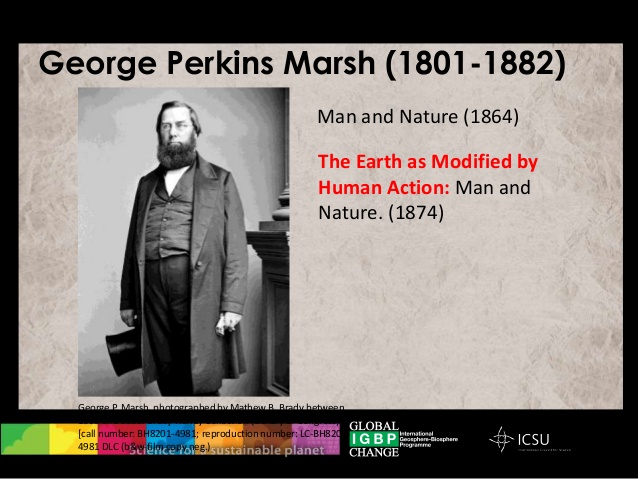
Cherub-faced with granny glasses and a slight paunch, George Perkins Marsh would today be called the ultimate environmental nerd—a real tree-hugger.  But don’t let his overly sophisticated look fool you, Marsh was the first true environmentalist with the guts to stand up and say, “Hey folks, we’re really making a mess of things here on Earth!” In 1864, he published Man and Nature which was followed by a revised edition in 1874 entitled The Earth as Modified by Human Action: Man and Nature. Taken collectively, these two books are widely regarded as the first modern discussion of our planet’s environmental problems. 

Born in 1801 in Woodstock, Vermont, Marsh grew up in an egalitarian household replete with all the trappings of wealth and prosperity and attended the finest schools—Philips Exeter Academy, Dartmouth College, and Vermont Law School. Possessing boundless energy, endless enthusiasm, and immense intelligence, Marsh was a true Renaissance Man. 

Throughout his 80 years, Marsh had many careers as a lawyer, newspaper editor, sheep farmer, mill owner, lecturer, politician and diplomat. A Master of Linguistics, he also knew 20 languages, wrote a definitive book on the origin of the English language, and was known as the foremost Scandinavian scholar in North America. He also invented tools and designed buildings including the Washington Monument. In his “spare time”, Marsh served his country in several important capacities, including as a member of the US House of Representatives from Vermont (1843–1849), Minister to the Ottoman Empire (1850–1853), and Ambassador to Italy (1861–1882). 

As we discussed earlier, the US was dominated by intense westward expansion in the second half of the 19th Century. This growth was fueled by a combination of the California Gold Rush and massive economic upheaval spawned by the start of the Industrial Revolution.  No sense of environmental accountability could be found anywhere on the American landscape or in the overriding political spectrum of the day until 1864 when Marsh published his book, Man and Nature.

A true environmental landmark, Man and Nature espoused a new way for evaluating human progress.  Marsh realized that natural resource use—for energy production, forest products, hydropower, fisheries stocks, and the like—was essential to sustain economic progress.  But he also warned that unrelenting and unmitigated overuse of our natural treasures would lead to big problems down the road.

Given his unique—at the time—understanding of Earth and its processes, Marsh was the first person to document systematically how human activity could have a cumulative and destructive effect on ecosystems as well as on the ability of those ecosystems to support human culture. Prior to Marsh, humans assumed that nature stood outside of human culture, was unchanged by human acts and works, and was infinitely capable of providing the resources that human economy extracted from it. As revealed in his writings, Marsh smashed this very wrong-headed logic to smithereens  and—in so doing—actually became the first person to suggest that man’s actions on Earth could be causing negative effects on the world’s climate.

To exemplify his points, Marsh conducted extensive surveys of the beneficial effects of natural forests, including their capacities to moderate local and regional climates.  In this frighteningly portentous passage based on this research, Marsh writes: “Even now…we are breaking up the floor and wainscoting and doors and window frames of our dwelling, for fuel to warm our bodies and seethe our pottage.  (As a result our planet is) fast becoming an unfit home for its noblest inhabitant. … Another era of equal human crime and human improvidence … would reduce it to such a condition of impoverished productiveness, of shattered surface, of climatic excess, as to threaten the depravation, barbarism, and perhaps even extinction of the [human] species.”

We can only be left to believe that Marsh—writing more than 150 years ago—could see the handwriting on the wall for what we are now facing from the threat of Climate Change.  Watching the “Doomsday Clock” (see Part Three for more on this) now ticking ever closer and closer to midnight, we can bear witness to the deep and sad truth of Marsh’s words.

As serious Climate Change analysts, we all need to pay special attention to George Perkins Marsh’s beseeching writing about working toward a harmonious blend of human activities and ecosystem health.  Even while the US still harbored an enormous bounty of natural wealth, Marsh empathized that we should be paying close attention to the effects our actions were having on the planet and working diligently to improve the sustainability of our lifestyles.  Marsh’s prose can be used to eloquently drive home the point that concerns about Climate Change are not just some “new kids on the block”.  They have—in fact—been around for a very long time.

Text excerpted from book: “PROTECTING THE PLANET: Environmental Champions from Conservation to Climate Change” written by Budd Titlow and Mariah Tinger, published by Prometheus Books.

Author’s bio:  For the past 50 years, professional ecologist and conservationist Budd Titlow has used his pen and camera to capture the awe and wonders of our natural world. His goal has always been to inspire others to both appreciate and enjoy what he sees. Now he has one main question: Can we save humankind’s place — within nature’s beauty — before it’s too late? Budd’s two latest books are dedicated to answering this perplexing dilemma. “PROTECTING THE PLANET: Environmental Champions from Conservation to Climate Change”, a non-fiction book, examines whether we still have the environmental heroes among us — harking back to such past heroes as Audubon, Hemenway, Muir, Douglas, Leopold, Brower, Carson, and Meadows — needed to accomplish this goal. Next, using fact-filled and entertaining story-telling, his latest book — “COMING FULL CIRCLE: A Sweeping Saga of Conservation Stewardship Across America”— provides the answers we all seek and need. Having published five books, more than 500 photo-essays, and 5,000 photographs, Budd Titlow lives with his music educator wife, Debby, in San Diego, California.
Dr. Ernst Haeckel Introduces Ecology to the World

by

Budd Titlow

http://www.buddtitlow.com

Ironically four years after we successfully obliterated nearly two percent of the US population during our Civil War, a word now famous for emphasizing the importance of maintaining both interspecific and intraspecific biodiversity made its first appearance in the lexicon of biologists.  In 1866, Ernst Haeckel—a German zoologist and master of many other scientific and artistic endeavors—introduced the concept of ecology onto the world scene. 

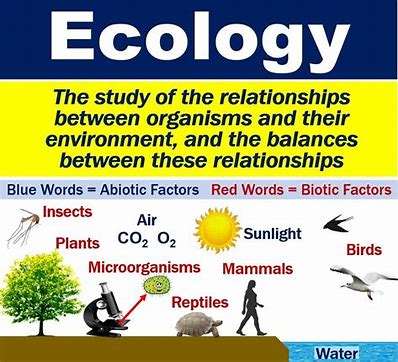
While Haeckel is officially credited with coining the term, we owe the origin of the word to the ancient Greeks.  In fact, understanding the word is most easily accomplished by looking at its Greek roots—oikos meaning house and logiameaning study.  So—to best understand the word ecology—envision observing everything that is going on in your own house, including everything from the interactions of your family with each other to how each family member is using everything in the house.  This visualization of your own household will give you a good handle on the meaning of ecology.

Now apply the same types of interactions that are taking place in your own home to what is happening in each ecosystem in the natural world.  Ecology is about the ongoing relationships that are continuously taking place among all the living things and their associated non-living elements found in each of the earth’s ecosystems.

For example, if a bird captures and eats a worm, that’s an ecological interaction.  If the bird—in turn—gets captured and eaten by a fox, that’s another ecological interaction.    Then when the fox stops by a pond to wash his meal down with a cool drink of water that’s still another ecological interaction.   Taken collectively, all the ecological interactions occurring in all the ecosystems on Earth form the science of ecology—the term Dr. Haeckel officially introduced to the world so long ago.

Why is this so important to know?  The study of ecology has become the basis for analyzing and evaluating everything that is going on in the natural world—including the influence of humans, now popularly known as anthropogenic effects.   By looking at how our activities are affecting individual ecosystems—with an emphasis on increases or decreases in biodiversity (the number of different species of organisms living in an ecosystem or ecosystems)—we gain an understanding of how and why our behaviors need to be modified.  

This is of critical importance today because if we take a hard, honest look at the Earth’s ecology, we’ll quickly see that what we’re doing does not paint a pretty picture.  Ice sheets melting, oceans warming, coral reefs dying, species going extinct—Dr. Haeckel gave us the tool for diagnosing the diseases, now we just have to take our medicines and get them all cured!

Text excerpted from book:     “PROTECTING THE PLANET: Environmental Champions from Conservation to Climate Change” written by Budd Titlow and Mariah Tinger, published by Prometheus Books.

Author’s bio:  For the past 50 years, professional ecologist and conservationist Budd Titlow has used his pen and camera to capture the awe and wonders of our natural world. His goal has always been to inspire others to both appreciate and enjoy what he sees. Now he has one main question: Can we save humankind’s place — within nature’s beauty — before it’s too late? Budd’s two latest books are dedicated to answering this perplexing dilemma. “PROTECTING THE PLANET: Environmental Champions from Conservation to Climate Change”, a non-fiction book, examines whether we still have the environmental heroes among us — harking back to such past heroes as Audubon, Hemenway, Muir, Douglas, Leopold, Brower, Carson, and Meadows — needed to accomplish this goal. Next, using fact-filled and entertaining story-telling, his latest book — “COMING FULL CIRCLE: A Sweeping Saga of Conservation Stewardship Across America” — provides the answers we all seek and need. Having published five books, more than 500 photo-essays, and 5,000 photographs, Budd Titlow lives with his music educator wife, Debby, in San Diego, California.
THE MYSTIQUE OF THE BOSTON RED SOX

By Budd Titlow

http://www.buddtitlow.com

A lifelong baseball fan, I experienced something on a crisp evening in late October 1986 that changed me forever.

I had just moved to Boston and my television was tuned to Game Six of the World Series—being played between the Boston Red Sox and the New York Mets. I was a dedicated Los Angeles Dodgers’ fan, so when Mookie Wilson’s little grounder trickled between Bill Buckner’s legs—costing the Red Sox the game and their first World Series Title in 67 years—I thought, “Wow—that’s really a shame.” But—as any Red Sox fan will quickly tell you—I really had no idea! 

The impassioned outcry about that one play lasted for another 18 years—until the Sox finally broke their 85-year curse and won it all in 2004. It also forced Buckner—a long-time standout major league hitter, with nearly 3,000 hits—to escape the daily abuse and move his family all the way to Idaho.

So, what could possibly create such a state of deep acrimony over one little baseball play? It’s really quite simple—a thing called the Red Sox Mystique. It starts the first time you walk up a stadium ramp and stare out at the hallowed grounds of 110-year-old Fenway Park. The deep green grass imbued with the Red Sox Logo, the towering Green Monster, the glowing CITGO sign, the Pesky Pole—they’re all right there for your viewing delight.  

After a few minutes of soaking up these vaunted sights, your eyes grow misty and your heart starts palpitating as you think of all the baseball greats that have roamed this hallowed place—The Babe, Teddy Ballgame, Yaz, Oil Can, The Spaceman, Pudge, El Tiante, The Rocket, The Hit Dog, Pedro, Big Papi. Your mind revels in the realization that all of these legendary players—and their vaunted heroics—took place right out there, on the field right in front of you. 

For a lifelong baseball fan, it just can’t possibly get any better than this—except for just one thing. The undying adoration for the Red Sox was always tempered by the team’s inability to win it all. But whenever each new spring training rolled around, every true Red Sox fan had the same thought—this could be “The Year”!    

And—so it became with me. From that glorious spring day in 1987—when I attended my first Fenway Park game—the Red Sox Mystique had me hooked. The Los Angeles Dodgers had faded into my rearview mirror—just like a massive Boston traffic jam. I was now a Red Sox fan for life. 

And yes—I finally understood the epitome of hardball exasperation that was birthed in Beantown on that crisp evening in late October 1986.

Author’s bio:  For the past 50 years, professional ecologist and conservationist Budd Titlow has used his pen and camera to capture the awe and wonders of our natural world. His goal has always been to inspire others to both appreciate and enjoy what he sees. Now he has one main question: Can we save humankind’s place — within nature’s beauty — before it’s too late? Budd’s two latest books are dedicated to answering this perplexing dilemma. PROTECTING THE PLANET: Environmental Champions from Conservation to Climate Change, a non-fiction book, examines whether we still have the environmental heroes among us — harking back to such past heroes as Audubon, Hemenway, Muir, Douglas, Leopold, Brower, Carson, and Meadows — needed to accomplish this goal. Next, using fact-filled and entertaining story-telling, his latest book — COMING FULL CIRCLE: A Sweeping Saga of Conservation Stewardship Across America — provides the answers we all seek and need. Having published five books, more than 500 photo-essays, and 5,000 photographs, Budd Titlow lives with his music educator wife, Debby, in San Diego, California.