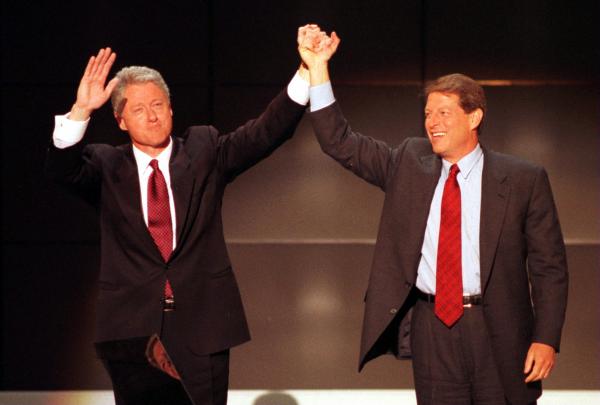
Bill McKibben’s Step It Up Campaign and the Birth of 350.org

Text excerpted from the book: PROTECTING THE PLANET-Environmental Champions from Conservation to Climate Change (ISBN 978-1-63388-225-6)

by

Budd Titlow & Mariah Tinger

https://www.amazon.com/dp/B0BG98CCWF / http://www.buddtitlow.com

In 2007, renowned Climate Change activist, Bill McKibben, started a nationwide environmental campaign that he called “Step It Up”.  Step It Up’s primary goal was demanding that the US Congress take action on Climate Change.  On April 14, 2007, McKibben organized hundreds of rallies in cities and towns all across America.  The “battle cry” of Step It Up was “Curb Carbon Emissions By 80% By the Year 2050”.  The Step It Up Campaign spread like wildfire and quickly earned the unified support of a wide variety of environmental, student, and religious groups.
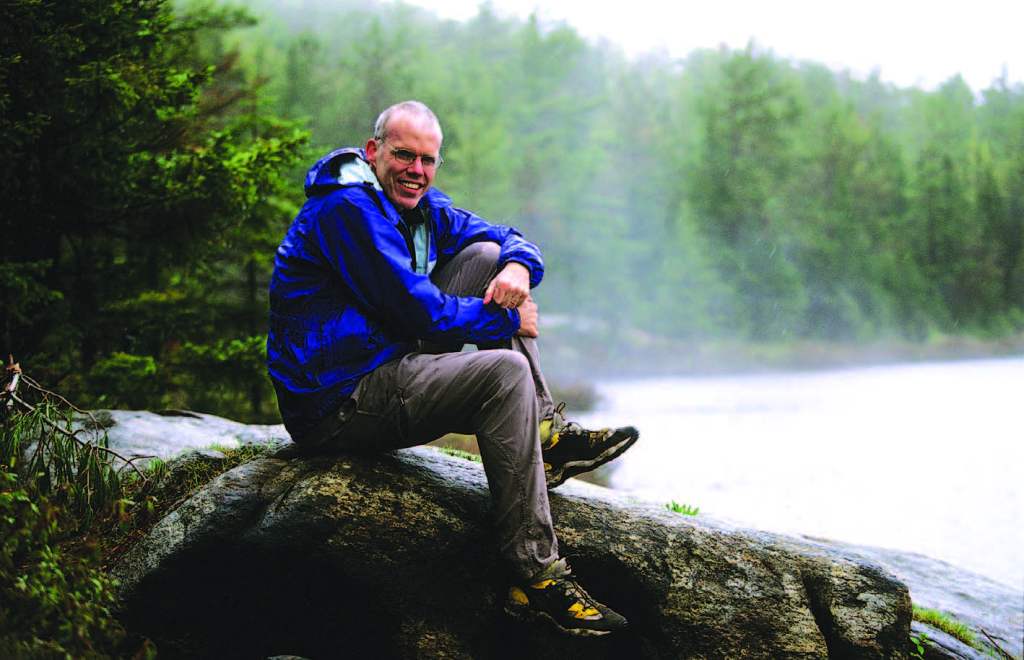
On November 3, 2007—again under McKibben’s leadership—Step It Up 2 took place.  In addition to the “80% by 2050” slogan from the first campaign, the second added a 10% reduction of emissions in three years (“Hit the Ground Running”), a moratorium on new coal-fired power plants, and a “Green Jobs Corps” to help fix homes and businesses so those targets could be met.
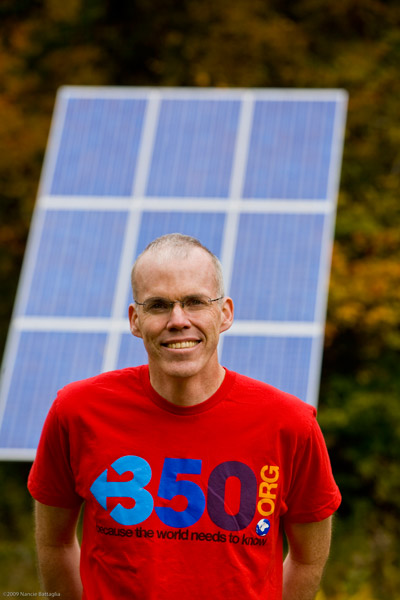
In the wake of Step It Up’s achievements, the same team announced a new campaign in March 2008 called 350.org. The organizing effort—aimed at the entire globe—drew its name from the now famous contention from climate scientist James E. Hansen that any atmospheric concentration of carbon dioxide (CO2) above 350 parts per million was unsafe. “If humanity wishes to preserve a planet similar to that on which civilization developed and to which life on Earth is adapted, paleoclimate evidence and ongoing climate change suggest that CO2 will need to be reduced from its current 385 ppm to at most 350 ppm, but likely less than that.” With offices and organizers in North America, Europe, Asia, Africa and South America, 350.org attempted to spread the 350 warning number in advance of international climate meetings in December 2009 in Copenhagen, Denmark.

On Oct. 24, 2009, 350.org coordinated over 5,000 demonstrations in more than  180 countries. It gained wide acclaim for its creative use of Internet tools, with Critical Mass’s website declaring it to be “one of the strongest examples of social media optimization the world has ever seen.” Additionally, Foreign Policy Magazine lauded it “the largest ever globally coordinated rally of any kind.”

Because of all he has done in devoting a significant portion of his life to Climate Change awareness and response, Bill McKibben is featured as one of our premiere Climate Change Heroes.


Bill McKibben—Climate Change Hero #1

We tracked down Bill McKibben in a windowless makeshift basement conference room in Paris, France. This ad hoc office space was the hub for 350.org’s massively successful civil disobedience actions at the COP-21 Climate Changeconference. At well over six feet tall, signature Red Sox ball cap included, McKibben’s presence is commanding, yet gentle. We could sense his exhaustion—he and his team had been working around the clock, doing everything (tweeting, texting, emailing, posting on Facebook) they could to raise awareness for strong civil disobedience actions at COP-21 to stop Climate Change.
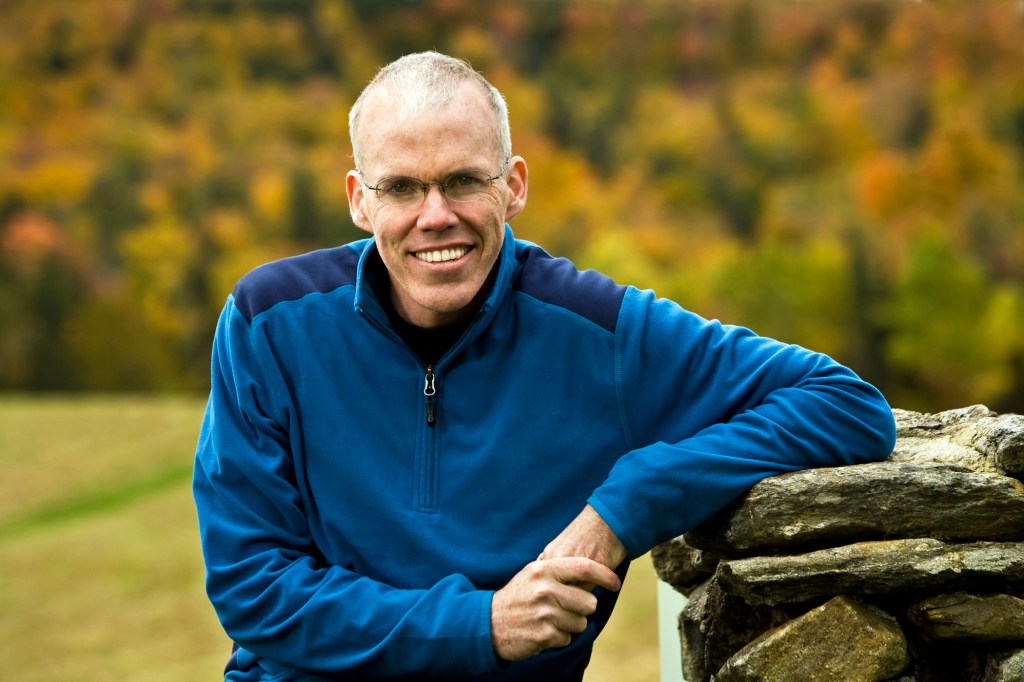
Portrait of Bill McKibben, author and activist. photo ©Nancie Battaglia

When we asked him what brought him to the cause he said, “I was a journalist and this seemed such a huge story to me—the most interesting possible story. But partway through writing the first book on it, I realized that I was not objective in the strictest sense. I did not want the world to heat up, dry up, and blow away. At some other level, perhaps I was even more objective than in the past. You know, I sort of understood what the basic reality was so… (he grows quiet) I mean, there are times when I wished that I hadn’t stumbled across all this, because there are other things that I may have wanted to do with my life. But you know, this has been a good place to be engaged in a good fight.”
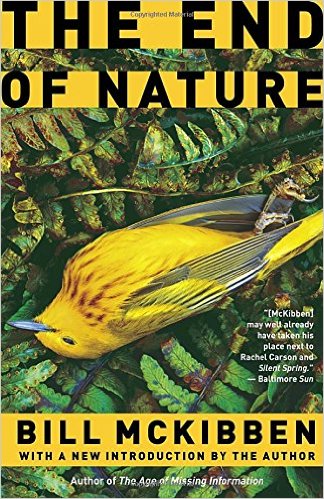
Some of our heroes strategically avoid the words fightconflictbattle as too incendiary for the politics around Climate Change. But for McKibben, this is a fight and indeed, it is personal. It is becoming apparent that many of the fossil fuel companies have known about the science for over twenty-five years. In his opinion, they have robbed him of a life that could have been devoted to something different (vs. “rhetorical battle with retrograde congressmen” as he puts it in Oil and Honey). 
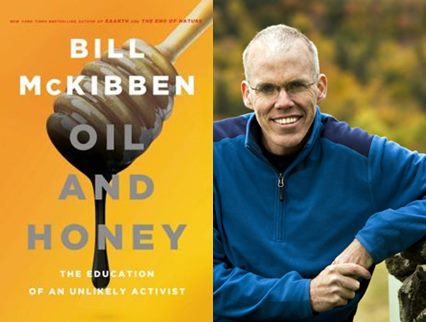
More than that, climate change may rob him of the beauty that satiates and fills his soul. McKibben says, “I think the next big front in the climate fight…may be trying to peel back all that we can learn about Exxon and what it and other oil companies knew twenty-five years ago. And I think I take that one fairly personally in a sense because I have been working on this a very long time. I wrote the first book about climate change, so I am getting uncomfortably close to thirty years of steady work on this, and knowing that twenty-five years ago, Exxon could have ended the whole faux/phony debate about it, simply by saying what they knew, makes me aggravated. Because then we could have spent the last quarter century working on solutions. We would not have solved the problem by now, but we would be well on the way. We would have turned the corner. And instead, we wasted what may turn out to be the crucial quarter century of geological history on this.  In summary, McKibben believes we have already lost lives, species and landscapes that could have been saved twenty-five years ago.

McKibben is adamant that it is far too late to stop Global Warming. That is not one of the possibilities at this point. The temperature of the planet is already 1°C warmer, and there is momentum that will raise it further than that. For him, the pertinent question now is “Can we still stop it short of damage so severe that it threatens our ability to have civilizations like the ones we are used to?”

There are only so many large physical features on Earth that can absorb carbon. Once you have run through the Arctic, the Antarctic and the world’s oceans it becomes a runaway train. The question now is not are we going to make the changes and transitions needed to head toward a renewable future. We clearly are. The question is—are we going to do it quickly enough to even begin to catch up to the physics of climate change. “That I am less convinced of, and that is why we have to keep pushing hard!”.

And McKibben has been pushing hard—really hard. We gave you the background about 350.org and its inception in Part Three. 350.org has now “organized more rallies than Lenin, Gandi, and Martin Luther King combined”. What McKibben has done with 350.org has been “the most satisfying work of my life, endlessly difficult and endlessly interesting”. He has won countless victories, the biggest of which was Obama’s rejection of the Keystone XL pipeline on November 6th, 2015.

McKibben takes great hope in the fact that the movement keeps growing and it is working. If one builds big movements, then change starts inexorably to happen. He wants it to continue to grow until it is big enough that everybody’s part in it makes sense. His optimism is cautious, however. He explains, “It is anybody’s guess whether we can build it in time or not. As I say, we will find out, and we will find out in our lifetimes. It is going to take many generations to win this fight, but we can easily lose it in the next five or ten years if we keep pouring carbon into the atmosphere”.

The next phase in the climate fight for McKibben is to get companies to pay for their injustices – which we can all hope will fund the transition towards renewable energy sources. He says, “The most important thing is the mobilization of a big movement. Once that happens it opens up all kinds of space. Now there are lots of politicians who are suddenly moving in the right direction”.  Bill stated his great optimism for the world’s ability to solve the Climate Change crisis. Ever the realist, however, he couched it by saying we have about a five year window to take swift actions before the warming trend is irreversible.


Author’s bio: For the past 50 years, professional ecologist and conservationist Budd Titlow has used his pen and camera to capture the awe and wonders of our natural world. His goal has always been to inspire others to both appreciate and enjoy what he sees. Now he has one main question: Can we save humankind’s place — within nature’s beauty — before it’s too late? Budd’s two latest books are dedicated to answering this perplexing dilemma. PROTECTING THE PLANET: Environmental Champions from Conservation to Climate Change, a non-fiction book, examines whether we still have the environmental heroes among us — harking back to such past heroes as Audubon, Hemenway, Muir, Douglas, Leopold, Brower, Carson, and Meadows — needed to accomplish this goal. Next, using fact-filled and entertaining story-telling, his latest book — COMING FULL CIRCLE: A Sweeping Saga of Conservation Stewardship Across America — provides the answers we all seek and need.Having published five books, more than 500 photo-essays, and 5,000 photographs, Budd Titlow lives with his music educator wife, Debby, in San Diego, California.

Al Gore’s Inconvenient Truth

Text excerpted from the book: PROTECTING THE PLANET-Environmental Champions from Conservation to Climate Change (ISBN 978-1-63388-225-6)

by

Budd Titlow & Mariah Tinger

https://www.amazon.com/dp/B0BG98CCWF / http://www.buddtitlow.com

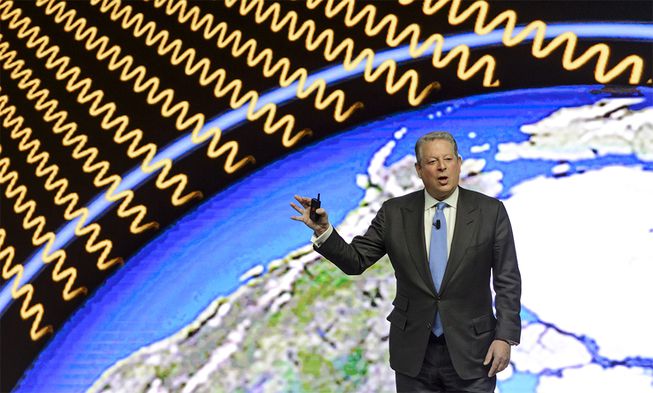
An Inconvenient Truth is a 2006 documentary film directed by Davis Guggenheim about former US Vice President Al Gore’s campaign to educate citizens about Climate Change and Global Warming.  To accomplish this educational endeavor, Gore presents a comprehensive slide show that he estimates he has given more than a thousand times. 

Premiering at the 2006 Sundance Film Festival and opening in New York City and Los Angeles on May 24, 2006, the documentary was a critical and box-office success, winning two Academy Awards for “Best Documentary Feature” and “Best Original Song”. The film grossed $24 million in the U.S. and $26 million in the foreign box office, becoming the eleventh highest grossing documentary film to date in US history.

The idea to document Gore’s efforts at educating the public about the hazards of Global Warming came from producer Laurie David who saw his presentation at a town-hall meeting which happened to coincide with the opening of the feature film, The Day After Tomorrow. Laurie David was so inspired by Gore’s slide show that she, along with producer Lawrence Bender, met with Guggenheim to adapt the presentation into a film.

Since the film’s release, An Inconvenient Truth has been credited for raising international public awareness of Climate Change and reenergizing the US Environmental Movement. The documentary has also been included in science curricula in schools around the world, which—as you might expect—has also spurred significant controversy.

In fact, since its release, “An Inconvenient Truth” has had a pronounced dual effect—sharpening the understanding and sense of foreboding in believers while further polarizing and alienating deniers.  

Al Gore—Communicator / Leader

If we were asked to select a “poster boy” for the Climate Change movement in the US, that person would be former Senator and Vice President Al Gore, Jr. In a highly unusual move among typically image-conscious politicians, Mr. Gore stood up and—with his PowerPoint presentation turned into a 2006 Oscar-winning documentary film entitled An Inconvenient Truth— told the world that Climate Change was real, that humans were responsible, and that we needed to take action immediately to preserve our quality of life on the planet.  In the process, he endured a barrage of slings, arrows, hate mongering, and insults unlike few other US politicians have ever had to contend.

Al Gore making one of his more than 1,000 presentations of “An Inconvenient Truth”.

As a creature of the Washington, DC establishment, Al Gore, Jr. has been involved in politics his whole life.  He was born on March 31, 1948 and raised in Washington, DC where his father, Al Gore, Sr., served on Capitol Hill from 1939 to 1971—first as a US Representative and then as a Senator from the State of Tennessee.  As a result, the junior Gore spent his boyhood attending prestigious private schools in the District of Columbia with summers working on the family farm in Carthage, Tennessee.

Then as a student at Harvard University during the 1960’s, Gore roomed with future actor Tommy Lee Jones and actually stumbled into the issue of Climate Change and associated Global Warming. In his senior year at Harvard, he took a class with oceanographer Roger Revelle, who sparked his interest in Global Warming and other environmental issues. Gore grasped the Climate Change science quickly and—as his political star rose—never relented in his determination to alert people that we’re baking our planet and ourselves with our lust for fossil fuels.

Beginning his career in public service in 1977, Gore was elected to represent the State of Tennessee in both the House and then in the Senate, serving from 1977 to 1993. Early on, he became one of the first politicians on Capitol Hill to grasp the seriousness of Climate Change. In fact, he held the first congressional hearings on the subject in the late 1970s. 

During his tenure in Congress, Gore also co-sponsored hearings on toxic waste in 1978–79, and then organized more hearings on Climate Change/Global Warming in the 1980s. In 1989, while still a Senator, he published an editorial in the Washington Post, in which he lamented, “Humankind has suddenly entered into a brand new relationship with the planet Earth. The world’s forests are being destroyed; an enormous hole is opening in the ozone layer. Living species are dying at an unprecedented rate.

In 1990, Senator Gore presided over a three-day conference with legislators representing over 42 countries seeking to create a “Global Marshall Plan”—”under which industrial nations would help less developed countries grow economically while still protecting the environment.” In 1992, he wrote his first book, Earth in the Balance. It became the first book written by a sitting Senator to make The New York Times “bestseller list” since John F. Kennedy’s Profiles in Courage.

While serving as Vice-President in the Clinton Administration, Gore launched the GLOBE program on Earth Day 1994.  This was an education and science activity that— according to Forbes Magazine—”made extensive use of the Internet to increase student awareness of their environment”. Then in the late 1990s, he strongly pushed for the passage of the Kyoto Protocol, which called for reduction in Greenhouse Gas emissions. As we have previously described in Part Three, despite Gore’s staunch efforts, the US totally botched the Kyoto Protocol.

In 2000, Gore famously lost one of the closest Presidential elections in U.S. History to George W. Bush.  Having an election as the world’s most powerful leader in the palm of his hand only to see it mistakenly and churlishly—in his mind and the mind of many Americans—ripped from his grasp, initially devastated Gore. 

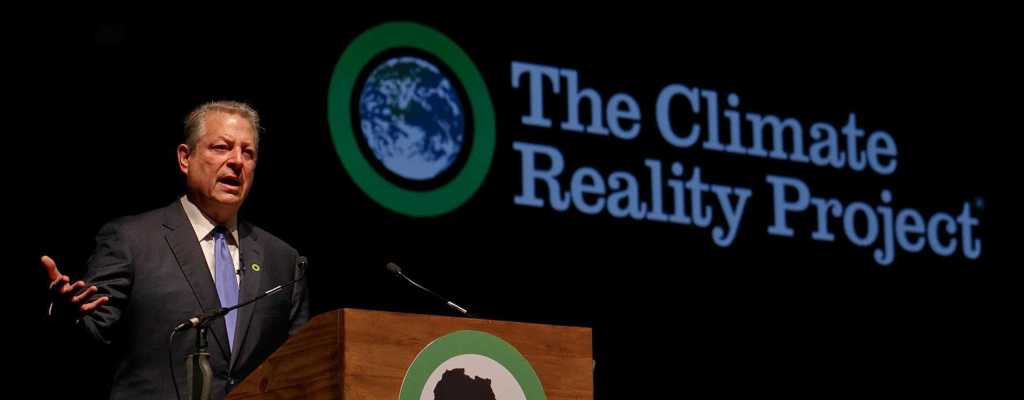
While fate may have kept Al Gore from the US Presidency, his tenacity created something few politicians ever achieve: a genuine cause that they feel passionate about. In Gore’s case, of course, this passion was Climate Change. In 2005, he founded the “Climate Reality Project” (originally the “Alliance for Climate Protection”) which is a non-profit organization devoted to solving the Climate Change crisis. Through grassroots leadership trainingsglobal media events, digital communications, and issue campaigns, “Climate Reality” works to spread the truth and raise awareness about Climate Change. Today, Gore serves as the group’s chairman and works with the organization to promote awareness of the ongoing dangers posed by Global Warming pollution and to develop solutions for Climate Change.

Gore also created a global media brand around his An Inconvenient Truth, which became the fourth highest-grossing documentary film in US History.  A 2006 book with the same title became a bestseller. 

In October of 2007, Gore was named as joint winner of the Nobel Peace Prize—together with the UN’s Intergovernmental Panel on Climate Change (IPCC).  As part of the award, he was recognized for being “probably the single individual who has done most to create greater worldwide understanding of the measures that need to be adopted to combat Global Warming.”

In recent years, Gore has remained busy traveling the world speaking and participating in events mainly aimed towards Global Warming awareness and prevention. His keynote presentation on Climate Change consistently receives standing ovations, and—according to his writing in, An Inconvenient Truth—he has presented it at least 1,000 times.


Author’s bio: For the past 50 years, professional ecologist and conservationist Budd Titlow has used his pen and camera to capture the awe and wonders of our natural world. His goal has always been to inspire others to both appreciate and enjoy what he sees. Now he has one main question: Can we save humankind’s place — within nature’s beauty — before it’s too late? Budd’s two latest books are dedicated to answering this perplexing dilemma. PROTECTING THE PLANET: Environmental Champions from Conservation to Climate Change, a non-fiction book, examines whether we still have the environmental heroes among us — harking back to such past heroes as Audubon, Hemenway, Muir, Douglas, Leopold, Brower, Carson, and Meadows — needed to accomplish this goal. Next, using fact-filled and entertaining story-telling, his latest book — COMING FULL CIRCLE: A Sweeping Saga of Conservation Stewardship Across America — provides the answers we all seek and need. Having published five books, more than 500 photo-essays, and 5,000 photographs, Budd Titlow lives with his music educator wife, Debby, in San Diego, California.

The Hockey Stick Controversy 

Text excerpted from the book: PROTECTING THE PLANET-Environmental Champions from Conservation to Climate Change (ISBN 978-1-63388-225-6)

by

Budd Titlow & Mariah Tinger

http://www.buddtitlow.com

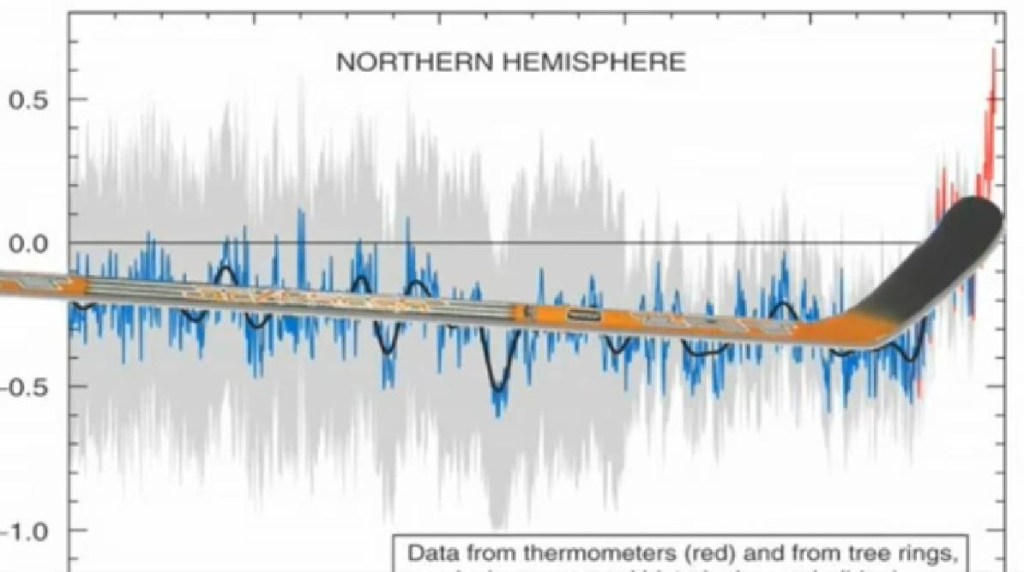
The “Hockey Stick Controversy” was an offshoot of a graph developed in 1998 that clearly showed almost a millennium’s worth (Year 1000 to Year 1900) of steady, but slowly declining global temperatures followed by radical increases in temperatures beginning in 1900’s and extending into the early 2000’s.  The shape of this graph looked like a hockey stick with a long and relatively straight handle ending in a sharply angled, short blade. The source of the data used to construct this graph led to a bitter debate between Climate Change scientists who were primarily involved with the IPCC and deniers mainly associated with the oil and gas lobby.

In 1998 and 1999, Michael E. Mann (University of Virginia), Raymond S. Bradley (University of Massachusetts – Amherst), and Malcolm K. Hughes (University of Arizona) produced MBH98 (based on the last initials of the three authors combined with the year), and then a modified MBH99—as the first eigenvector-based Climate Field Reconstructions (CFRs).  MBH98 was created using temperature data from the recent past coupled with paleoclimatic datasets—such as those from tree rings, ice cores, and coral sections—that date back to the Year 1400.  MBH99 then modified the research trio’s original graph by going back even further to the Year 1000 and thus incorporating an entire millennium’s worth of climate information.

Climatologist Jerry Mahlman then coined the term hockey stick to succinctly describe the pattern that the graph showed. Soon afterward, the “Hockey Stick Graph” was elevated to iconic status for climate believers and a bulls-eye for climate deniers.

Since MBH99 was first produced, more than two dozen additional Climate Field Reconstructions (CFR’s)—using various statistical methods and combinations of proxy records—have supported the broad consensus of Global Warming shown in the original “Hockey Stick Graph” with some variations in how flat the pre-20th Century shaft appears.  The 2007 IPCC Fourth Assessment Report cited 14 reconstructions, 10 of which covered 1,000 years or longer, to support its strengthened conclusion it was likely that Northern Hemisphere temperatures during the 20th Century were the highest in at least the past 1,300 years. Arguments over the reconstructions have been taken up by the fossil fuel industry lobbying groups that are attempting to cast doubt on Climate Change

Climate Change skeptics often cite the “Little Ice Age” and “Medieval Warming Period” as pieces of evidence not reflected in the “Hockey Stick Graph”, yet these extremes are examples of regional, not global, phenomena.  “From an intellectual point of view, these contrarians are pathetic, because there’s no scientific validity to their arguments whatsoever,” says Michael Mann. “But they’re very skilled at deducing what sorts of disingenuous arguments and untruths are likely to be believable to the public that doesn’t know better.”

Michael Mann—Theorist / Communicator

In the “olden days” (i.e., the Sixties), if you really wanted to put someone down, one of the ways you could do it was by calling him a “hockey puck”.  But how about living with a situation where every time someone says your name, many people conjure up visions of a “hockey stick”?  Well, since 1998, that’s what Professor Michael Mann has been living with.  Although he probably doesn’t think of it in a negative context.  You see, Dr. Mann was the scientist primarily responsible for what is known as the “Hockey Stick Graph” which dramatically and conclusively shows that today’s Climate Change is not a long-term cyclical event. 

Michael E. Mann was born in 1965 in Amherst, Massachusetts where his father was a Professor of Mathematics at the University of Massachusetts.  He received his undergraduate degrees in Physics and Applied Math from the University of California at Berkeley, an MS degree in Physics from Yale University, and a PhD in Geology & Geophysics from Yale University. He is currently a Distinguished Professor of Atmospheric Science at Penn State University where he also serves as director of the Earth System Science Center (ESSC). His present research focus involves the use of theoretical models and observational data to better understand Earth’s climate system. 

Mann was a Lead Author on the Observed Climate Variability and Change chapter of the Intergovernmental Panel on Climate Change (IPCC) Third Scientific Assessment Report in 2001 and was organizing committee chair for the National Academy of Sciences Frontiers of Science in 2003. He has received a number of honors and awards including NOAA’s outstanding publication award in 2002 and selection by Scientific American as one of the fifty leading visionaries in science and technology in 2002. He contributed, with other IPCC authors, to the award of the 2007 Nobel Peace Prize.

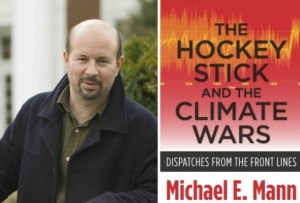
The author of more than 190 peer-reviewed and edited publications, Mann has published two books including Dire Predictions: Understanding Climate Change and The Hockey Stick and the Climate Wars: Dispatches from the Front Lines. He is also a co-founder of the award-winning science website RealClimate.org.

Okay, so let’s get back to this hockey stick controversy—specifically Mann’s involvement with it. To begin with, his innovative research helped recreate the Earth’s historical temperature record and separate the noise of natural weather fluctuations from the steady signal of real climate change.  This led Mann and his co-researchers to produce the “hockey stick graph” in 1998 which has since played a significant role in the development of the overwhelming scientific consensus that the planet is warming and human activities are responsible.

Since then, Mann—an affable scientist—has been dragged into the fray by diehard Climate Change deniers. He was a central figure in the trumped-up “Climategate” scandal—that we discussed in Part Three “—accused with other scientists of fraud by conservative bloggers and pundits before being vindicated by eight separate independent investigations. He was later the subject of an “academic witch-hunt” by former Virginia Attorney General Ken Cuccinelli until a circuit court judge ruled that Cuccinelli had provided no “objective basis” for his crusade.

But if Mann began as an unwilling combatant in the public debate, he has since become a fierce defender of scientific discourse. He’s currently suing for defamation the National Review, right-wing columnist Mark Steyn, and the Competitive Enterprise Institute (CEI)—a libertarian think tank.  The Washington Post has dubbed CEI “a factory for global warming skepticism” that has received funding from ExxonMobil, the American Petroleum Institute, and Arch Coal—among others.

Mann laments the fact that climate naysayers are still running around all over the place.  He staunchly believes that if the public had a better grasp of how science works, there would be no climate “skepticism”.  They would understand that climatology is based on the same “scientific method” as many other fields of endeavor.  But he also understands that much of the negative flashback is being stoked by the fossil fuel industry and their ham-fisted cohorts.   

In a March 28, 2016 posting on the HuffPost Green’s web site, Mann wrote this about fossil fuel companies misleading the public and policymakers about the risks of their products for decades: “As early as the late 1970s, executives at fossil fuel companies were well aware that burning oil, gas and coal could cause irreversible and dangerous climate change. Indeed, as early as 1981, Exxon-Mobil was weighing whether or not to develop carbon-intense gas reserves off the coast of Indonesia because of the climate risks associated with the project.”

Mann then continued with his indictment by writing that Exxon-Mobil and other fossil fuel companies chose to suppress what its own scientists knew. “From 1979 to 1983, the American Petroleum Institute operated a scientific task force to study climate change. According to a researcher who worked on the project, it was taken out of scientists’ hands and quickly buried—and forgotten—until reporters rediscovered it just last year.”

In concluding his piece, Mann once again defended the veracity of his “hockey stick graph” this way: “Our key finding, that the recent warming trend is unprecedented over at least the past 1000 years, has not only been overwhelmingly affirmed by more than a dozen subsequent studies, but has been vastly strengthened. There is now widespread consensus in the scientific community that recent warmth is unprecedented over an even longer time frame—for the full story behind fossil fuel industry-funded attacks on me and the hockey stick, read my books.”


Author’s bio: For the past 50 years, professional ecologist and conservationist Budd Titlow has used his pen and camera to capture the awe and wonders of our natural world. His goal has always been to inspire others to both appreciate and enjoy what he sees. Now he has one main question: Can we save humankind’s place — within nature’s beauty — before it’s too late? Budd’s two latest books are dedicated to answering this perplexing dilemma. PROTECTING THE PLANET: Environmental Champions from Conservation to Climate Change, a non-fiction book, examines whether we still have the environmental heroes among us — harking back to such past heroes as Audubon, Hemenway, Muir, Douglas, Leopold, Brower, Carson, and Meadows — needed to accomplish this goal. Next, using fact-filled and entertaining story-telling, his latest book — COMING FULL CIRCLE: A Sweeping Saga of Conservation Stewardship Across America — provides the answers we all seek and need. Having published five books, more than 500 photo-essays, and 5,000 photographs, Budd Titlow lives with his music educator wife, Debby, in San Diego, California.

James Balog and Chasing Ice

Text excerpted from the book: PROTECTING THE PLANET-Environmental Champions from Conservation to Climate Change (ISBN 978-1-63388-225-6)

by

Budd Titlow & Mariah Tinger

http://www.buddtitlow.com

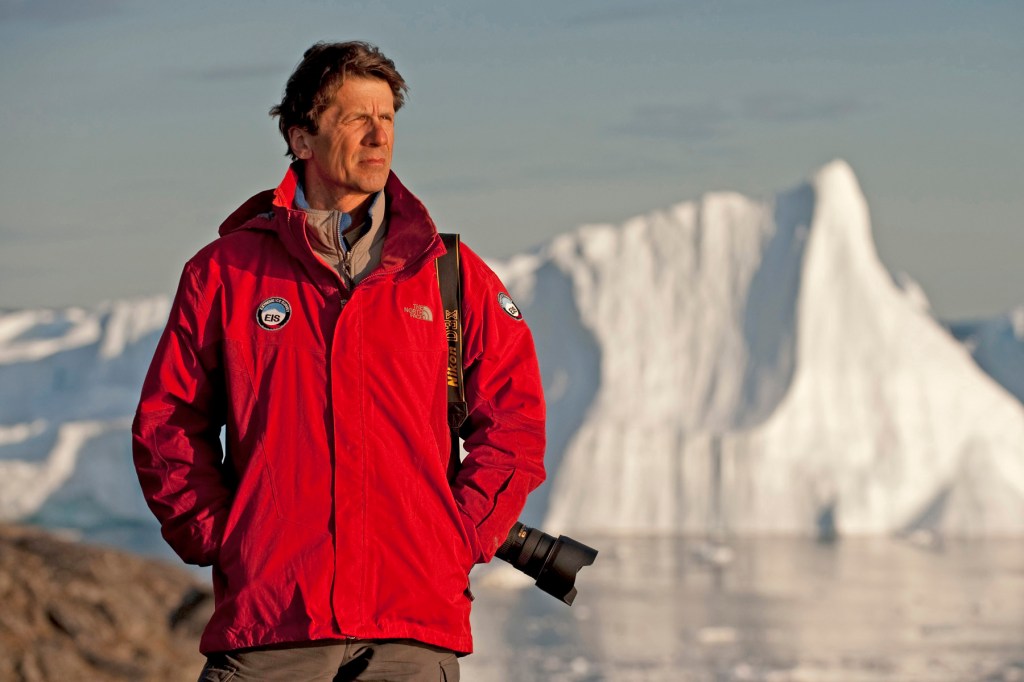
In the spring of 2005, acclaimed environmental photographer James Balog headed to the Arctic on a tricky assignment for National Geographic: to capture images to help tell the story of the Earth’s changing climate. Even with a scientific upbringing, Balog had been a skeptic about Climate Change. But that first trip north opened his eyes to one of the biggest stories in human history and sparked a challenge within him that would put his career and his very well-being at risk.

James Balog with icebergs at Ilulissat Isfjord, UNESCO World Heritage site.

Chasing Ice is the story of Balog’s mission to change the tide of history by gathering undeniable evidence of our changing planet. Within months of that first trip to Iceland, the photographer conceived the boldest expedition of his life: “The Extreme Ice Survey”. With a band of young adventurers in tow, Mr. Balog began deploying revolutionary time-lapse cameras across the brutal Arctic to capture a multi-year record of the world’s changing glaciers.

As the Climate Change debate polarized America and the intensity of natural disasters ramped up globally, Balog found himself at the end of his tether. Battling untested technology in subzero conditions, he came face to face with his own mortality. In the end result, Balog’s hauntingly beautiful videos compress years into seconds and capture ancient mountains of ice in motion as they disappear at a breathtaking rate. Chasing Ice depicts a photographer trying to deliver evidence and hope to our carbon-powered planet.

On a personal note, our first viewing of Chasing Ice left us mesmerized, exhausted, and enraged.  At the conclusion of Mr. Balog’s questions and answers, the entire audience of 500 people instinctively rose as one in a show of support for the film’s dramatic message and the man who had risked so much to put it together.  We believe that it’s impossible to watch Chasing Ice and come away still doubting that Climate Change is really happening.


James Balog—Explorer / Communicator

James Balog has given a visual, both beautiful and devastating, to Climate Change. He squeezed in an interview before his trip to touch the glaciers of Mount Kilimanjaro—a trip he had been anticipating and planning for fifteen years. He was in a race against time to visit this glacier, a recurring theme for him: the frozen subject matter of his “Extreme Ice Survey” (EIS) keeps disappearing. He has devoted his recent work to capturing these glaciers before they melt away permanently.

Balog is the Founder and Director of Earth Vision Institute, National Geographic Photographer and Geomorphologist, and also Founder of the EIS which is the most wide-ranging, ground-based, photographic study of glaciers ever conducted.  He has been photographing the Anthropocene “since 20 years before it was given a name.” 

The immediate catalyst that squelched Balog’s skepticism about Climate Change was the realization that there were concrete measurements of ancient climates trapped in the ice cores of Greenland and Anarctica. These cores held an actual empirical record of how the atmosphere had changed. “The climate change story was not about computer models. When I understood it to be an empirical science, an actual tangible collection of evidence, that is what really got me fired up.” The final catalyst for him was an article he read fifteen years ago about the vanishing snows of Kilimanjaro. This sparked his enthusiasm and built his anticipation of finally seeing the glaciers that have receded significantly since he read that article. 

The EIS captured shots of 23 glaciers in Antarctica, Greenland, Iceland, Canada, Austria, Alaska and the Rocky Mountains of the US.  Through the time-lapse photography, Balog captured images of ninety-five percent of the glaciers in the world retreating or shrinking, since the project began in 2007.  The documentary Chasing Ice features this phenomenon, and won the 2012 award for Excellence in Cinematography at the Sundance Film Festival. It was also shortlisted for the 2013 Academy Awards and featured on ABC, NBC, CBS, and PBS television networks.

Balog’s cameras make the invisible visible, and if seeing is believing, the images Balog has collected prove that we are losing glaciers permanently and rapidly. The loss of this frozen ice is turning into sea level rise, directly attributing to precipitation and changing temperature patterns. Balog says there is no significant scientific dispute about this, “it’s been observed, it’s measured, it’s bomb-proof information”. He refers to these glacial retreats as “the canaries in the coalmine”, indicating that their rapid melting should be setting off warning bells for the world.

In Chasing Ice, Balog’s resiliency and determination for the importance of capturing glacial retreat is highlighted by his persistence in the research despite a serious knee injury and several surgeries.  When asked why he said, “We are fundamentally a species that works in favor of its survival—we self-propagate. The more emotional and intellectual understanding we have of how rapidly the world is shifting around us, the more likely we are to take the actions necessary to alter course.”

We need a paradigm shift—a demand for the technological and political will to help us incrementally peel away from fossil fuel use where we can. According to Balog, for change to begin happening, we need to take all of the different things that people know how to do and apply them to climate change. “If everybody does a piece of that activity -whether it is to engineer wind turbines, put photovoltaics on the roof of your house, caulk your windows, put a smart thermometer in your house, change to a different car, or go to Washington and try to influence that crazy policy machine- it all keeps rippling out. Eventually it makes a new story that society absorbs and understands,” he says. This story eventually becomes the new paradigm and creates a new future.

Author’s bioFor the past 50 years, professional ecologist and conservationist Budd Titlow has used his pen and camera to capture the awe and wonders of our natural world. His goal has always been to inspire others to both appreciate and enjoy what he sees. Now he has one main question: Can we save humankind’s place — within nature’s beauty — before it’s too late? Budd’s two latest books are dedicated to answering this perplexing dilemma. PROTECTING THE PLANET: Environmental Champions from Conservation to Climate Change, a non-fiction book, examines whether we still have the environmental heroes among us — harking back to such past heroes as Audubon, Hemenway, Muir, Douglas, Leopold, Brower, Carson, and Meadows — needed to accomplish this goal. Next, using fact-filled and entertaining story-telling, his latest book — COMING FULL CIRCLE: A Sweeping Saga of Conservation Stewardship Across America — provides the answers we all seek and need. Having published five books, more than 500 photo-essays, and 5,000 photographs, Budd Titlow lives with his music educator wife, Debby, in San Diego, California.

Solar and Wind Take Flight

Text excerpted from the book: PROTECTING THE PLANET-Environmental Champions from Conservation to Climate Change (ISBN 978-1-63388-225-6)

by

Budd Titlow & Mariah Tinger

http://www.buddtitlow.com

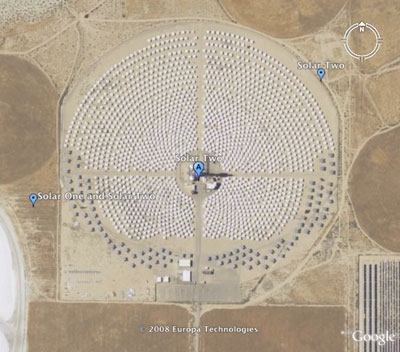
Despite the onset of the Reagan backlash, the early 1980’s saw several significant renewable energy and conservation related events.  These included the completion of the Solar One Project in the Mojave Desert just east of Barstow, CA. Designed by a team of scientists from the Sandia National Laboratories in Livermore, California; Southern California Edison; the Los Angeles Department of Water and Power; and the California Energy Commission; Solar One was a pilot solar-thermal project that provided the first test of a large-scale solar tower plant

Prototype of a large-scale solar farm

The plant’s method of collecting energy was based on concentrating the sun’s energy onto a common focal point to produce the heat needed to run a steam turbine generator. It had hundreds of large mirror assemblies, or heliostats, that tracked the sun and reflected the solar energy onto a tower where a black receiver absorbed the heat. High-temperature heat transfer fluid was then used to carry the energy to a boiler on the ground where the steam was used to spin a series of turbines—much like a traditional power plant.

The first half of the Reagan “Decade of Decadence” hit another positive note when the US wind energy industry spun into existence with 17,000 turbines centered primarily in California.  Danish companies—including Kuriant, Vestas, Nordtank, and Bonus—crafted most of the world’s first aeolian units including those installed in the US.  Unfortunately, the wind industry in the US soon fell prey to a combination of bad technology and lackadaisical policy.

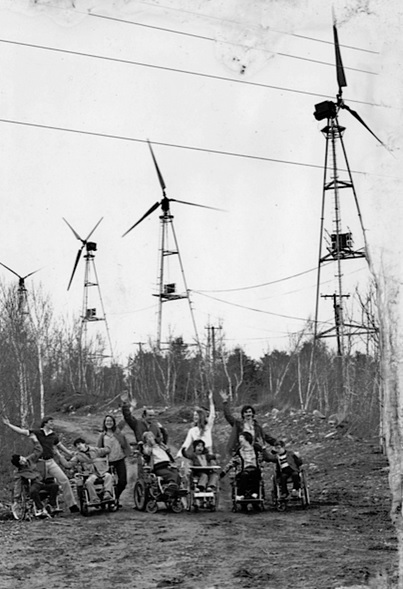
The first wind farm in US history—consisting of twenty 30 kilowatt (kW) turbines—was constructed on Crotched Mountain in New Hampshire in 1981.  The project was deemed a failure due to turbine breakdowns and overestimation of wind power as a reliable energy source. Then in 1985, a wind farm in California—that was powering 250,000 homes—was determined to be inadequate because of the limited maximum capacity of its turbines.  Meanwhile throughout the decade, US DOE funding for wind power research and development was experiencing a decline—reaching a low point in 1989.

Crotched Mountain Wind Farm in New Hampshire

Author’s bio:For the past 50 years, professional ecologist and conservationist Budd Titlow has used his pen and camera to capture the awe and wonders of our natural world. His goal has always been to inspire others to both appreciate and enjoy what he sees. Now he has one main question: Can we save humankind’s place — within nature’s beauty — before it’s too late? Budd’s two latest books are dedicated to answering this perplexing dilemma. PROTECTING THE PLANET: Environmental Champions from Conservation to Climate Change, a non-fiction book, examines whether we still have the environmental heroes among us — harking back to such past heroes as Audubon, Hemenway, Muir, Douglas, Leopold, Brower, Carson, and Meadows — needed to accomplish this goal. Next, using fact-filled and entertaining story-telling, his latest book — COMING FULL CIRCLE: A Sweeping Saga of Conservation Stewardship Across America — provides the answers we all seek and need.Having published five books, more than 500 photo-essays, and 5,000 photographs, Budd Titlow lives with his music educator wife, Debby, in San Diego, California.


Dawn of the Internet and The Global Communication Age

Text excerpted from the book: PROTECTING THE PLANET-Environmental Champions from Conservation to Climate Change (ISBN 978-1-63388-225-6)

by

Budd Titlow & Mariah Tinger

http://www.buddtitlow.com

The late 1990’s saw the blossoming of a new weapon in the arsenal of environmental activists.  The full-on advent of the Internet opened the world of cyberspace to information dissemination and recruitment of new members. Suddenly almost every corner of the world—no matter how remote—was accessible to open communication with the rest of the world.  Plus every piece of information ever produced on the planet could now be transferred to other locations in less than a blink of eye.  Yes, the onset of the information age had started in full tilt and our world would never be the same again!

While he didn’t really invent the Internet—as many have jokingly claimed—Clinton’s Vice President Al Gore has consistently been one of the world’s most resourceful politicians in using the Internet for dissemination of information about Climate Change and other significant environmental issues.  In a 1997 letter to the US State Department under the heading Environmental Diplomacy: The Environment and US Foreign Policy, Gore provided this poignantly insightful assessment of global environmental conditions:

“Environmental problems such as global Climate Change, ozone depletion, ocean and air pollution, and resource degradation—compounded by an expanding world population —respect no borders and threaten the health, prosperity, and jobs of all Americans.  All the missiles and artillery in our arsenal will not be able to protect our people from rising sea levels, poisoned air, or foods laced with pesticides.  Our efforts to promote democracy, free trade, and stability in the world will fall short unless people have a livable environment.  We have an enormous stake in the management of the world’s resources.  Demand for timber in Japan means trees fall in the US.  Greenhouse gas emissions anywhere in the world threaten coastal communities in Florida.  A nuclear accident in the Ukraine kills for generations. Our children’s future is inextricably linked to our ability to manage earth’s air, water, and wildlife today.”


Author’s bio: For the past 50 years, professional ecologist and conservationist Budd Titlow has used his pen and camera to capture the awe and wonders of our natural world. His goal has always been to inspire others to both appreciate and enjoy what he sees. Now he has one main question: Can we save humankind’s place — within nature’s beauty — before it’s too late? Budd’s two latest books are dedicated to answering this perplexing dilemma. PROTECTING THE PLANET: Environmental Champions from Conservation to Climate Change, a non-fiction book, examines whether we still have the environmental heroes among us — harking back to such past heroes as Audubon, Hemenway, Muir, Douglas, Leopold, Brower, Carson, and Meadows — needed to accomplish this goal. Next, using fact-filled and entertaining story-telling, his latest book — COMING FULL CIRCLE: A Sweeping Saga of Conservation Stewardship Across America — provides the answers we all seek and need.Having published five books, more than 500 photo-essays, and 5,000 photographs, Budd Titlow lives with his music educator wife, Debby, in San Diego, California.
REVEREND SALLY BINGHAM

Faith-Based Groups Jump on the Climate Change Bandwagon

Text excerpted from the book: PROTECTING THE PLANET-Environmental Champions from Conservation to Climate Change (ISBN 978-1-63388-225-6)

by

Budd Titlow & Mariah Tinger

http://www.buddtitlow.com

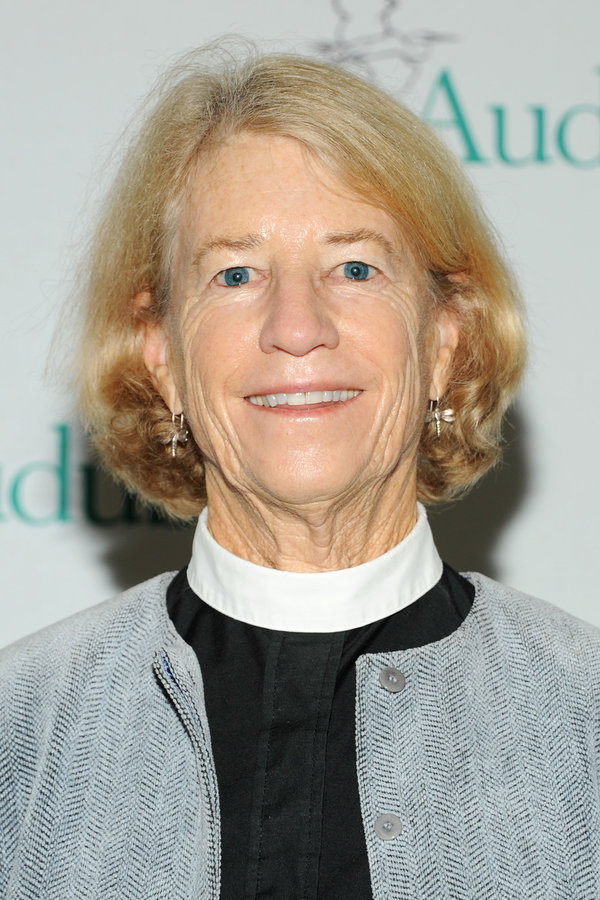
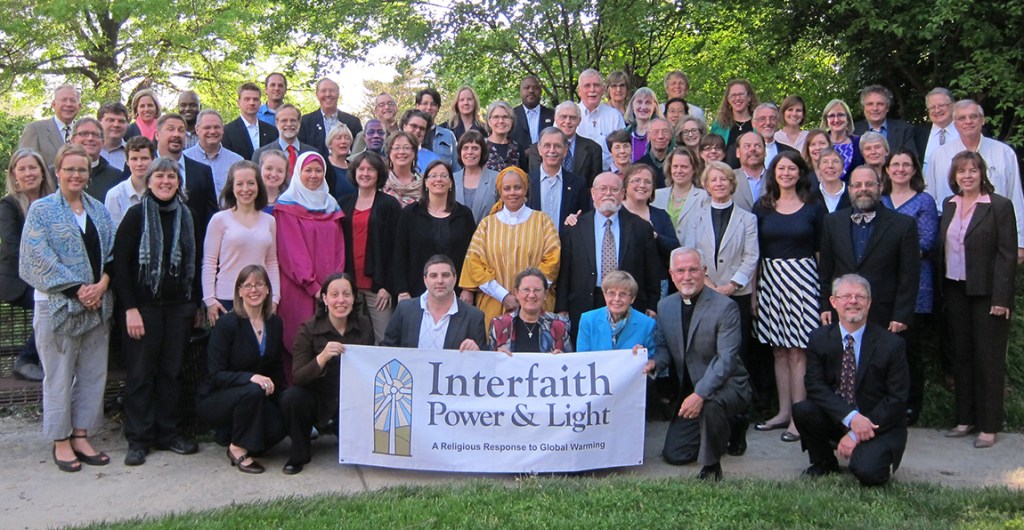
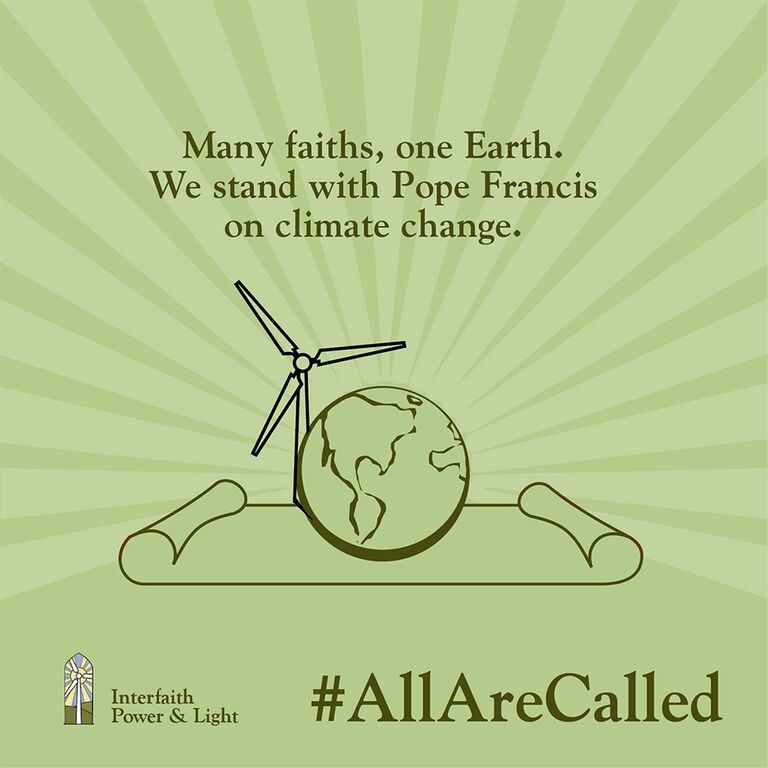
In 1998 at Grace Episcopal Cathedral in San Francisco, California, Reverend Sally Bingham founded the Interfaith Power & Light (IPL)—a staunchly environmental, faith-based organization.  IPL now has affiliates in 40 states, involving a total of 18,000 congregations. The mission of IPL’s campaign is to be faithful stewards of Creation by responding to Global Warming through the promotion of energy conservation, energy efficiency, and renewable energy. Their goals are protecting the Earth’s ecosystems, safeguarding the health of all Creation, and ensuring sufficient, sustainable energy for all.

NEW YORK, NY – MAY 29: Reverend Sally Bingham attends The National Audubon Society 10th Anniversary Women in Conservation Luncheon on May 29, 2013 in New York, United States. (Photo by Ben Gabbe/Getty Images)

In her capacity as President of IPL, Reverend Bingham has brought widespread attention to the link between religious faith and the environment through her work on The Regeneration Project and the IPL Campaign. As one of the first faith leaders to fully recognize Global Warming as a core moral issue, she has mobilized thousands of religious people to put their faith into action through energy stewardship.


In her leadership role at IPL, Reverend Bingham has sparked a growing crescendo of God’s mandate to humans to be faithful stewards of Creation.

In her leadership role at IPL, Reverend Bingham has sparked a growing crescendo of God’s mandate to humans to be faithful stewards of Creation.“Every person of faith should become aware of their moral responsibility to be a steward of Creation.  God put Adam in the garden to till and to keep (Genesis). Every mainstream religion has a mandate to care for Creation. Sometimes [followers] have not thought about it or they have not addressed it, and then they see an opportunity to really be faithful stewards of Creation and they join our program,” she explained in an interview. 

Bingham went on to say, “People who sit in houses of worship and say they love God and their neighbors have a particular obligation to take care of the Earth and each other.  If you sit in a pew on Sunday and say you love God and you love your neighbor, how can you not be taking care of your neighbor’s air and water? They are now starting to recognize that responsibility and act.”

That responsibility is deeply connected to her knowledge that Climate Change is harming the people of the world, and her faith mandates a responsibility to care for them. “[Climate Change] affects every single aspect of life, affects every living thing—starting with the rising sea, the temperature change, the number of long heat days that are causing people to die…the fact that the droughts are more extreme and are disrupting crops…the fact that people are starving because they can’t grow food in an area that has not had any rain in five years…that the storms that are so much more severe than they ever were and are killing people and destroying properties,” says Reverend Bingham with a note of sadness in her voice. She continues, “It is happening because the climate is changing.  Why is the climate changing? Because we are putting too much carbon dioxide into the atmosphere.”

One poignant action that she hopes congregations will do is to join the IPL campaign. The IPL is a growing national movement that is completely interfaith, as the name implies. The campaign has brought massive growth and awareness to religious people about their responsibility to protect the climate.  IPL began with an episcopal church in the diocese of California asking its congregations to buy renewable energy for their electricity.  Those congregations served as examples to their communities and it grew rapidly from there. 

IPL began with an episcopal church in the diocese of California asking its congregations to buy renewable energy for their electricity.

Prior to COP21 in Paris, IPL requested its members to take the Paris Pledge to show the world that the faith community in the United States is committed to cutting emissions, creating jobs, and saving money at the same time. Indeed, IPL took an eleven foot long scroll with 4,500 congregations and individual households who pledged to cut their carbon emissions in half by 2030 and be carbon neutral by 2050.

Reverend Bingham knows as well as anyone that the environment has become a political issue. Bingham says, “It is almost universal that if you are a Democrat you are an environmentalist and if you are a Republican you are not. That unfortunately is a big stumbling block for the issue. We don’t believe in our organization that the environment is a political issue, we see it is as an issue of science but in the big picture, it is a moral issue.  Where are our values, what do we care about, what is our responsibility to the future and it’s about how to leave this world to come back to our moral integrity.”

While Reverend Bingham does not offer solutions for solving the politicization of environmental issues, she is enthusiastic about the willingness to think differently on the issues in the religious community. The majority of the people she speaks with are in support of her initiatives, though on occasion she receives push back. “What we have come up against occasionally because our focus has been on Climate Change is that God would never allow anything bad to happen to Creation.  And then we have to do some explanation about how God has given us Free Choice and some of our choices have been harmful to Creation.  Mostly we get the comment that I had never thought about like that before,” she offers. Religiously, she thinks people are really on board with human beings as the species put on planet to keep it safe and healthy for not only ourselves, but the people that come after us.  “There are very few people that would argue with that,” Reverend Bingham asserts.

Pope Francis’ message in his 2015 “Environmental Encyclical” saying, similarly, that this is about the moral values that every person of integrity needs to have.  His Encyclical was not just for Roman Catholics it was for people that have a conscious.  Through IPL, Reverend Bingham has been teaching this for over fifteen years, “and now to have somebody as well known, as famous and as popular as Pope Francis to come out and say the same thing, it has been hugely helpful to our movement” explains Bingham. This message is being received extremely enthusiastically, and people see participation in the IPL program as an opportunity to be faithful stewards of Creation.

Reverend Bingham’s hope for our future comes from the fact that more and more people are involved and concerned.  She believes we are almost a critical mass and soon things will change for the better.  “We stopped smoking almost overnight when enough people were touched by disease due to cigarettes.  We are close to enough people being harmed by climate change now that it can no longer be denied.  People of faith are taking a leading role and once the moral and religious leaders are involved and speaking out the movement will succeed.”


Author’s bio:For the past 50 years, professional ecologist and conservationist Budd Titlow has used his pen and camera to capture the awe and wonders of our natural world. His goal has always been to inspire others to both appreciate and enjoy what he sees. Now he has one main question: Can we save humankind’s place — within nature’s beauty — before it’s too late? Budd’s two latest books are dedicated to answering this perplexing dilemma. PROTECTING THE PLANET: Environmental Champions from Conservation to Climate Change, a non-fiction book, examines whether we still have the environmental heroes among us — harking back to such past heroes as Audubon, Hemenway, Muir, Douglas, Leopold, Brower, Carson, and Meadows — needed to accomplish this goal. Next, using fact-filled and entertaining story-telling, his latest book — COMING FULL CIRCLE: A Sweeping Saga of Conservation Stewardship Across America — provides the answers we all seek and need.Having published five books, more than 500 photo-essays, and 5,000 photographs, Budd Titlow lives with his music educator wife, Debby, in San Diego, California.
Paul Hawken, Natural Capitalism, and Project Drawdown

Paul Hawken—Innovator / Visionary

Text excerpted from the book: PROTECTING THE PLANET-Environmental Champions from Conservation to Climate Change (ISBN 978-1-63388-225-6)

by

Budd Titlow & Mariah Tinger

http://www.buddtitlow.com

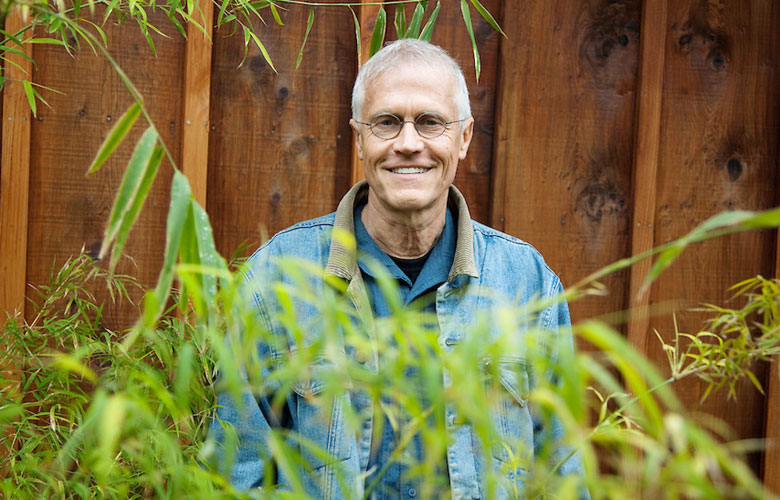
When it comes down to personal ingenuity and plans for solving Climate Change, one man stands head and shoulders above all.  Entrepreneur Paul Hawken has parlayed a financial empire built on selling garden supplies and materials—through the once world-famous Smith & Hawken Company which he co-founded—into “Project Drawdown”, the world’s most ambitious undertaking for finding and testing solutions to our climate dilemma.

Let’s step back for a moment now and take a closer look at this Climate Change visionary’s background.  In 1966, Hawken took over a small retail store in the City of Boston in 1966 called Erewhon (after Samuel Butler’s 1872 utopian novel) and turned it into the Erewhon Trading Company, a natural-foods wholesaler. Next with Dave Smith, he co-founded the Smith & Hawken Garden Supply Company in 1979—a retail and catalog business.

Next with Dave Smith, Paul Hawken co-founded the Smith & Hawken Garden Supply Company in 1979—a retail and catalog business.

In 1999, Hawken co-authored a book with Amory and Hunter Lovins entitled, Natural Capitalism: Creating the Next Industrial Revolution. Natural Capitalism—which has been translated into 26 languages—popularized the idea that Earth’s natural resources should be considered as “natural capital” since they provide “ecosystem services” from which humans derive such benefits as clean water and waste decomposition.  Then in 2008, he co-founded Biomimicry Technologies with biologist Janine Benyus, the author of Biomimicry, Innovation Inspired by Nature

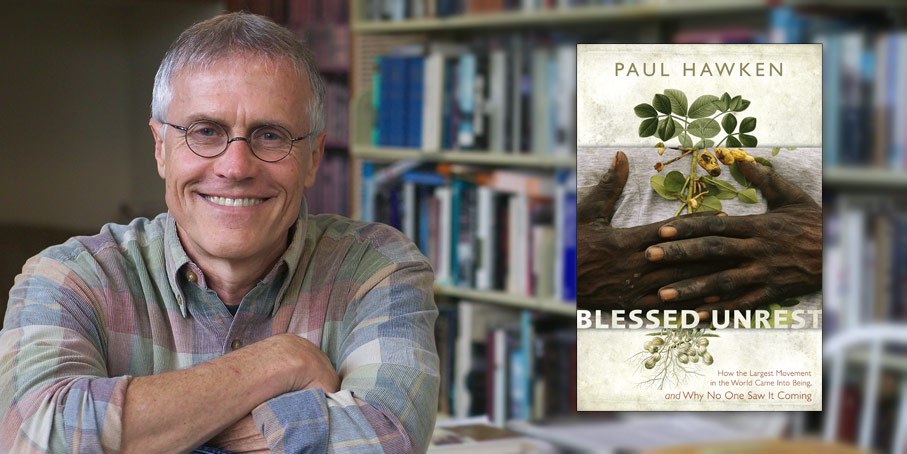
In 2007, Viking Press published Hawken’s New York Times bestseller, Blessed Unrest: How the Largest Movement in the World Came into Being and Why No One Saw It Coming. The book is about the many non-profit groups and community organizations, dedicated to many different causes, which Hawken calls the “environmental and social justice movement”.

In an interview with us, Hawken provides this elaboration: “Blessed Unrest describes what I call humanity’s immune response to ecological degradation, economic disease, and political corruption. All three are intimately intertwined with Global Warming. When I was doing the initial research [for this book], our institute was cataloging the more than 2,000 different types of non-profit organizations in the world according to their purpose, and month after month we saw the climate movement emerge, grow, and differentiate.”

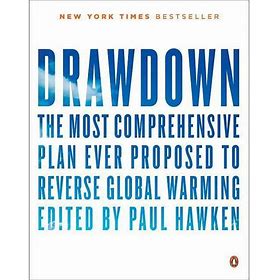
Now we arrive at Hawken’s piece de resistance: His “Project Drawdown” is aimed at reducing—not just stabilizingGreenhouse Gas (GHG) concentrations in the atmosphere in order to reverse rising global temperatures. “Drawdown” grew out of Hawken’s frustration with actionable, scalable solutions that would make a meaningful dent in the atmosphere’s growing accumulation of GHG. As he saw it, the solutions that had been put forward over the years were all seemingly out of reach—involving either ungodly amounts of solar and wind energy or the mass adoption of futuristic, unproven technologies.

In a conversation with GreenBiz’s Joel Makower, Hawken recalled, “It made me feel like this is intractable, that it requires such Promethean work by such mammoth institutions—with policy changes that are more than structural,” Hawken recalled. “It made me feel like it wasn’t possible to address Climate Change, rather than giving me hope.” In Climate Change activist Bill McKibben’s seminal 2012 Rolling Stonearticle entitled Global Warming’s Terrifying New Math, Hawken asked, “Why aren’t we doing the math on the solutions? Somebody should come up with a list and see what it requires so you get to drawdown.”

In 2013, Hawken began teaching at San Francisco’s Presidio Graduate School, alongside climate activist and entrepreneur Amanda Joy Ravenhill. “One day we were just riffing, and we started talking about drawdown and we said, ‘Let’s do it. No one else is doing it,” Hawken recounted. Today, Ravenhill is “Project Drawdown’s” Executive Director and—with Hawken—the project book’s co-editor. Together, the two recruited more than 80 advisors, partners, scientists, government agencies, and participating universities—plus another 200 graduate students—to work on the project.

Hawken further described his “Project Drawdown” process in his February 2016 responses to our interview questions: “[In Project Drawdown] we are filling this void by doing the math on the atmospheric and financial impacts of state-of-the-shelf solutions if deployed globally and at scale over the next 30 years. State-of-the-shelf refers to techniques that are widely practiced, commonly available, economically viable and scientifically valid.”

He continued: “In Drawdown we identify solutions that are already in place. But we also describe what we call ‘coming attractions,’ solutions so new and incipient that we cannot as yet fully measure and map their impact. Here we see genius and brilliance and humanity at its best.”

True to Hawken’s nature—he’s not likely to be satisfied with simply creating a book, however ambitious and meticulously detailed.  Instead, “Project Drawdown’s” plans extend in several directions: The solutions and calculations will be contained in a publicly available database—along with the means for individuals and groups to create customized applications. There are also plans for accompanying educational curricula developed by the National Science Foundation. And possibly some media projects based on the work.

For our interview, Hawken provided the following conclusions: “There are many reasons to believe [that Climate Change can be solved].  In “Drawdown”, we identify over 100 of the most substantive solutions that are in place and expanding globally. We see in our models [that] the moment in time when Greenhouse Gases decline on a year-to-year basis in the upper atmosphere is possible within three decades. “Drawdown” is the only goal that makes sense for humanity. And it is eminently doable. By collectively drawing carbon down, we lift up all of life.”

As author Makower concludes in his October 2014 GreenBiz article: “It’s easy, in today’s divisive and toxic political environment, to view “Project Drawdown” as too good to be true—a quixotic quest for an unattainable goal. But there’s something simple and sane about the project’s collective ingredients: unabashed optimism tempered by sharp-pencil calculations, a bold goal undergirded by scientific pragmatism, immediacy coupled with a 30-year horizon, all leveraging the wisdom of a very smart crowd.”


Author’s bio:For the past 50 years, professional ecologist and conservationist Budd Titlow has used his pen and camera to capture the awe and wonders of our natural world. His goal has always been to inspire others to both appreciate and enjoy what he sees. Now he has one main question: Can we save humankind’s place — within nature’s beauty — before it’s too late? Budd’s two latest books are dedicated to answering this perplexing dilemma. PROTECTING THE PLANET: Environmental Champions from Conservation to Climate Change, a non-fiction book, examines whether we still have the environmental heroes among us — harking back to such past heroes as Audubon, Hemenway, Muir, Douglas, Leopold, Brower, Carson, and Meadows — needed to accomplish this goal. Next, using fact-filled and entertaining story-telling, his latest book — COMING FULL CIRCLE: A Sweeping Saga of Conservation Stewardship Across America — provides the answers we all seek and need.Having published five books, more than 500 photo-essays, and 5,000 photographs, Budd Titlow lives with his music educator wife, Debby, in San Diego, California.
The Environmental Justice Movement

Text excerpted from the book: PROTECTING THE PLANET-Environmental Champions from Conservation to Climate Change (ISBN 978-1-63388-225-6)

by

Budd Titlow & Mariah Tinger

http://www.buddtitlow.com

One other notable environmental/social achievement of President Clinton is directly related—by global extension—to the developed nations versus developing nations controversy that is a significant component of today’s Climate Change debate.  By Executive Order in 1994, Clinton decreed that “each Federal agency shall make achieving environmental justice part of its mission.”

The roots of the Environmental Justice Movement—that Clinton referenced in his decree —can be traced back to Warren County, North Carolina in 1982.  With a predominant African-American population, this mostly poor rural county was selected as a site for a polychlorinated biphenyl (PCB) landfill that handled some of the deadliest carcinogens ever produced by man. More than 500 people were arrested when the community marched in protest.

While their efforts to stop the landfill failed, these demonstrators succeeded in bringing the issue of environmental racism to the forefront of the American public.  Their claims emphasized that environmental organizations were run by rich, white people advocating for protection of pristine natural resources while ignoring the conditions of the poor minority populations of the nation.

The prevailing attitude was that natural resources were more important than the ethnic minority populations of the US.

The prevailing attitude was that natural resources were more important than the ethnic minority populations of the US.  As a result, many of our nation’s most vile waste products—including radioactive materials—were being deposited in areas predominantly occupied by poor minority homeowners.  The driving theory in this disgraceful practice was that there would be less chance of organized opposition since the residents were less likely to be aware of what was happening to their communities.

Robert Bullard—Originator / Author

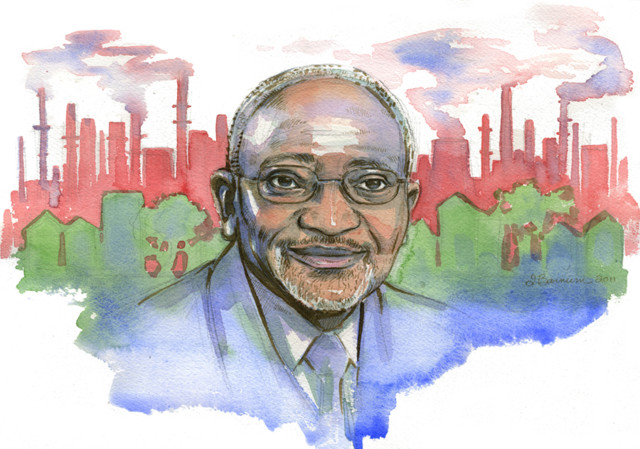
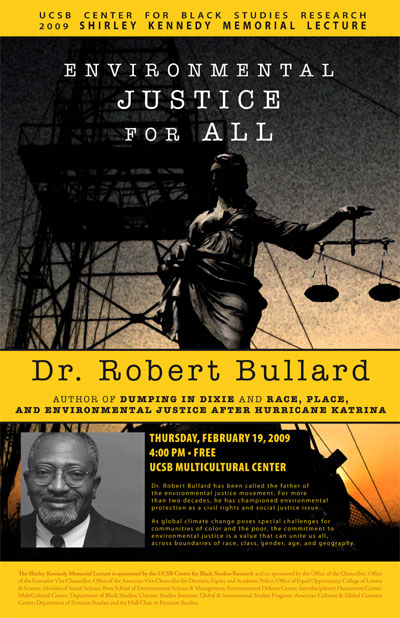
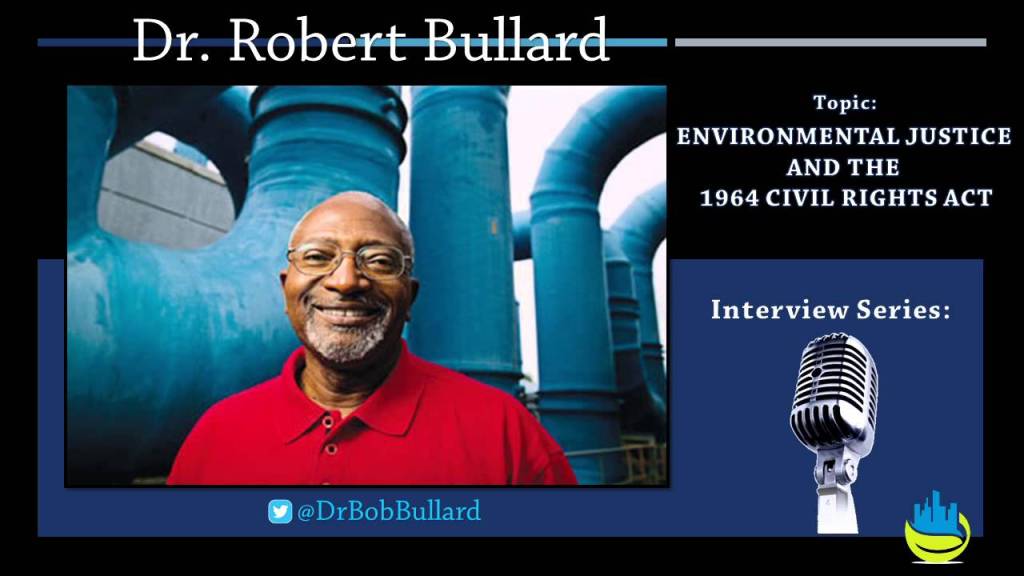
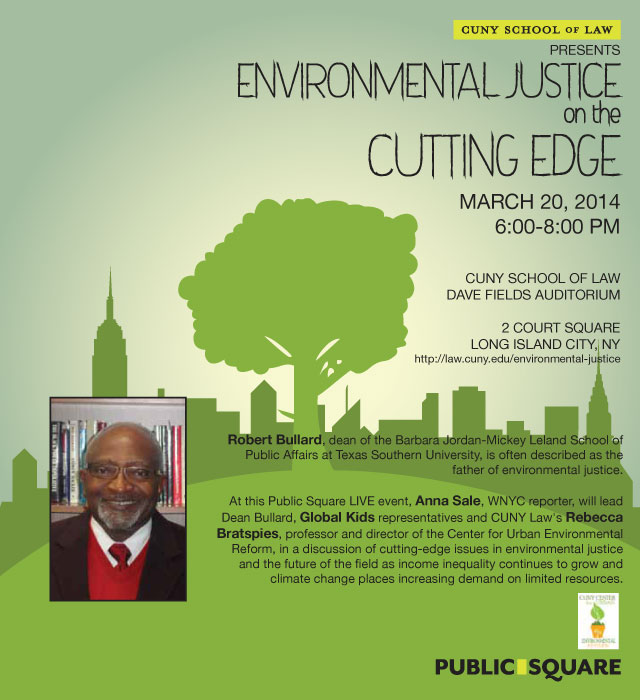
Robert Bullard, often called the “Father of Environmental Justice”, uses his expertise and media savvy to garner attention for communities burdened with environmental hazards. He has dedicated his career to protecting minority and low-income communities from becoming toxic pollution dump sites.  Bullard sees environmental justice issues at the heart of everything, in his words, “The right to vote is a basic right, but if you can’t breathe and your health is impaired and you can’t get to the polls, then what does it matter?”

Dr. Robert Bullard is often called the “Father of Environmental Justice Movement”.

Professor Bullard voiced a loud and clear opinion about the disproportionate number of landfills that were cited near predominantly black communities throughout the South, saying “Just because you are poor, just because you live physically on the wrong ‘side of the tracks’ doesn’t mean that you should be dumped on.” His voice was heard and the implementation of the environmental justice movement occurred. 

In 1994, President Bill Clinton summoned Dr. Bullard to the White House to witness the signing of an executive order that would require the federal government to consider the environmental impact on low-income communities before implementing policies.  Bullard co-wrote a report titled Toxic Wastes and Race at Twenty, 1987-2007: Grassroots Struggles to Dismantle Environmental Racism which prompted the Environmental Protection Agency (EPA) to state, “The EPA is committed to delivering a healthy environment for all Americans and is making significant strides in addressing environmental justice concerns.”

Robert Bullard grew up in Elba, Alabama, a small town that kept him closely acquainted with the civil rights movement, as did his parents, activists for the movement.  He earned an undergraduate degree in government from Alabama A&M, a historically black university, and subsequently a Master’s degree in Sociology from Atlanta University.  Two years after completing a sociology Ph.D. from Iowa State University, he began a study to document environmental discrimination under the Civil Rights Act.  Bullard found that, despite a demographic of only 25% African American in Houston, 100% of the city’s solid waste sites, 75% of the privately owned landfills and 75% of the city-owned incinerators were located in black neighborhoods. Since the city of Houston did not have zoning at this time, he knew that individuals in government orchestrated these sitings.  This hooked him into the cause.  

Dr. Bullard worked his way through academia, holding research positions and professorships at a number of universities in Texas, Tennessee, California among others.  He currently holds a position as Dean of the Barbara Jordan-Mickey Leland School of Public Affairs at Texas Southern University in Houston, Texas.  As with many of our Climate Change Heroes, Bullard works in academia, but turns his attention and voice to political matters and advocates vociferously for his cause.

Bullard’s book, Dumping in Dixie: Race, Class and Environmental Quality was the first tome on environmental justice issues. Bullard believes that sustainability cannot exist without justice.  As he puts it, “This whole question of environment, economics, and equity is a three-legged stool.  If the third leg of that stool is dealt with as an afterthought, that stool won’t stand.  The equity components have to be given equal weight.”  To him, part of the solution is to pair mainstream environmental groups with environmental-justice groups that have the ability to mobilize large numbers of constituents.  This type of grassroots movement will get people marching and filling up courtrooms and city council meetings to kick off conversations about environmental movement. He believes that reality will force collaboration and that the awareness that our actions in the developed world have impacts that are not isolated to just us. While this is a step in the right direction, we need to move it to another level of action and policy and apply the framework that environmental justice has laid out to be used across developing countries.  

Robert Bullard has received countless awards, including: The Grio’s 100 black history makers in the making, Planet Harmony’s African American Green Hero, and Newsweek’s  top Environmental Leaders of the Century. In 2013, he was the first African American to win the Sierra Club John Muir Award, and in 2014 the Club named its new Environmental Justice Award after Dr. Bullard.


Author’s bio:For the past 50 years, professional ecologist and conservationist Budd Titlow has used his pen and camera to capture the awe and wonders of our natural world. His goal has always been to inspire others to both appreciate and enjoy what he sees. Now he has one main question: Can we save humankind’s place — within nature’s beauty — before it’s too late? Budd’s two latest books are dedicated to answering this perplexing dilemma. PROTECTING THE PLANET: Environmental Champions from Conservation to Climate Change, a non-fiction book, examines whether we still have the environmental heroes among us — harking back to such past heroes as Audubon, Hemenway, Muir, Douglas, Leopold, Brower, Carson, and Meadows — needed to accomplish this goal. Next, using fact-filled and entertaining story-telling, his latest book — COMING FULL CIRCLE: A Sweeping Saga of Conservation Stewardship Across America — provides the answers we all seek and need.Having published five books, more than 500 photo-essays, and 5,000 photographs, Budd Titlow lives with his music educator wife, Debby, in San Diego, California.

The Clinton Presidency—High Hopes Dashed

Text excerpted from the book: PROTECTING THE PLANET-Environmental Champions from Conservation to Climate Change (ISBN 978-1-63388-225-6)

by

Budd Titlow & Mariah Tinger

http://www.buddtitlow.com

In November 1992, America elected President William Jefferson “Bill” Clinton – the first democratic leader of the free world in 12 years and most environmentalists breathed a long, deep sigh of relief.  Personally, since I (Budd) was still making a living as an environmental consultant, I indeed felt like a sweet spring wind had just swooshed across the American landscape.  Things surely had to get better now that a left-leaning Democrat was back in the White House.

As president, Clinton had many similarities with his Democratic predecessor—Jimmy Carter from the late 1970’s.  He had a strong southern heritage, a gubernatorial background, status as a Washington outsider, and a brilliant mind.  In fact, Clinton was imbued with a skill that Carter didn’t possess.  He was a great communicator—the Democratic equivalent of Ronald Reagan—with the charisma and savvy to be one of America’s greatest presidents.  But alas Clinton fell victim to the same extreme weakness that has plagued so many other great—as well as not so great—male world leaders.

Alas President Bill Clinton fell victim to the same extreme weakness that has plagued so many other great—as well as not so great—male world leaders.

Unfortunately, one thing Clinton didn’t share was Carter’s high moral ground.  He did much more than “lust in his heart after the fairer sex”—President Carter’s famous quote about how he experienced sexual fantasies.  In fact, it would have been interesting to see exactly how much Clinton could have accomplished in the environmental—as well as other arenas—if he had not fallen prey to the feminine charms of a White House intern named Monica Lewinsky.

From a Climate Change perspective when he first took office, Clinton had an outspoken commitment to reduce CO2 and other GHG emissions.  He proclaimed that Climate Change was a global strategic threat that required bold leadership.  In his first Earth Day address, Clinton announced that he would sign the Biodiversity Treaty and also promised to reduce GHG emissions to 1990 levels by the year 2000, both actions that were embarrassingly rejected by President H. W. Bush at the 1992 Rio Earth. Unfortunately, when Clinton left office, GHG emissions were nowhere near the 1990 levels that he promised.

In general, during the Clinton administration, many environmental activists began to be known as “Lite Greens”—they wanted to protect the environment, but not when it would cause any downgrading of their own personal quality of life. While definitely possessing the knowledge base and passion for increasing environmental protection, Clinton immersed himself in the belief that the economy had to come first, above all else.  This was based on his perception that an affluent, acquisitive society was what the American people wanted.

Despite his economic proclivities, Clinton did manage to accomplish some significant natural resource gains—especially during his last years in office.  He use the Antiquities Act of 1906 to make more than 3 million acres of federal land off-limits to development by declaring them national monuments.  These areas included Utah’s Grand Staircase-Escalante, Arizona’s Grand-Canyon-Parashant, and California’s Pinnacles. He also used his executive power to declare one third of our national forestland—58 million acres in 39 states—off-limits to road building, logging, and oil and gas exploration.

Clinton also took on a variety of commercially complex issues, including restoring the hydrology of the Everglades, restricting flights over the Grand Canyon, banning snowmobiling in national parks, and fighting off congressional attempts to open the Arctic National Wildlife Refuge to oil and gas drilling. In addition, he made headway in so-called brown issues—including approving new clean air standards for soot and smog, cleaning up 515 Superfund sites (more than three times as many as the previous two administrations), doubling the number of chemicals that industry must report to communities through right to know laws, and setting tough new standards for reducing sulfur levels in gasoline. His administration also took measurable action to protect the nation’s waterways and water quality by launching the Clean Water Action Plan, strengthening the Safe Drinking Water Act, and permanently barring new oil leasing in national marine sanctuaries.

But some of Clinton’s most significant environmental accomplishments came not in the form of what he achieved, but what he staved off.  He faced an aggressive and hostile Congress that worked consistently to dismantle fundamental environmental laws such as the Endangered Species Act and to frustrate the ability of agencies such as the EPA to carry out their regulatory work. Clinton consistently resisted these attacks by vetoing numerous anti-environmental bills, including the package of legislation that was part of the 1995 Congressional leadership’s “Contract with America.”

Soon after taking office, Clinton shifted the bulk of his administration’s environmental watchdog duties onto his Vice President, Al Gore.

Soon after taking office, Clinton shifted the bulk of his administration’s environmental watchdog duties onto his Vice President, Al Gore.  A staunch conservationist, Senator Gore authored the 1992 best-seller, Earth in the Balance, that called for mandating much tougher environmental laws and regulations.  After leaving office, Gore also became one of our Climate Change Heroes—most notably because of his 2006 documentary film and later book entitled, An Inconvenient Truth.  We will talk much more about Mr. Gore—and his substantial influence on the Climate Change arena—later in this chapter plus a detailed biography in Part Four.

Author’s bio:For the past 50 years, professional ecologist and conservationist Budd Titlow has used his pen and camera to capture the awe and wonders of our natural world. His goal has always been to inspire others to both appreciate and enjoy what he sees. Now he has one main question: Can we save humankind’s place — within nature’s beauty — before it’s too late? Budd’s two latest books are dedicated to answering this perplexing dilemma. PROTECTING THE PLANET: Environmental Champions from Conservation to Climate Change, a non-fiction book, examines whether we still have the environmental heroes among us — harking back to such past heroes as Audubon, Hemenway, Muir, Douglas, Leopold, Brower, Carson, and Meadows — needed to accomplish this goal. Next, using fact-filled and entertaining story-telling, his latest book — COMING FULL CIRCLE: A Sweeping Saga of Conservation Stewardship Across America — provides the answers we all seek and need.Having published five books, more than 500 photo-essays, and 5,000 photographs, Budd Titlow lives with his music educator wife, Debby, in San Diego, California.